..the non-empirical (“armchair”) character of philosophical investigation—its focus on conceptual truth—is in tension with [the goal of discovering actual truth]. That’s because our concepts exhibit a highly theory-resistant complexity and variability. They evolved, not for the sake of science and its objectives, but rather in order to cater to the interacting contingencies of our nature, our culture, our environment, our communicative needs and our other purposes.
Showing posts with label personal. Show all posts
I think I've had just about enough.
Often, people believe lies because they like the sound of them. It has been said that our minds are hardwired to look for patterns, even where there are none. In addition, we lock on to some of these patterns and superimpose them on things that we subsequently see. We let preconceived notions determine how we experience the world.
Certainly, such phenomena are not necessarily bad; to some extent they may even be important in helping us make sense of the world. At the same time, however, they lead us to all kinds of falsehood by making us insensitive to our actual experiences. They impose a mental processing system by which we make sense of and even twist these experiences to suit our preconceived notions.
The genius philosopher Wittgenstein devoted part of his life's work to quashing traditional philosophical thinking that falls into such a pattern. To quote a recent New York Times article on the subject:
Letting premade concepts filter our experience can inure us to authentic experiencing, compelling us into thinking that our experiences conform to those concepts. I believe that this is what makes people automatically assume that there is a god and that certain experiences are divine and must have had certain effects. It's what makes people believe in miracles that can happen any time they want.
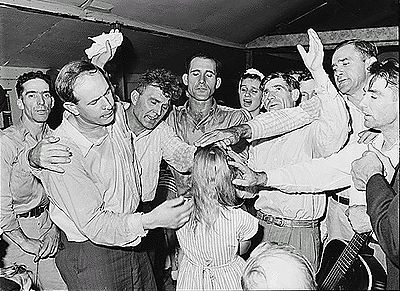
The scientific-minded may just cite the lack of conclusive evidence for the occurrence of miracles, but this objection goes beyond that. It highlights how we, fundamentally, look at the world around us in an inauthentic way and why we are capable of seizing upon lies and integrating them into our reality. It demystifies what is at once an act of cosmic arrogance and wilful ignorance.
And the most egregious cases of this act are what I just can't stand anymore.
You vs. the world
Posted by
moses
@
09:26
adulthood,
optimism,
personal,
pessimism,
self help
0
comments
When cornered, many animals fight back. We should probably do the same. Compromise becomes impossible when there is no middle ground. The only options are capitulation and confrontation, and at times only the latter offers a chance at survival.
When people talk about confronting an issue or a problem, they sometimes mean capitulating to it. Catchphrases like "change your mindset" or "adapt to the situation" may conceal a sense of helplessness that has prompted the speaker to give up without actually admitting as much.
Indeed, surrendering may often seem the easier option. Sometimes, the world seems hostile to our ideas and our aspirations; sometimes, it defeats us. However, even if we haven't lost, it's so much easier to give up without a fight. Let the world consume us rather than resist it. After all, isn't defeat inevitable?
It's true that, chances are, going against the world will be a tough long slog. And you're often alone in that struggle. But it may be your only chance at achieving freedom when everything conspires to bind you. The more remote the possibility of compromise, the more you have to fight.
If we do choose to fight, we shouldn't expect to survive, much less to win. But perhaps, by the time we are done fighting, a path towards compromise would have opened. Or perhaps we would indeed have to surrender in the end. But you will certainly never find out for yourself if you give up from the start.
And that I think is a fitting message to think on as the new year rolls around.
Education
Posted by
moses
@
09:56
education,
personal,
philosophy,
self help,
Singapore
0
comments
Every year it's the same. I would be lulled into thinking that there are possibilities here, that things will be different. This year, I actually convinced myself that I think positively now, that I will see things differently. I was even beginning to think that I may prefer to stay here instead of leaving again. But, in the end, I still feel the same way
The people are still the same. People might change since you've got to know them, but they'd never change again. Here, they are still indifferent. You can't rely on them to make the simplest of gestures unless they can see what's in it for them. In general, old friends tend to become nothing but a tiny blot in the paper of the mind, a memory of people who exist but who are of little concern to you now.
Every year, I learn a little more about how to live a largely solitary existence. When family became lost to me emotionally, I had friends. Now friends are merely a collection of acquaintances. You don't leave a place and expect to pay no price. Maybe some people can, but such are my blessings.
Each time, to stave off bitterness, I have to know that I've become better. I have to be able to say that I've become more self-sufficient. To achieve that, I have to turn again to philosophy. Only philosophy can teach you how to live alone and nonchalantly.
The strong person is an essentially solitary person. I have no need for friends, as they have no need for me.
I'm going back to the start
Posted by
moses
@
06:29
ethics,
life,
personal,
philosophy
0
comments
What might seem like simple things can indeed unravel the whole.
I don't even need to look elsewhere. I just need to look inwards. At the end of another pointless day doing mundane work for an exploitatively small wage, I feel little.
But I can blame the world for that, talk about how stupidly work is organised in this society, how for the sake of a few lines in our résumés we force ourselves to seek 'work experiences' that, in reality, teach us almost nothing.
However, there is something else I can't push away in self-pity—something that might seem much simpler on the face of it, but that might mean a lot to someone else. Something that ultimately means a lot to me as well.
At the end of another pointless day, after an errand done "on the way home" that sent me in a different direction from home, I was wishing that things were better. That was when a woman fell onto her hands and knees on the side of the path just in front of me, without a sound. I even looked. She looked like she might be ill.
And I didn't know what to do, so I walked on as though I was afraid of doing something about it. People walked past. I turned back to look after a short while, but I didn't stop. Perhaps I was hoping that she had gotten up on her own. She hadn't.
At first, after I left the scene, it bothered me a little and I thought to treat it as a lesson learned. "Next time, be sure to offer help when something like this happens."
But I couldn't think of why I couldn't have done that earlier.
Then I thought to myself, "Well, if you're going to be ruthless to get ahead in this world, maybe you shouldn't let this bother you. It was probably nothing serious anyway."
Unfortunately, I couldn't buy that thought for more than a few seconds. It occurred to me that, having walked past, I was no different from the others around me at that time. I am the same. I am the most Singaporean of Singaporeans.
This was like poison in my mind. I realised that I am not different, that I can't look past myself. I feel little. Too little to offer even the simplest of help in a little situation.
What have I got to be proud of? I have lived for a good while and I have failed to really learn anything worthwhile. I realised that, because of this, I can't be anything.
And perhaps that is my real problem—today has proven that, after more than twenty years, I have done nothing.
Without realising it, it's been more than half a year on. I think it's time for a little introspection. I'm actually surprised I haven't done this before, though I remember at least intending to do so. So let's take a look at where this blog has gone, where it stands and what direction it should take in the future.
Looking back at its short history, there have been a few developments. First, there was a short period of uncertainty as to whether it should continue. But I decided that this blog is not so easily found and associated with me such that unfamiliar people can pick out things that they don't like and acquire an immediate prejudice (face it, that's how people tend to operate) against me in real tangible life. So that's history now.
A more interesting development is an evolutionary one—the fact that entries have on average become longer and denser.
That is actually contrary to my initial intentions. I wanted to write short, snappy things, but influence from my studies got the better of me. And I do often wonder if this is for the better.
But, at the end of the day, many things just can't be said in a few short sentences. And, on the flip side, I'm not going to turn this into a perpetual essay-writing exercise either. Essays, though more rigorous, don't tend to get the point across effectively. I'm sure that's reflected in how most of us feel or felt when we read academic papers.
And this where the apologetics begin: I wish to defend the direction that this blog is taking.
I should say that philosophy isn't my forte—political philosophy is more like it—but I do follow broadly in the continental tradition, as opposed to the analytic one. The differences between them are somewhat confusing, but it's possible to make out some trends. Most clearly, analytic philosophy has a greater predisposition towards propositional logic.
That doesn't mean continental philosophy is illogical, though. But it does mean that analytic philosophy seeks to avoid contradictions while continental philosophy, with its dialectical tendencies, finds an important place for them. Provided that they make sense, of course.
Now this implies that continental philosophers tend to write in a more nuanced way in order to be able to capture and convey the contradictions that are present in reality. It certainly means they are unlikely to argue with the same kind of formalistic structure employed by analytic philosophers.
But, having pronounced where I stand, my sympathies are actually a little divided. Nuance to the point of ambiguity may be appropriate in some cases, but I do value clarity. A paper full of propositional logic is hell to read, but so is one filled with ambiguity.
So, in sum, I think the way that I currently write is, perhaps with a little refinement, in the right direction—a non-formalistic and sometimes nuanced way, adopting points of view that are rationally defensible (hence the need for clarity and mass) without attempting to be formally logical.
It also helps that my intention here is not to write papers. At the same time, however, I wish to retain some cautiousness. Quite a lot criticism can probably still be made from a formalist angle, but it also helps that I'm not exactly trying to be right. My intention has always been to provoke thought rather than necessarily convince anyone. I aim to question more than to provide complete answers.
And I think that suits my character rather well.
It's new year's eve again, and I feel no compunction to join the merry-makers out there. As it would often seem to me, New Year's Day is just another day. Why would I suffer the vicissitudes of a crowded night in anticipation of it?
This year, though, I do feel that the coming of the year has some sort of significance—perhaps as a celebration of the passing of days past and of hope for the future?
Well, you're likely to reap what you've sowed for the past year or even earlier, so you shouldn't be too surprised at what's coming. And wishing for luck is meaningless. I just don't like the vague idea of hope, without a good reason behind it, as it soon translates disappointment—as many will find out once again.
Maybe, for this year, the fact that the new millennium is entering into its teens is a fact worth celebrating? After all, when will you see a 9-year-old millennium turn 10 again? But, the interesting idea aside, does that really make a difference?
It seems hard to find much significance when the coming of the year does not by itself bring about change. But I think I found a good and simple answer.
Ultimately, the greatest meaning that could be ascribed to the occasion lies not so much in looking towards the new year as in looking at the passing one. And it's not to look at the past for some sort validation for present decisions on the future, but to look at past mistakes and to learn from them.
I think that's what new year resolutions amount to if they're any good at all—you tell yourself not to repeat the mistakes of the past year (or years). That's much more concrete and meaningful than having a vague and ephemeral hope for the coming year, or a determination to do a random assortment of things that you don't have much reason to believe you would end up doing. It gives a genuine reason to be hopeful.
And with that in mind, I hope you have a happy new year.
This might seem a little... different.
This time the question is a lot more personal but no less complicated: Why does this place make me feel depressed?
I wrote a while ago that I'm optimistic. I wasn't lying. But there are some days or some nights when I think to myself, "So, what's up?" And the answer seems to be accompanied with the feeling of an inescapable reality crashing down: "Nothing really."
Sometimes, don't you feel that you're just so sick of the properness of it all? You get up in the morning, you go to work or do the same things, come home, maybe say a few words to your family members, have a meal, shower, and finally sleep. Routine is formality, especially where it entails expectations. The expectations of your employers, of 'the society', of your family. The expectation that you come in at 9 in the morning, the expectation that you should always be diligent till 5 in the evening, the expectation that you must come home to your family.
Right now I want to say fuck all of that.
Would spirituality fill the gap? There's a picture of Jesus on my wall that my mom put up because she thought it'd be a nice reminder. "I am your Good Shepherd," it says. That was my parents' job description till a few years ago, actually.
No, it's not nice, and, no, I don't want to be reminded. Stop telling me what's good for me. I know what is – or I just don't care.
Maybe I'd pick up smoking, just because.
Now a very good ancillary question is this: I have routines when I'm studying overseas too, but why don't I feel like this?
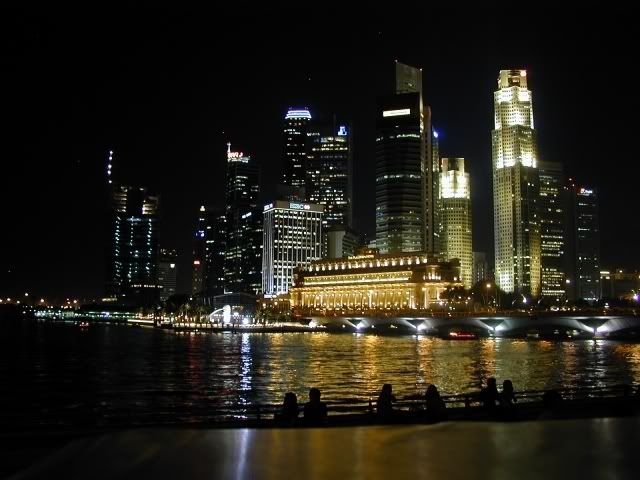
Maybe the place makes a big difference. Somehow I don't feel confined there. Maybe this place just brings back memories of a life spent conforming to rigid expectations, or even exceeding them. It brings back the reality of years of living under the religiosity of my family. It reminds me once again just how stifling this island is. You watched the National Day Rally? Well, I don't give a shit about it.
And maybe it's also because of how everyone seems to be walking away, largely to follow the paths that society seems to have set for them. Only a few good people actually want to see me while I'm here. 3 months, and I can probably count with the fingers of my hands how many people I'd end up meeting up with.
Frankly, Singapore sucks.
There, I said it.
Well, maybe I should do a silly roof raise to bring up what crashed down. It's time to be silly. Maybe I'd go out to party in the middle of the night. How or where or with who, I don't know. Maybe I'd take that awful picture down and tell my mom I don't want it there. Maybe it's time to take control of my life, the control that I have when I'm not here. And I guess, in the end, I'll be gone and I'll never really come back.
And maybe it's time for Singaporeans to take control of their lives and be real.
I guess the real point of this entry is for you to know, when you feel like this, that out there someone else feels or at least felt like you. And there you have a friend.