Padd Solutions

Converted by Falcon Hive

Showing posts with label United Kingdom. Show all posts

Let's face it, adults as a group are pretty bad at giving advice to young people. For example, if young people aim low, adults tell them to aim higher and have more ambition; on the other hand, if young people aim high, adults tell them to be realistic and to pay their dues first. Basically, a lot of advice actually boils down to "do/don't do what I did" or "be/don't be like me".

Then there are those who assume that people think or should think they way they do, and this group certainly includes young people as well.

In times of great uncertainty, the advice and words of wisdom become especially loud and numerous, as everyone chimes in on what they think people should or will do. And I dare say that most of them haven't got a clue.

Now, on the Guardian's question of whether the tripling of tuition fees to £9,000 will inevitably turn students into consumers –this is a silly question and those who are happy with it are quite inevitably going to come up with silly answers. I mean, it implies that students haven't always been consumers. Does the price of a good determine whether you are a consumer? Or is there some kind of a consumer continuum? Shoppers at cheap Tesco are not as much consumers as shoppers at Waitrose?

Of course, this doesn't matter to those who wish to use the question as an excuse to air their self-righteous opinions and advice. In particular, I'm thinking of those who would take this opportunity to remind young people of the value of education, of which they are themselves naturally and keenly aware.

But instead of rushing to tell people what they should or will do, let's address the question carefully. Aside from the fact that it seems to be predicated on the strange idea that students aren't already consumers of education, there is a related question that we must first ask: What qualities can we objectively attach to consumers as a group? Certainly, there are examples of consumers behaving both rationally and irrationally. At times, they are able to make pretty good cost/benefit calculations and drive the market in a way that benefits them; at other times, they consume almost mindlessly. The diversity of consumer behaviour means we cannot assign any particular quality to consumers in their capacity as consumers and argue whether students will be more or less like them.

It also suggests that it is difficult, if not impossible, to predict how students will generally behave due to the fee increase, beyond invoking a basic economic maxim and saying that demand for higher education will almost certainly go down to some extent.

So there really isn't a good answer to the question of whether university students will become consumers, not even if we interpret it as one that is concerned with the value that future students will place on university education.

Is that a boring answer? Well, I think it certainly beats the millionth musing on how students don't value the education they are receiving enough.
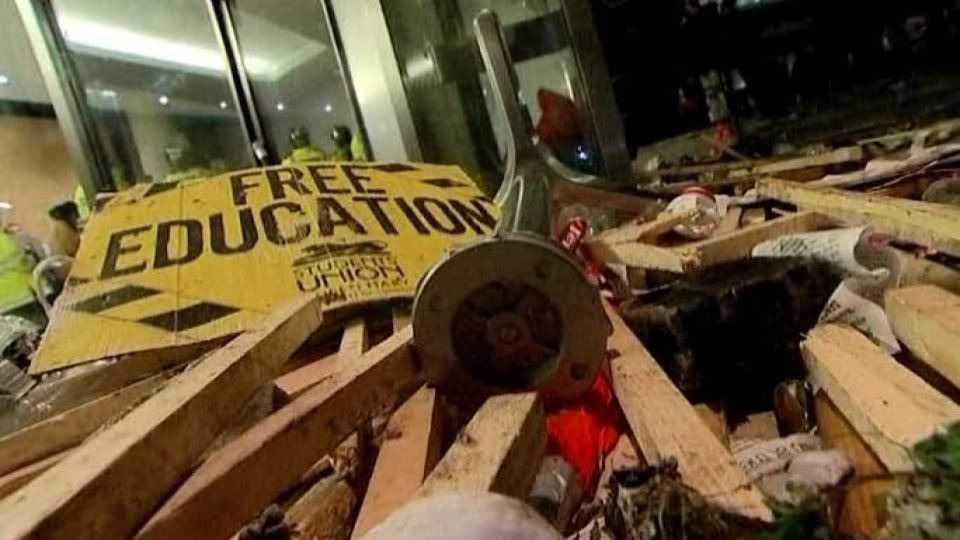

Having witnessed first hand the large student protest against the UK government's decision to raise tuition fee caps, I'm neither unnerved by the sporadic violence nor disheartened by the chaos of mass action. Rather, looking at the aftermath of the day, I've become more convinced of the corruption and the absurdity of the system.

Bourgeois sensitivity towards militant action is amusing. Repeatedly, we've been treated to condemnations of acts of violence and hooliganism by the established channels of the dominant bourgeois voice. The emphasis has been on the contrast between justified peaceful protest and bad violent protest. Perhaps if those sitting in their sofas watching the telly would reach a little into their memory and recall the last large-scale peaceful protest, they might remember the time when more than a million marched against Britain's participation in the Iraq War. The government went ahead with it anyway.

So what the official mouthpieces are really advocating is mass action that can be sidelined and ignored while the elite go on with their business. God forbid that a demonstration might make the latter anxious.

Violence is inherently problematic as it is simultaneously a powerful tool of the dominant ideology. Yet this does not diminish the idiocy of refusing to recognise the violence as a politically relevant part of this mass action. Statements about how a peaceful student movement has been hijacked by violent factions is begging the question: Where do these violent people come from and what do they want? Are they simply embodiments of the semi-mythical anarchic ruffian archetype? Or are some of them—God forbid—people who are genuinely frustrated by how they are treated by the politicians and their law enforcement minions?


While people are desperately protesting their disenfranchisement in ways that they think might have an impact, the official mouthpieces are busy trying to appeal to middle class disgust towards violence. They are also painting attacks on icons of traditional authority as appalling anti-social acts. Under this 'objective' and 'reasonable' surface discourse, ideology is plainly at work, and there is nothing too absurd for its efforts.

The attack on a royal car, in particular, has received much coverage worldwide. In Britain, some channels have been very active in expressing horror at the act. The time-honoured and sacred tradition of the monarchy itself seems to be under attack. Will those protesters stop at nothing in their quest to destroy the very fabric of society? Nevertheless, the public would be glad to know that the royalty proceeded bravely and resolutely to attend the royal variety show despite the attack.

A comedian on the show couldn't have done better.

This letter is a synthesis of my arguments in an extended on-line debate with a member of an older generation. The debate pertains to the political situation in Singapore, but I believe my arguments can also be applied to the context of some of today's so-called liberal democracies, particularly the United Kingdom.

---

Dear Sir,

In the past year, I have witnessed growing discontent in the two societies that I am part of. There is increasing resentment against the ruling elite that stems from economic grievances. Yet, as apt as this may seem from a Marxist point of view, I think much of the resentment is not as productive as one might hope.

In saying this, I appear to be critical of criticisms from the ground, but this neither suggests that I am on your side nor that I have an intellectually elitist viewpoint. I just don't think the criticisms are radical enough.

I'm saying that simpler socio-economic complaints belie the real issue of our need to take back our agency. I'm also saying that we shouldn't get sidetracked into pseudo-xenophobic discussions about immigration. Many European countries are getting mired in this situation and it basically only allows the disaffected to expend their energy on something that wouldn't help them in the longer run. They can restrict immigration, but it wouldn't solve the fundamental problems in their society.

Essentially, the root of the problem is the fact that the people have been patronised all along by the government. I believe what many of us also believe—that our democracy is dysfunctional. You know why the government doesn't listen to us? Because it doesn't really have to. How are we even going to debate public policy properly when the government holds all the cards? And our own culture, mentality and method of opposition are contributing to this. We ourselves are guilty for letting this continue.

One reason might be that we are engaging in politics of wish-fulfilment. We look to the government to fulfil our wants and needs, and we give it pretty much a free hand as long as it can do this. That may sound par the course in politics, but that's also why we're so easily duped. In the next election, the ruling elite would come up with some bones to toss our way, and the majority of us would lap it all up and once again perpetuate the system. Who really holds the power—whether it's the bureaucrats, the politicians or the people—never really mattered to us. And no matter what evasive answers one might give about the necessity of a true participatory democracy, nothing changes the fact that it is what enables the people to govern themselves. If we don't want it, then we can't really cry when we are ignored by the ruling power. We have to blame ourselves for that.

To be fair, it's not entirely our fault. Our psychology is the product of the system. But that's all in the past. The government might have justified a top-down system because of the need to develop. However, now that we have developed to a large extent, what is pretty much the same system is still being kept around in the name of continued economic growth. When will this stop? That is the present question, and only we can come up with the answer.

On the economic aspect of social organisation, I agree that material interests are legitimate interests, but not when we run away with them and forget everything else. Now that times are hard, people are unhappy—that's a perfectly valid sentiment. But what about when times were good? Did we care about how things were done?

A true participatory democracy cannot guarantee that we meet our desired material goals, especially when we set the bar higher and higher. However, what it does guarantee is that we have a real say and that we as a people run our country. The overly risk-averse state of mind is what makes us captives of the system—we want rights and we want to be heard, but we won't take the necessary material risks to make our country our own.

The basic reactionary position is to deny that there is a real fundamental problem, or at least to justify the current system by pointing out that other systems have problems too. Yes, there is an empirical basis for making the latter claim. But does that mean that every society is simply stuck with its own set of problems? I'm saying that there is a possible way forward through changing the system. And systemic change is worth looking at because the problem is structural—it has to do with mechanisms of feedback and control.

There is no panacea for all problems, but we can choose to do something about them instead of simply suffering perpetual injury.

I doubt, however, that you will understand this line of reasoning as long as you choose to regard it as yet another normative point of view in a relativist political paradigm. It doesn't simply boil down to a subjective choice of political and moral values. Advocates of participatory democracy have valid and positive points to make about issues of power and participation as long as democracy serves as our political ideal.

On a final note, you might point to an uncertain future as the defining problem, but so does the ruling elite. And their proposed solution is to band together under their banner to work for the common good.

Yet there is an alternative, one that neither you nor they are willing to entertain. But perhaps under a system that clearly favours one particular brand of hegemonic discourse it's not surprising that we are not really being heard. Just like many of those who have simpler grievances.