Padd Solutions

Converted by Falcon Hive

Showing posts with label democracy. Show all posts

With so many things that are happening and that have happened, I've decided to fire up my blog again.

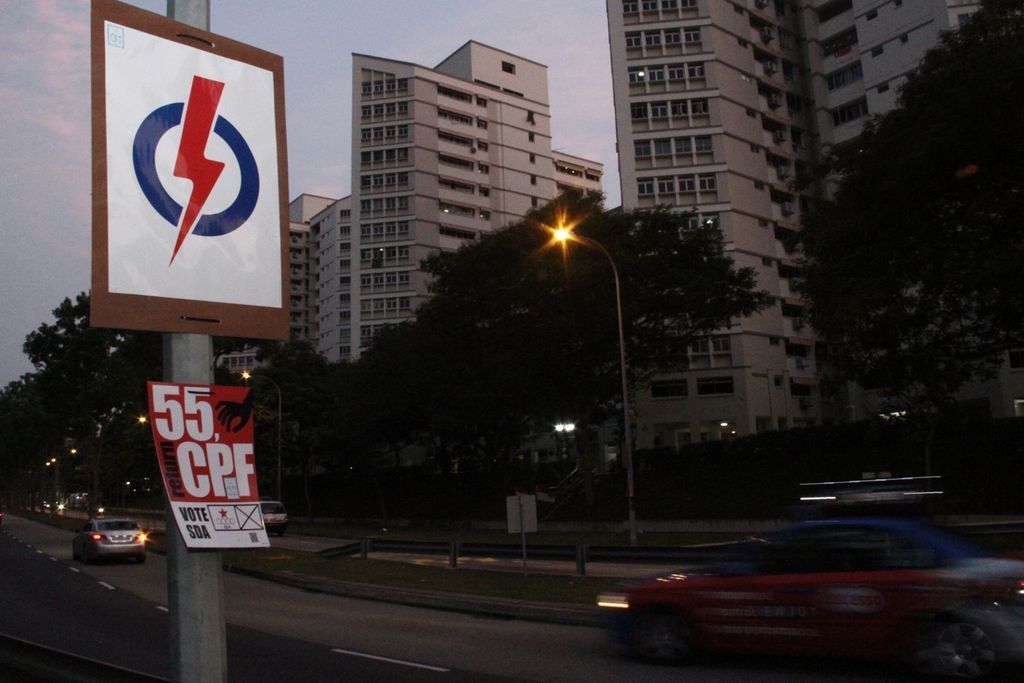
Singapore is going into election day, and the media has been abuzz with election-related news and discussions. The parties in the opposition have received unprecedentedly positive attention this election cycle, and the role of social media in contemporary politics is undoubtedly the primary contributing factor.

My social media is full of messages in support of the opposition, although there certainly are enough supporters of the ruling party as well (especially the wealthier, conservative or typically apolitical people). It actually seems to have become quite a norm. And judging from the attendance at the opposition rallies, the sentiment on the ground is also pretty warm.

I think Singapore politics will see exciting days ahead. Like it or not, we are seeing a trend where we can expect more successful politicians to be those who have their ears closer to the ground. There are more debates among the public, and politicians of all stripes will have to be responsive to public sentiment, balancing traditional rationality with an appeal to citizens' passions.

But unlike conservative ideologues in Singapore, I will not hasten to trot out the label 'populism' here, because responsiveness and accountability to the electorate is part and parcel of a democratic system. 

Too often, modern audiences are fixated on procedural democracy—on the process of holding elections—as well as on the representative part of democracy. However, the traditional idea of democracy was not usually limited to having an elected aristocracy. In democratic thinking, the people are meant to have a say in how they are governed. There is populism, and then there is democracy; the latter does not necessarily translate to the former just because one party no longer has a free hand to rule as they see fit.

Understandably, many in Singapore will feel some trepidation about the opening of the floodgates. Are we as a society ready for the full democratic experience? Will we be able to maintain current levels of prosperity when the ruling party no longer dominates local politics with impunity?

No matter who is in charge, the future will remain uncertain. As the financiers say, past success is not indicative of future performance. For now, it's time to prepare ourselves for societal change.


O tempora, o mores!

@ 15:59 • , , • 0 comments


I was recently asked one of those questions by old people that went like this: "Is it true that young people these days are more sensitive and need to be handled gently?" My reply was that that really isn't true, or at least that's beside the point. What is true is that the younger generation today expect to be treated with respect. And, obviously, not all young people are pampered, witless kids anyway.

Certainly, the hollow and delusional pronouncements made by the dreamier ones, like the many vacuous 'Gen Y manifestos', don't do anything to help. What needs to be done is to give a proper account of the general trends in which the younger generations find themselves, and not speculate about how individual upbringing contributes to the collective character of the youth.

Complaining that young people don't have the right qualities, that they are lazy and addicted to easy living, is a recurring behaviour and tradition that dates back to ancient times. Socrates was supposed to have said, "Children nowadays are tyrants. They contradict their parents, gobble their food, and tyrannise their teachers." And such quotes from the ancients, whether or not they are verifiable, have been trotted out for centuries, suggesting that concerns about the morals and behaviour of youth are certainly not a new thing.

In this light, all the talk about the "entitled generation" seems myopic, even navel-gazing. And it overlooks the fact that the younger generations do deal with their own problems, as such perks as stable employment and certainty increasingly become a thing of the past.

What is actually happening, then, is that society seems to be getting more used to living with the idea of democratisation.  Our political and social systems are beginning to cast off the mantle of the old patriarchal, authoritarian structures, and the wide availability of information today means the elders have less of a monopoly on knowledge through their experience. This means the youth of today feel less need to be silent and quiescent before their elders and their ‘betters’. Consequently, they expect more respect from their fellow human beings and have less unquestioning respect for authority. That is why shouting at them doesn't have the effect that you were expecting.

It seems to me a positive thing if people respected each other more no matter who they are. Thus, it seems that this is something that the older generations can learn from the youth of today. Are they willing to accept this, though, or will they stick to their guns? How they react would show which generation is in fact the better one.


I'd finally gotten round to seeing The Dark Knight Rises last month, and, frankly, I enjoyed it. As such, although the film—like Nolan's other works—did not leave me with much of a lasting impression, I will not be too critical of it, acknowledging the film for what it is: An encapsulation of Hollywood at its flashiest.

Certainly, one may detect proto-fascist undertones in the film. The Dark Knight Rises tells us, after all, that raw violence and not money or influence is the ultimate source of power—Bruce Wayne's wealth and position may get him all his fancy gadgets, but he could not defeat Bane until he trained himself up physically and prevailed against his adversary in a slugging match.

Nevertheless, I will not go as far as to say that The Dark Knight Rises' politics are regressive or backward. For one, the film strikes me as partly an attempt to articulate a contemporary brand of political consciousness; although it does so in a traditional comic-book-hero fashion, hence the seemingly more backward elements in its symbolisms. The film's favouring of muscle power over sophisticated methods could, for example, simply be explained by the film's comic book roots.

The Batman of the Nolan films is also very much a traditional comic book hero. He is basically benevolent, despite his psychological scars and his initial motivation to seek vengeance. And he fights for a supposedly universal sense of justice while remaining outside of the political and legal systems. The latter is an especially important aspect in The Dark Knight Rises, and it has been given a contemporary twist: The legal and political system of Gotham are structurally unable to solve the city's serious crime problem, and it's thanks to the work of a vigilante hero that the city is saved—a narrative that banks heavily on today's post-crises distrust of traditional institutions.

But Batman isn't just Batman; he is also Bruce Wayne, whose wealth and technological expertise can save the world in their own right. How he uses or does not use them is bound to be interesting. And it turns out that he chooses not to use them except in aid of his role as the vigilante hero—all because of his fear that someone might misuse whatever technological marvel he came up with that could, on the other hand, have untold benefits for humankind.

Not only that, while fighting crime as Batman, the wealthy and powerful Bruce Wayne does little or nothing to transform the legal and political systems that are part of Gotham's problem. As such, Bruce Wayne/Batman stands for the contemporary reluctance to rock the boat too hard, representing our bitterness towards the capitalist/democratic system that is, at the same time, tempered by an unwillingness to cast it aside. Nolan's Batman is thus the hero of today: A benevolent but broadly non-interventionist patriarch, shaking his head at the excesses of late capitalist society but letting it go on nonetheless, only scraping at the mould on the rotting meat. If anything, the world must be "ready" for utopia before it can be given it—or, more correctly, it must ready itself, because he is too cynical to help it along.

Where radical movement and revolution are represented in the film, they are portrayed as simply a big con job perpetrated by the terrorist Bane, who is not actually interested in emancipating the people. Even then, when Bane's motives are finally revealed, the film plainly steers clear of any portrayal of ideological conflict. The origins of the war (on terror) can ultimately be attributed to family drama, a perennial bourgeois favourite of a genre since when novels were the most prevalent form of mass entertainment.

Thus, it's difficult not to see the film as reactionary, a middle class abrogation of things like the Occupy movement, or perhaps even a vision in a Tea Party reverie with Bruce Wayne standing in for the Koch brothers. However, it is probably overstating the case to say, for example, that the film advocates fascist politics or plain old feudalism. After all, I would hesitate to attribute a nefarious genius to a politically-flat director like Nolan. Instead, I would suggest that the film was primarily made to entertain and, like many other films, to make money, and that its haphazard politics are merely an accident, the result of the film being made in contemporary times.

Thinking that way certainly helped me switch off and enjoy the mindless entertainment while it lasted.

Please subvert

@ 16:08 • , , , , • 0 comments


Art and patronage has a complicated relationship. The reason is simple: Whoever pays for and facilitates the creation of art tends to influence the direction of art.

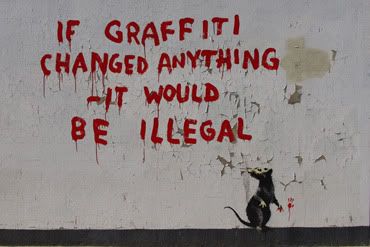
While this may be an ordinary thing in the art market, where artworks are freely hawked like any other commodity, it presents a problem for political art of the subversive kind. Art that receives state patronage is by definition art that is approved by the state; it therefore has limited subversive potential. Subversive art must hence be art that is not explicitly approved by the state; and an artistic object or act that is extra-legal is thus a good candidate for subversive art.

The arrest of the 'Sticker Lady' in Singapore and the subsequent online furore provides a good entry point for a discussion about the relationship between the state and subversive art.

From the point of view of the state, what she did was an act of vandalism or (if the distinction matters) at least that of the defacing of public property; to many, it was art. These are irreconcilable viewpoints not just because the state is not the best arbiter of what is and what is not art, which is a complex debate not suited to the dry legalist realm of discourse, but also because what she did is so compelling by virtue of the fact that it was an act of defiance of the law—in other words it spoke to its audience because it was subversive.

So, in that sense, demanding that the government recognise what she did as art and not a crime is quite beside the point. And, by extension, turning this into an issue of national policy on art and creativity is the wrong way to go about it; without a consensus that what she did was worthy of official recognition, the conversation would quickly reach a dead end. Instead, what we can do is to question the penalty against such acts and debate the implications of a harsh penalty on freedom of expression. Realistically speaking, what she did would always be legally deemed as a crime, but the enforcement of the relevant laws could certainly be toned down.

Why is a review the legal penalty for vandalism important? Firstly, a harsh penalty for vandalism is indicative of an authoritarian political culture that is not tolerant of dissenting voices, especially when this penalty is disproportionately heavy compared to penalties for other more severe crimes.

Secondly, if we want art of every kind to flourish, including subversive art, then it follows that we should try to reduce the heavy-handed prosecution of some kinds of art. Demanding that the authorities recognise subversive art is contradictory, but asking them to be less stern towards it is not.

Finally, this would also serve as a tangible and actionable goal that extends beyond this incident–a larger goal that could actually be reached without the debate being hopelessly mired in arguments about art and vandalism.


Doing some research on the public discourse surrounding last year's racist tram incident in the UK, I was prompted to ponder the rise of xenophobic sentiments in Singapore. 

As held in diaspora studies, there is no such thing as a mythical, unchanging homeland. A people's conception of their homeland is formed through experience: What you grow up knowing as your home will be the home that you know. That may seem obvious and tautological; yet people persist in perceiving their homeland as a thing unchanging, when, in reality, their conception of the homeland is simply that which they have learned.

As such, if you're used to the idea of a homogeneous or monocultural homeland, that is how you would conceive of your homeland; that is the image in which you might want to remake your country.

At the very least, Singaporeans are accustomed to the idea of multi-racialism. It has been drilled into us since we were young. Those with a libertarian bent may deride such education as plain indoctrination, but, in truth, it is hardly alien to the process of socialisation that every normal member of society goes through as he/she grows up. And it works. Of course, racism still exists, but there is no popular challenge to idea of Singapore as a multi-racial society.

Yet it has not saved Singapore from the tensions and culture shock associated with immigration, as immigrants from 'alien' cultures have become numerous enough to have a perceived impact on the local way of life. 

Further fuelling the tensions is the political situation, the official support for mass immigration, which sets up a bitter conflict between the authorities and citizens who feel that their grievances are being ignored. While I believe that an open immigration policy is, as typically held by liberal political philosophy, morally right, Singapore's immigration policy is firmly rooted in neoliberalism. In line with the country's ideology of 'pragmatism', immigration is to be supported on the basis of its necessity for economic growth. 

This ideology reduces not only immigrants into economic units, it does the same to the locals, who must embrace cutthroat competition. Wages are driven down and the economic worth of immigrants, especially that of the wealthy among them, is emphasised. The latter is clearly demonstrated by the Chinese evening daily's headline on the recent accident involving a reckless Ferrari driver from China. While hardly relevant to the tragic incident, the newspaper opted to announce the wealth and prestige of the driver first, perhaps to pre-empt local anger, ever-simmering as it was, towards Chinese immigrants. 

What the headline ends up doing is intensifying the existing social tensions, as locals once again feel that they are being treated as mere economic units whose worth is incessantly being compared to the immigrants'. And the fact that local media is tightly controlled by the authorities lends whatever the former prints an air of official legitimacy—it certainly means the authorities cannot conveniently push the blame away. 

Thus, the knee-jerk xenophobia among the public, while deplorable, should be understood as a by-product of the neoliberal race to the bottom, which has exacerbated social inequality in the name of economic growth. And as long as growth takes precedence over social justice and a fair distribution of rights and responsibilities, the government will continue to give ammunition to the xenophobes; which is a pity, since an open immigration policy could work without driving down local living standards and causing so much resentment, if only the government would speak the right language of multiculturalism, abandon the neoliberal religion and adopt better labour regulations. 


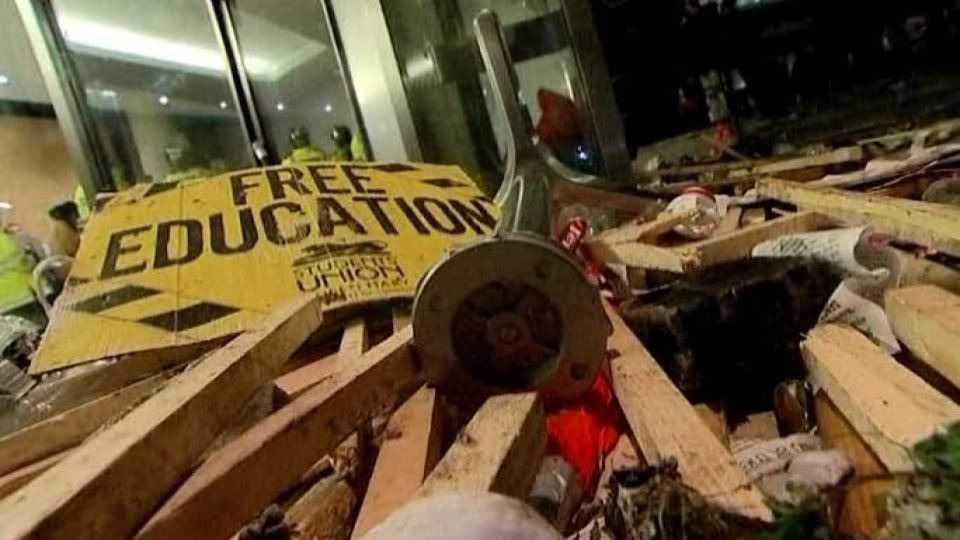
Having witnessed first hand the large student protest against the UK government's decision to raise tuition fee caps, I'm neither unnerved by the sporadic violence nor disheartened by the chaos of mass action. Rather, looking at the aftermath of the day, I've become more convinced of the corruption and the absurdity of the system.

Bourgeois sensitivity towards militant action is amusing. Repeatedly, we've been treated to condemnations of acts of violence and hooliganism by the established channels of the dominant bourgeois voice. The emphasis has been on the contrast between justified peaceful protest and bad violent protest. Perhaps if those sitting in their sofas watching the telly would reach a little into their memory and recall the last large-scale peaceful protest, they might remember the time when more than a million marched against Britain's participation in the Iraq War. The government went ahead with it anyway.

So what the official mouthpieces are really advocating is mass action that can be sidelined and ignored while the elite go on with their business. God forbid that a demonstration might make the latter anxious.

Violence is inherently problematic as it is simultaneously a powerful tool of the dominant ideology. Yet this does not diminish the idiocy of refusing to recognise the violence as a politically relevant part of this mass action. Statements about how a peaceful student movement has been hijacked by violent factions is begging the question: Where do these violent people come from and what do they want? Are they simply embodiments of the semi-mythical anarchic ruffian archetype? Or are some of them—God forbid—people who are genuinely frustrated by how they are treated by the politicians and their law enforcement minions?


While people are desperately protesting their disenfranchisement in ways that they think might have an impact, the official mouthpieces are busy trying to appeal to middle class disgust towards violence. They are also painting attacks on icons of traditional authority as appalling anti-social acts. Under this 'objective' and 'reasonable' surface discourse, ideology is plainly at work, and there is nothing too absurd for its efforts.

The attack on a royal car, in particular, has received much coverage worldwide. In Britain, some channels have been very active in expressing horror at the act. The time-honoured and sacred tradition of the monarchy itself seems to be under attack. Will those protesters stop at nothing in their quest to destroy the very fabric of society? Nevertheless, the public would be glad to know that the royalty proceeded bravely and resolutely to attend the royal variety show despite the attack.

A comedian on the show couldn't have done better.

This letter is a synthesis of my arguments in an extended on-line debate with a member of an older generation. The debate pertains to the political situation in Singapore, but I believe my arguments can also be applied to the context of some of today's so-called liberal democracies, particularly the United Kingdom.

---

Dear Sir,

In the past year, I have witnessed growing discontent in the two societies that I am part of. There is increasing resentment against the ruling elite that stems from economic grievances. Yet, as apt as this may seem from a Marxist point of view, I think much of the resentment is not as productive as one might hope.

In saying this, I appear to be critical of criticisms from the ground, but this neither suggests that I am on your side nor that I have an intellectually elitist viewpoint. I just don't think the criticisms are radical enough.

I'm saying that simpler socio-economic complaints belie the real issue of our need to take back our agency. I'm also saying that we shouldn't get sidetracked into pseudo-xenophobic discussions about immigration. Many European countries are getting mired in this situation and it basically only allows the disaffected to expend their energy on something that wouldn't help them in the longer run. They can restrict immigration, but it wouldn't solve the fundamental problems in their society.

Essentially, the root of the problem is the fact that the people have been patronised all along by the government. I believe what many of us also believe—that our democracy is dysfunctional. You know why the government doesn't listen to us? Because it doesn't really have to. How are we even going to debate public policy properly when the government holds all the cards? And our own culture, mentality and method of opposition are contributing to this. We ourselves are guilty for letting this continue.

One reason might be that we are engaging in politics of wish-fulfilment. We look to the government to fulfil our wants and needs, and we give it pretty much a free hand as long as it can do this. That may sound par the course in politics, but that's also why we're so easily duped. In the next election, the ruling elite would come up with some bones to toss our way, and the majority of us would lap it all up and once again perpetuate the system. Who really holds the power—whether it's the bureaucrats, the politicians or the people—never really mattered to us. And no matter what evasive answers one might give about the necessity of a true participatory democracy, nothing changes the fact that it is what enables the people to govern themselves. If we don't want it, then we can't really cry when we are ignored by the ruling power. We have to blame ourselves for that.

To be fair, it's not entirely our fault. Our psychology is the product of the system. But that's all in the past. The government might have justified a top-down system because of the need to develop. However, now that we have developed to a large extent, what is pretty much the same system is still being kept around in the name of continued economic growth. When will this stop? That is the present question, and only we can come up with the answer.

On the economic aspect of social organisation, I agree that material interests are legitimate interests, but not when we run away with them and forget everything else. Now that times are hard, people are unhappy—that's a perfectly valid sentiment. But what about when times were good? Did we care about how things were done?

A true participatory democracy cannot guarantee that we meet our desired material goals, especially when we set the bar higher and higher. However, what it does guarantee is that we have a real say and that we as a people run our country. The overly risk-averse state of mind is what makes us captives of the system—we want rights and we want to be heard, but we won't take the necessary material risks to make our country our own.

The basic reactionary position is to deny that there is a real fundamental problem, or at least to justify the current system by pointing out that other systems have problems too. Yes, there is an empirical basis for making the latter claim. But does that mean that every society is simply stuck with its own set of problems? I'm saying that there is a possible way forward through changing the system. And systemic change is worth looking at because the problem is structural—it has to do with mechanisms of feedback and control.

There is no panacea for all problems, but we can choose to do something about them instead of simply suffering perpetual injury.

I doubt, however, that you will understand this line of reasoning as long as you choose to regard it as yet another normative point of view in a relativist political paradigm. It doesn't simply boil down to a subjective choice of political and moral values. Advocates of participatory democracy have valid and positive points to make about issues of power and participation as long as democracy serves as our political ideal.

On a final note, you might point to an uncertain future as the defining problem, but so does the ruling elite. And their proposed solution is to band together under their banner to work for the common good.

Yet there is an alternative, one that neither you nor they are willing to entertain. But perhaps under a system that clearly favours one particular brand of hegemonic discourse it's not surprising that we are not really being heard. Just like many of those who have simpler grievances.


People say there is no such thing as a free lunch. Surprisingly, the very same people who might say something like that often seem to expect it.

Let's not talk about corporate bailouts and taxpayer-funded bonuses. That's too much of a fish in a barrel (though it's a large fish that manages to swim away nonetheless). Let's talk about public action, in the sense that the public takes action to negotiate—diplomatically or otherwise—with the authorities.

I've written some time ago that people must organise themselves to fight for their interests, and that legality is not a necessary moral consideration because of the imperfections of the legal system. The angle I'm going to take here is similar but slightly different. It can be encapsulated by a question: What are the ethics of public action?

And, to go straight to the point, I will ask another question: What is the moral worth of representative democracy if the representatives are not willing to, first and foremost, present the interests of the people they represent but are overwhelmingly concerned about being 'constructive'?

Certainly, there are valid considerations that call into question the idea that you must do exactly as the people you represent wish. What if you think that what they want isn't in their interest or is morally wrong? But the issue is not quite so complex here. The issue is whether the desire to be constructive trumps the proper presentation of a legitimate concern of the public.

Well, unlike in what seem to pass for public campaigns these days, the ethics of public action should not be based primarily on etiquette. Whether you are seen as being polite or positive should not be considered ahead of doing what is necessary to push for the interests of the people you are representing. This isn't business, and the fact that business etiquette has bled into politics is quite alarming.


The issue remains when it's the public itself that is overly concerned about the tone of the negotiations. Essentially, the point is you are either prepared to do some tough bargaining if it proves necessary, or you won't change anything. Being positive is not a trump card and asking for charity is seldom going to work. There's no free lunch, remember?

Or is that an excuse for some things only?

But going deeper than that, being constructive means accepting the framework that is imposed by those in positions of power. And by doing so, you are often being put on the defensive when you should be on the offensive.

To take an example from real life, the fact that students pay (sometimes exorbitant) fees for their education is a fact. Hence, that the executives making decisions for the university feel that they are free to increase those fees while cutting services should not, from every reasonable perspective, simply be accepted. It should be resisted as far as possible by the students. However, by choosing to be strictly 'constructive', a student union that is supposed to fight for their interests has already given up half the fight. By doing so, it is assuming a weaker position and is relying on the goodwill of the executives to grant concessions on a matter where there is a conflict of interest between the students and the university. And how such a body can thereafter retain the claim to represent students is beyond me.

On the contrary, the ethics of public action should demand that the necessary actions be taken to fight for the interests of the public. And if that means having to be less constructive and even destructive, so be it.

However, we must note that being destructive does not necessarily mean being physically destructive. In many cases, physical destruction is unwarranted and morally wrong. Rather, being destructive means the opposite of being constructive, and that is not to accept the imposed framework, rejecting it from the democratic perspective of the people's right to decide their affairs. For what is the moral worth of democracy if the people are merely suppliants bound by codes of conduct, amongst other fetters? Similarly, the ethics of public action must be closely tied to the public itself, the subject and the object of public action.

Now, having rejected the imposed framework, negotiations might come to an impasse. And this is where we return to the subject of tough bargaining. Only when you are able to threaten the prevailing order will you have any basis for negotiations. Only when you are willing to commit fully to your own cause will you get anything. To think otherwise is naive and irresponsible.

There are other reasons for declining rates of political participation in some liberal democracies, but the impotence of the public, its inability to effect the desired changes, certainly plays a part.

After all, if we can only go as far as it's polite to do, then we're only going to be politely declined. So what's the point?

A while ago I talked about my scepticism towards concepts like Corporate Social Responsibility. While it's not nowadays considered nice or constructive to be dismissive of such things – we are dismissing all the good that do exist in the world, they would say – I think I gave a good enough explanation of why those are inherently absurd. But allow me to elaborate on it, with a view to what we can do.

What I'm going to say might not sound new here, but I hope it's a coherent synthesis of the ideas I have expressed, delivered concisely at a particular angle of social commentary.

A few centuries ago, it might have been feasible to appeal to a traditional regard for virtues or a sense of honour and responsibility in the powerful – noblesse oblige, the responsibility of those who have. That was a world of stratified social relations based on feudal or patriarchal links. There were strong forces of tradition that prescribe relationships between a someone of higher rank and someone of lower rank, relationships generally involving responsibility and even compassion on one side and loyalty on the other. Appeals to the ideas associated with such traditions would thus make perfect sense.

Now, I'm not looking at history with nostalgic glasses. Of course, there were plenty of inherent injustices in the old stratified societies. What I'm trying to point out is the anachronism of a method with respect to the times.

The rise of the classical liberals has destroyed the old forms of society. Social relations are no longer to be forged out of customs and slavish adherence to associated ideas. Rather, as Adam Smith suggested, they are to consist of mutual relations of self-interest. This is the bourgeois revolution. Fetters of tradition and its morality were to be removed to allow all men (and eventually women) to advance their own interests to a potentially unlimited extent. The rule of law is to be established to keep things in order, but no longer are people bound by prescribed roles and responsibilities.

The only duty one owes is to the state, the embodiment of the social contract. But the rhetoric of loyalty and virtue that is still frequently used sits uncomfortably with the new direction of political philosophy. Strictly speaking, we have a duty to the state not because of some traditional moral concept or other, but because we are bound by the common interest in a stable society.

This arrangement sounds fine and well. However, the role of the state is still a grey area. We know why the state is there, but is the existence of a raison d'être enough?

In practice, the state needs to perpetually affirm its purpose and existence through its acts, which interfere even with our daily lives. A state that does not act is a state that no one has faith in; it is naturally one that will subsequently cease to exist. Some people might wish to say otherwise, but reality attests to the fact that the only viable states are states that act. And so what the state ends up doing is a matter of concern, and with it comes the question of its role and responsibilities.

The problem, as in the case of other legal entities such as corporations, is with the fact that the state is not a person. The state is a machine consisting of multitudes of individuals and bureaucratic apparatuses with non-human systemic considerations, likely controlled by certain interests that are themselves collective groups. The state has legally-defined responsibilities, but an appeal to its sense of responsibility or to its moral sense is useless. What you might expect to move a monarch or a lord is not likely to move a modern state with highly distributed powers, especially since it is constructed from relations of mutual self-interest.

As such, appealing to morality – that might work on some individuals within the system, but it would be absurd to expect it to move the system as a whole. Chances are, that way, we will be hung out to dry waiting for our concerns to be addressed satisfactorily.

If we assume a system that is somewhat just, as Rawls does, relying on the state's legally-defined responsibilities would be enough. But I fail to see how a state that is, in reality, perpetually in the stranglehold of particular interests would ever realistically be just enough. We only need to look at the state of the world to confirm this: How many people remain hungry, poor and oppressed just because certain interests have to be kept satisfied, even in liberal democracies (keeping in mind, of course, the effect one nation has on another)?

And, if what I have said so far is correct, the satisfaction of the concerns of those who are unjustly treated cannot be achieved merely by appealing to old concepts and traditions of morality. In a society built on mutual self-interest, you are pretty much responsible for advancing your own interests. This is why those who are oppressed must organise themselves as a force to fight for their interests.

But should they act only within legally-defined limits?

I believe that they cannot always do so. Ideally, we would want obey the law to preserve stability in the society for everyone's benefit. However, the resources at the disposal of the powerful make attempts to effect change through the prescribed channels very difficult. The playing field is far from level. Thus, it is unreasonable to expect us to only exercise our political freedom by voting in elections and appealing to our political representatives.
We need other avenues, the most drastic of which is revolution. This is the practical argument for extra-legality. And since the same argument applies to the constitution, which is not necessarily just, extra-legality really amounts to extra-constitutionality.

Now, I do believe that the virtues are not completely lost. Otherwise, I could easily be construed as envisioning a world moved entirely by the force of might. However, in order to be able to appeal to them effectively, we have to take people out of their modern (liberal) institutional contexts. We have to appeal to human beings, the timeless individuals, not to citizens, soldiers or politicians. And this is the essence of the moral argument for extra-constitutionality – we do not adhere merely to the laws, but also to common moral concepts that hopefully have not died out. The moral appeal would strengthen the movement. However, before the movement can speak on such a level, it has to be able to operate on a level beyond the constitutional (i.e. in keeping with the practical argument). Otherwise, it would be trapped by the legal realist loop that smothers moral thinking.

In effect, what I espouse is a belief in the freedom to fight. Neo-liberals and free marketeers believe in free competition. But, as much as they might want to deny it, they are stuck within their own rigid systems. To be truly for liberty, we cannot advocate only a free market for products. We must advocate, above all, a free market for ideas and the political actions of individuals.

Conflict of interest is a circumstance of justice, and the lack of a viable conflict of interest in real life is an indication that something is wrong. A political system where we can only vote for parties with few differences between them is recipe for perpetual injustice. We must bring back other avenues of pressing for our interests, even if they are illegal. And we must appeal to human beings outside of the control of the modern state to fight in the name of what is good and just. This is the vision of justice as struggle and dialectics.

It is what it takes to strive for justice in the kind of society we live in.


A very common accusation made against the left-wing is that it is too idealistic. Communism fails to take into account human nature, they like to say – it's just too impractical.

Those who are fashionably or vacuously apathetic might be especially fond of this criticism. Moreover, according to many of these people, left-wingers and 'liberals' aren't just dreamers, they are also "self-righteous" bores who are always "pontificating".

As a matter of fact, there seems to be an inherent contradiction when one says that Marxism is "idealistic". Marx is said to have turned Hegelian dialectics on its head (or back on its feet) when he transformed it from an idealist to a materialist approach. Marxists generally see matter, not ideas, as the beginning and end of reality.

So why is Marxism labelled as "idealistic"? Well, you might say, that just means that it focuses on an ideal state or has an ideal state of society as its end.

What about democracy, then? Is it not essentially an ideal state of society? A few centuries ago, many would have laughed at those who extolled the virtues of democracy. It's too ideal, they'd say – the people are too unruly to rule themselves. Compare that to the common perception of it today. Many of the same people who would dismiss Marxism as too idealistic are likely to chide authoritarian regimes for being undemocratic. There's at least a tad bit of irony there, don't you think?

But democracy doesn't really have an ideal end, you might now say. It's an achievable state that has been realised and isn't aimed at creating a utopia.

Well, has it been achieved? Is the democratic process not ongoing, repeated regularly in the form of voting exercises? Does it not have to constantly face forces that seek to usurp its procedures, perhaps even powers that want people to choose to be unfree? Is it not always in conflict with the bureaucracy, the state within the state that has its own aims and its own way of doing things?

Democracy, therefore, is an end in itself, and one that will never be 'achieved' in the simple sense of the word. Democracy is a constant struggle.

And so is socialism.

Orthodox deterministic Marxism does lay claim to a scientific view that presages an inevitable Communist society, which is preceded by a period of 'socialism', a dictatorship of the proletariat. And Leninism goes on to say that this period is brought about by a revolutionary party. But these set paths and clear milestones are not necessary elements of Marxism or of its method of historical materialism.

Some Marxists believe in the constant struggle and conflict for a just society – a class struggle, the dialectics of society. Just as the struggle for democracy never really ends, this struggle is perpetual. We make no predictions or promises about a specific kind of utopian society at the end. We know, however, that struggle is the way to progress, that entrenched traditions of injustice have to be gradually worn down. And our end is the human being, who is deserving of equality and dignity.

Gradual progress is not impossible progress. It does not call for world revolution. I believe in working within the constraints of parliamentary government, in working autonomously as individuals in resisting exploitation, as well as in extra-constitutional methods – we can and should use whatever means is necessary and beneficial without contravening the over-riding principle: The equality and dignity of human life. We work towards an end, but we do not specify a particular situation as the outcome, much less do anything and everything to achieve that outcome. Marxism isn't about gulags and purges. Marxism should be humanist and highly realistic.

So, again, what is it about the left that is so idealistic? Choosing the status quo is not being realistic. Left-wingers are the genuine realists because they are attuned to reality and the great suffering that is present, which motivates them to fight for change. They are also realists because they believe that real material life is too important to be dictated by abstract ideas. Reality bears down upon us like an inexorable force. Hunger demands food; tiredness demands rest; discomfort demands alleviation. So when we are told that we have to face poverty and deprivation because of some concept or other, we find it difficult to accept, and we fight. And that is to face reality. That is what it really means to be realistic.

Now to those apathetic types, according to whom we are always "pontificating" and being merely "faux intellectual", there's not very much that needs to be said. Of course, such comments do not constitute criticism, merely some brash lashing out that likely hides an inferiority complex. And if such comments apply to us, they would apply to anyone who has argued for anything, such as in academics. Have such comments enough merit to invalidate whole fields of inquiry, just because these people have no mind for arguments?

But I think we should be quite sympathetic to them. After all, we are opposed to the real faux intellectuals – the 'experts' who treat ideas and unintelligible categories as science. In any case, the left-wing position should not be difficult to grasp. If everything else is ignored, an essential principle can still be easily understood, one that a fireman adheres to everyday: People first, property and wealth later.


This is a sad story of political repression.

Repression always makes for a sad story, no matter what they would have you believe. That might sound amazingly obvious to those accustomed to living in a free society, but in authoritarian ones, things get rather muddled. Repression leads to stability and prosperity, the official tune goes. If the government and the people had to deal with politics, they would have less time to concentrate on the economy.

That is utterly simplistic, of course. There is no reason why healthy political discourse cannot contribute to greater stability and prosperity. As a matter of fact, political accountability is an important factor in creating stability and prosperity in the most economically developed nations. And how do we have real accountability without healthy political discourse?

Certainly, the happy story of repression is a way to justify control.

Recently, five activists in Singapore were acquitted of "participating in a procession without a valid permit", a charge brought against them for simply walking down the street with slogans written on their T-shirts. A small victory, perhaps, but what should concern people is the fact that an assembly of more than four people is illegal. Worse, the law has been changed to ban any gathering of people that is in any way political, no matter the number. And that, supposedly, is for security reasons.

I really doubt that docile Singaporeans are going to riot, especially a mere handful of them.

What seems clear is that such laws are part of a long tradition of political paranoia.

On that note, let's assume for a while that the authorities are right. Let's say that even without hostile armies ravaging its countryside like in the Russian Civil War, a country needs to crack down on dissent in order to establish a semblance of stability. How long can such a circumstance last before all legitimate reasons evaporate if the country is not to be considered a failed state?

It's like taking a loan to keep afloat. Perhaps necessary in the short run, but if one does it for 40 or 50 years, one creates an unhealthy dependence, if one is not already bankrupt.

How long has it been since Singapore needed to be paranoid about dissent? If the authorities think that they have always been doing well, why are they so afraid? And a few decades ago, they had the cover of the Cold War. Now, with the Communists out of the way, the country that stands for freedom still doesn't bat an eyelid when its ally persists in its own internal Cold War against freedom.

It is said that politics is the art of the possible. I think politics is an art where any absurdity is possible.

But what's so bad about crushing dissent if things are working fine, you might ask. The first sign of a problem is the lack of substance in the political discourse. As differing opinions are suppressed and people are indoctrinated in the official line, no effective opposition remains to put the government in check when it is blundering into a catastrophe.

Such conditions have become an entrenched reality in Singapore. A small group of elites from the same schools and institutions are constantly being pulled into the government, which is essentially synonymous with the ruling party. People who dare speak out are hit with charges of libel and various legal-political methods of silencing them. As a result, people become reluctant to speak, and whoever is not co-opted is generally unable to match the intellectual muscle of the ruling group. The political culture is dead. The existing ideas are the ideas of the ruling class, and they exist to reinforce the position of the ruling class.

Hubris and bad luck are the only ingredients needed for a disaster.

So what can be done in this situation? Perhaps change has to come slowly; perhaps gradual change can happen. Or perhaps there will be an explosion of discontent one day; perhaps there will be crowds in the streets, trying to effect immediate change.

When that happens, will the rulers themselves march out to club their opponents to death? If they are determined to continue writing the story of repression, yes, they would.

And if they succeed, the blood on their hands would merely be what is needed to grease the economy.

Wow, I can hardly believe this. Check out what Prime Minister Lee had to say to students:
It is not all about grades, Prime Minister Lee Hsien Loong told undergraduates at the end of a dialogue on Tuesday. They should also be charged up about other issues and causes, like their counterparts in the United States, India or China, he added.

'If you look at the best students in dynamic societies such as the US, India or China, they are not just bright, they are passionate, idealistic, driven, out to change the world for the better and to make a mark for themselves.'
However, what will make the difference is when Singaporeans live overseas and are exposed to a different environment, he said. 'You see how other people live, and you cope with the different circumstances, and from that we hope you get new tools in your toolbox to solve problems.'
So we're supposed to bring the student scene from overseas here?

Somehow I really doubt they'd like protests and rallies much. A half-hearted attempt at change as usual? I guess so.

But, hey, why not try, right? So let's look at the ways through which we can participate, starting from the running of our daily lives.

I'm just going to focus on one aspect (but lessons for some others can be drawn from it), since a related issue has been around for some time: How to exercise some rights in the face of a private company's monopoly on a public service.

Consumers don't like monopolies for obvious reasons. They are price setters and might severely reduce the consumer surplus and create deadweight loss since they are producing at far below the Pareto Optimum in order to maximise profits. Economic jargon aside, I think all of us can at least intuit that monopolies can get away with doing things like setting much higher prices due to the lack of competitors.

So what happens in the case of a natural monopoly, where the set-up costs or any other barrier to entering the market is so high that there can only be one effective provider of a service? The government should then step in by nationalising the company, subsidising it or setting price controls to safeguard the interests of the public. Which measure is taken might depend on how vital the service is.

Unfortunately, the price isn't the only aspect where the public stands to lose when a vital service is run by a monopoly.

The private sector can get away with many things the public sector can't. Racial discrimination, for example, is not nice, but private companies reserve the right to not serve anyone for any reason. Your influence as a consumer in a free country lies in your ability to take your custom somewhere else. If a company is given to bad practices, they lose business. Simple as that.

This understanding is probably as entrenched in Singapore as in the USA. Some countries favour regulations to restrict bad practices, but Singapore has a 'one of the freest places to do business in' reputation to maintain, right?

But what happens when it's a monopoly? You can't take your custom anywhere else. You can simply not buy the service at all, but you don't really have a choice if it's a vital service. And – I'm getting to the issue itself – public transport is vital service.

SMRT has seen fit to enforce absurd restrictions on the consumption of food and drink within its vehicles and premises. Fair enough, many people might think. But as I've mentioned before, they've gone to such lengths as to fine someone for having a sweet in her mouth.

I've personally been told that even drinking plain water is not allowed. So they're saying that if someone feels dehydrated, she is not allowed to hydrate herself with good ol' H2O on their property? Even if the water spills, how much trouble would it be to clean up a small puddle of water, if needs cleaning up at all? Can you imagine telling your guest that he is not allowed to drink even plain water in your house?

Here's a tip: There are rules, and there is crazy enforcement.

Some things just aren't worth enforcing to such an extent if you don't want to be a major jackass. The government seems to know this sometimes, as shown by its present stance on 377A. SMRT doesn't.

Maybe it's not that big a deal, but its attitude constitutes giving bad service, especially since they can charge you a significant amount of money for a trivial thing. Money-making scheme much?

And despite public criticism, it has persisted with the practice. This is good evidence that it knows it's in a position to not have to back down on things, unless the government intervenes, which it probably won't do because again Singapore needs to promote business freedom.

And SMRT can do this because it's a monopoly facing an inelastic demand curve as a vital service provider. You still have to take its trains even if you don't like its policies.

I really dislike the idea of bending over for such companies. Many people don't either. So this is how you can exercise some rights: Flout the rule.

Oh, no, but that's bad or illegal!

But in what other way can we resist? When Rosa Parks flouted the rules, was she wrong?

This is the concept of civil disobedience – when you have no say, you refuse to obey.

However, although civil disobedience is meant to be visible as a political statement, I'm not suggesting we make martyrs of ourselves. It's not worth it to have to pay fines for stupid reasons just to make a statement that might not change anything, given the way things work here. Instead, we disobey quietly. Go on with eating and drinking simple things when the staff isn’t watching. It's not that difficult.

We make our actions visible as anonymous individuals acting in concert. They'd probably know that they can't stop people from doing it when they're not looking. Maybe they will let it go. Maybe they will continue and look like idiots. Maybe they will attempt to stop it with more ridiculous measures that would make the issue more manifestly absurd in the eyes of the public and draw increasing and harsher criticism. It's a lose-lose situation for the company.

But maybe the best thing is for their measures to actually be counter-productive. Instead of helping to maintain cleanliness and reduce costs, their anal-retentive policies should actually make their property dirtier. It would probably make them rethink their position.

To that effect, let's surreptitiously but intentionally spill stuff like soft drinks and create all sorts of mess when we can. It's time to punk a company that thinks it has free rein.

This is how we resist. This is how we learn not to take it up the ass because we have no say.


I finally glanced at a newspaper today, and the first thing I saw was not encouraging.

According to an article on Today, most Singaporeans are proud to be Singaporean. Here's why:
The high level of national identity is due to the "multi-faceted socialisation process viz the education system, national service and mass media", said Singapore Management University law professor Eugene Tan. "This sense of belonging is further aided by the economic and social success that Singapore has experienced in one generation."
But that's not all the article mentions. Still quoting Prof. Tan, it says that most Singaporeans readily identify themselves as Asian rather than as part of an ethnic group, and that may be because
"... we have portrayed ourselves on the world stage as a microcosm of Asia, and that Western models of governance and way of life are not entirely appropriate to Singapore."
However, the article goes on to say that,
While Singaporeans took their duty to vote seriously, they were not sure how instrumental their votes were. Nearly half of them agreed that "politics and government are so complicated that sometimes (they) don't understand what's happening". Over one in two felt they did not have power to influence Government policy or action, while four in 10 felt Government officials pay little attention to what "citizens like (them)" think.
So we are proud of being Singaporean because we're a successful nation, and we're also happy to identify ourselves as Asian because our nation is successful without having adopted "Western" models of governance. Yet on the subject of our model of governance, a significant number of us think that we have hardly any influence over it. Neither do many of us have the understanding of how it works. So we're proud of being disenfranchised, and of a system we do not even know much about?

I think that the implications of what Prof. Tan said should make us rethink our attitude. And there's no reason to believe that he is completely off the mark. 'Asian values' have often been touted by our leaders as providing a good alternative to 'Western' political philosophy, and we regularly witness proud rejections of Western criticism in the local media, views that hold up the success of our nation as the vindication of our methods.

Amartya Sen has criticised the 'Western' and 'Eastern' (or 'Asian') divide that such a worldview paints as misleading, even though I do think that such a divide has been successfully manufactured in our psyche. He is also a strong critic of the brand of authoritarianism that is an integral part of the 'Asian values' package. And, looking back, I think I've come to agree with him – by summer last year, I had written an article defending democracy (which is unfortunately no longer available on The Straits Times website).

But right here we have the making of a damning critique just on its own. In what kind of society are people proud of a political system they do not comprehend and under which they have little if any influence? I can think of only two kinds: One that is fascist and one that runs on blind faith.

So what sort of model do we have exactly?

"What is patriotism?" asked Emma Goldman at the beginning of her stinging indictment of 20th century patriotism. And this was the answer she gave: A ploy to win public support for the country's elite, who are either synonymous with the political establishment or the ones whom the politicians serve.

To further refine this point, let's ask ourselves the same question here. I wrote several years ago that patriotism can be a force for good. I still think so. But whether it is hinges on the answer to that question.

So what is patriotism? Is it about flag-waving, military training, having marching bands every year and fireworks with celebratory champagne? Claps on backs saying how great it is to belong to the country? Is it about loyalty to the state?

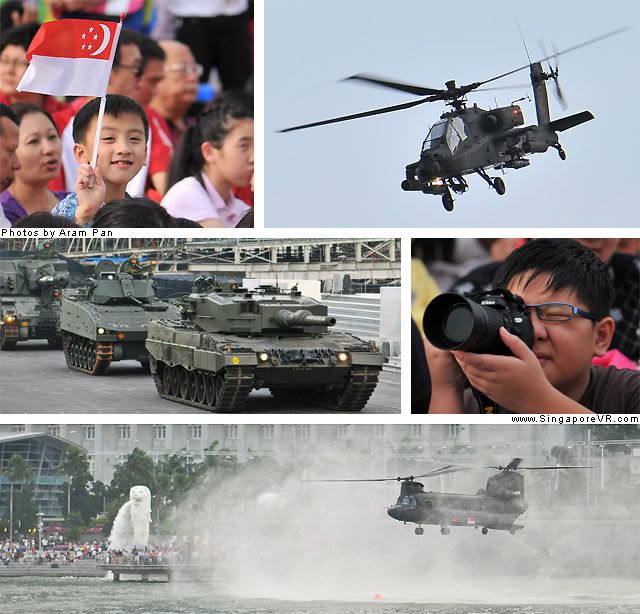
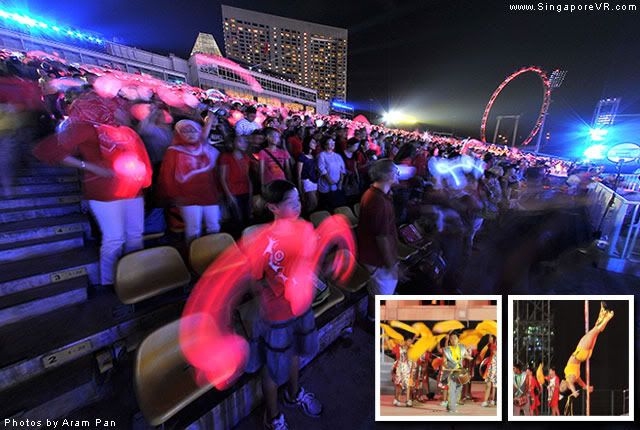
Singapore just celebrated its day of independence, and here I treat you to some highlights from the festivities:


Pictures from SingaporeVR

Very impressive. The military trains every year for this event, the one community service it performs regularly and with consistent zeal. Fireworks can only entertain us for so long, but such faithful commitment never gets old.

All in the name of the stars and stri– moon.

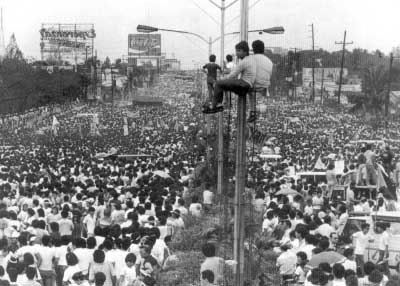
In contrast, the Philippines just observed the passing of one Corazon Aquino. No, not an FHM model, fortunately, but a former president who was a key figure in the popular revolution that ousted dictator Ferdinand Marcos. Yes, that's husband of Imelda Marcos who had that fabulous shoe collection. I'm waiting for her label to appear on the market too.

But, anyway, what was that popular revolt all about besides the usual rowdiness characteristic of Third Wold nations?


No wonder half of them are domestic workers today. Maybe they were protesting the construction of Ion on hallowed ground.

But something in me says that we have to admire the solidarity that these people had. They could have been shot at if things hadn't swung in their favour with defections sweeping through the ranks of the military. Marcos even had his 'finest hour', insisting that force was not to be employed despite the advice he got. But did the people know how it would turn out when they set off to stand up for themselves?

So maybe that's what patriotism is about: Solidarity with your fellowman and the courage to stand up as a people. And not about loyalty to the state, which is liable to be hijacked by special interests. Maybe these people, poor as they might be, know a very important thing about the essence of democracy. What is a nation primarily about after all – the piece of land and the flag, or the people who make it thrive? Maybe amidst our stability and our fortunes we have forgotten something that those people knew on that day.

So who is ‘First World' and who is 'Third World', really?

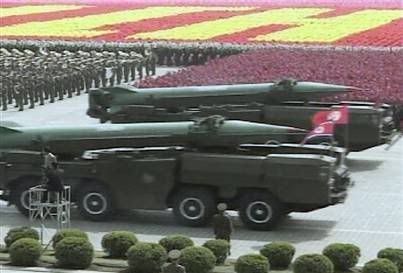
Well, we all love colourful parades. I enjoyed the ones in Disneyland. 

But I don't think I enjoy this sort much: