Padd Solutions

Converted by Falcon Hive

Showing posts with label patriotism. Show all posts

Since it's National Day, maybe I should do a bit of my patriotic duty by slamming criticism of the government. I'm proud of Singapore, man!

About a week ago, I read a blog entry complaining about the government's approach to solving the problem of insufficient parking spaces in public housing areas. Apparently, the authorities decided to double "the overnight parking fee from $2 to $4".
Cars need to find a place to park at night. You increase the parking fee, they still need to park there if they have to. How is increasing the fee from $2 to $4 going to help?
So says the blogger, who also adds:
Planning guys! Planning. Either you increase the number of parking spaces or you decrease the number of cars on the road. Increasing the parking fee only give you a bigger bonus at the end of the year. It does not help anyone at all. End of the day, those car still need to park somewhere.
Tsk, tsk. This ignorant bad person obviously needs to get into the shoes of a bureaucrat. Here is a very simple economic model that shows the supply and demand of parking spaces and the effect of price fixing on the market, which I think is sufficient to explain the situation:
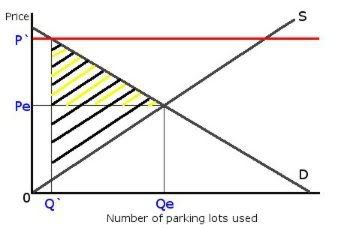
*I meant "spaces" not "lots"

The two grey diagonal lines represent the supply (S) and demand (D) 'curves' for parking spaces respectively. The y (vertical) axis of the graph measures the price of each parking lot, while the x (horizontal) axis measures the number of parking spaces used. Clearly, the graph shows the relationship between the price and the number of parking spaces used.

If the market is left to sort itself out, the common assumption is that it would default to a 'natural' sort of equilibrium. The equilibrium (default state of the market at which an equilibrium price is charged and an equilibrium number of parking spaces are used) point would be where the S and D curves intersect. So the equilibrium price would be represented by 'Pe' and the number of parking spaces used would be represented by 'Qe'. That is the point at which supply meets demand, so to speak.

However, let's say that in actual fact there aren't as many parking spaces as 'Qe'. Imagine that the S curve is vertical in the short term, since building of new car parks would take time or there just isn't enough space in the near future. Let's say there really are only 'Q`' number of parking spaces in the short term. So what happens then? The price has to correspondingly go up to 'P`' to reflect the reality of a shortage of supply.

But of course the real world doesn't quite work that way. Parking fees in public housing areas are most likely set by the authorities. That means when the authorities realise that there are too few parking spaces to meet demand, they would fix the price at a higher level in order to curb use and reserve available places for those who need them the most and are therefore willing to pay. 

So what happens in the above model is the authorities would impose the price of 'P`', represented by the red line, in order to meet a target of 'Q`' number of parking spaces used. In other words, this is similar to ERP and such price-based congestion-reducing measures. You increase the price (or impose a 'tax') to decrease the number of people who are ready to use the particular infrastructure.

But why not have the S curve vertical in the model to approximate reality better? First of all, as discussed above, since parking fees are set by the authorities, I want to show the effects of price fixing rather than those of limited and very inelastic supply. Secondly, I'm not sure that 'P`' is the price that corresponds (given demand) to the actual number of parking spaces available, so I can't say that 'Q`' is the number of parking spaces available in reality. Thirdly, this is just an example using very basic economic concepts, so it may not be the best model. Lastly, this can reflect the real situation in the longer term, when there is enough time to increase the supply of parking spaces.

So one of the things worth talking about is not the fact that people still need to park their cars despite the price increase, which is neither here nor there as it skips any attempt at rational analysis, but the fact that there is deadweight loss as represented by the shaded area. However, what is more relevant in this situation is not even that, since we are speaking from the public's point of view, but the loss of consumer surplus, which is represented by the black and yellow shaded area. This area represents the utility loss of those people who don't get to use the parking spaces they otherwise would have used because the fee is now higher than they deem affordable.

Now, it's probably the case that, in the short term, demand for car parks is more inelastic than shown (D curve more vertical) so doubling the price would indeed not result in a significant reduction in the number of parking spaces used. However, this doesn't necessarily mean that people can either have nowhere to park their cars or pay up, as the blogger seems to imply. They may decide to use non-public car parks since those are no longer as expensive relative to public car parks, or they may be more willing to risk parking illegally. More importantly, in the longer run, this may discourage people from using personal vehicles, allowing the supply of car parks to catch up more easily with the demand. 

So although this measure is not exactly good in the short term, it's a reasonable enough solution for the longer run. Besides, in the first place, what else can be done in the short term?

The reality is increasing the supply of parking spaces is not a short term solution, nor is managing the trend of growing use of personal vehicles. In fact, the increase in parking fees, as I've explained, is one way of doing the latter. Furthermore, the officials quoted in the news article this blog entry cites do talk about the need for longer-term solutions, so the entry proves to be very selective in what it mentions. And it certainly ignores the fact that, from an economic point of view, the price increase would better reflect the situation on the ground, giving preference to those with greater need and hence (presumably) greater willingness to pay.

So I've written one of my longest entries ever just to discuss a relatively trivial issue. But the point isn't really to prove that blogger wrong. The point is to illustrate that you don't have to be an expert to criticise something, as many people in Singapore like to imply (when it suits their purposes), but you should at least think through what you're saying. As it is, given such a small pool of dissent in the country, there is too much crap swirling around for it to be taken seriously. Any wonder that the opposition doesn't have much credibility?

Singaporeans like to complain about small things—well, who doesn't? But get it right more often. For a nation of brilliant scorers, we say a lot of stupid things.

Now go watch the parade.
Home

@ 12:46 • , , • 0 comments


I think this is a problem that people in such a small country like Singapore don't often appreciate.

When you move to a new place, you don't know anyone and you have to build your life anew. In a large country where there actually are different towns and cities, that is, where moving would count for something. But that's fine—you just have to work on it. The trouble is if it's temporary. Then it's simply going to get torn down again. And when you get back (if you do go back), you don't know anyone anymore either.

The problem can be set up and compounded by two things: The fact that you are moving to a different country with a different culture, and the fact that your original country is a deeply impersonal place. That way, you'd be a stranger everywhere.

But we don't have to complicate things that way. We can say something about the uprooting itself. When you uproot yourself, you set before you the task of building a new life. A new network, a new schedule, new habits, a new lifestyle (to a certain extent). But the normal assumption is that this is a task of some permanence. You rebuild. You don't normally rebuild to tear down again.

So I'm in a rare enough position.


But for me there is yet another dimension to this: Leaving my hometown (which isn't where I originated), I felt that I had begun to build a life of my own, and it was good. Losing that has an impact.

Maybe I'm just sensitive. Maybe this also has to do with the fact that I left my hometown having lost almost all connection with the people around me.

Nevertheless, I think one thing is true: They say you must know your roots, but the truth is you mostly need to grow them. Where you are, that's where you need to plant. There is no home where you don't have much to hold on to.

And that will never make it into one of the National Day anthems.


If you've been following world news, you must have learned about the 'controversy' surrounding Barack Obama's citizenship. Simply put, some people contend that he's Kenyan. Fortunately, Obama's official birth certificate has been produced and verified. Unfortunately, some of these people are demanding to see the original long-form certificate, which may or may not exist today, and that he produce various other records that he is not obliged to produce. Worse, someone found his purported Kenyan birth certificate.

If your memory of American politics extends further back to the presidential elections, you'd remember that Obama was also accused of being an Arab and of being a "Muslin".

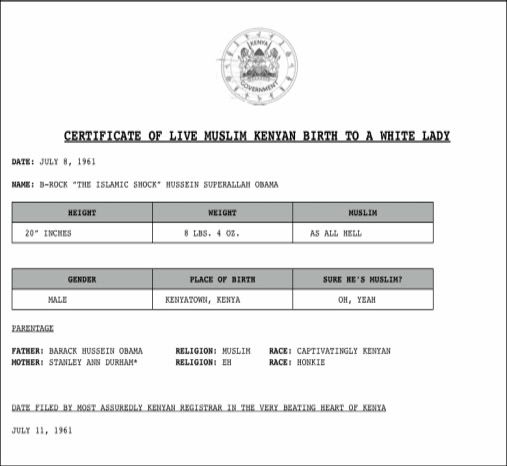
So who or what is Obama, really? Let's settle this issue for ourselves by looking at his real ultimate birth certificate:


Convinced?

This is America, the famous "melting pot" of the world. And the issue of the president's identity causes such an unnecessary stir, despite proofs that he is indeed American. Perhaps he's not American enough, unless he's white?

Someone asked me a few days ago if I feel a greater identification with my country when I'm overseas. Yes, I do. It's the only thing that identifies me when people ask me where I'm from. Yeah, I wasn't born here and I spent 10 years growing up in another country. I got my citizenship only when I was 21. And, yes, it seems that I have plenty of complaints about Singapore. Heck, I might even want to live elsewhere.

But this is my country. Is there any use in pretending otherwise?

So what exactly is national identity, as many people are looking out for? How do you measure 'Britishness' or 'Frenchness? This seems to be a very relevant question in Europe, where various groups of immigrants have real problems integrating; or perhaps it is the various societies that have problems accommodating the immigrants.

Perhaps the question is, in an age of globalisation, do nation states still hold the same level of significance as before? I wrote some time ago that patriotism should be about solidarity with your countrymen and not about loyalty to the state. But why stop at your countrymen? Is it because of a shared history? Surely things that happened in the country before you were born don't affect your identity directly. Rather, their legacy forms part of the country's culture. Is it then a question of cultural identity?

This is where globalisation complicates things, and where size also matters. The world is both too small and too big. Today, we readily absorb elements of other cultures that the media exposes us to. At the same time, the particularities of the sub-national regions that we come from continue to differentiate us from fellow citizens from another region. Can we pin down what makes us identify ourselves as citizens of a country?

Does essence precede existence? Are people from a country because they share a common identity, or do people share a common identity because they are from a country?

Is it possible for a Singaporean to not be Singaporean enough?

I think many people's gut instincts would be to say "yes". Otherwise, why do they regularly try to whip up some sort of esprit de corps, or why do they disapprove of those who don't have it? Labels like "unpatriotic" and even "ungrateful" testify to some sort of assumption that you have to qualify yourself as a true citizen.

And why do people regularly assume that to be Singaporean you have to be of a similar mind in some things? Do practices, perhaps, confer identity?

What I know is that it suffices that I am from this country. When people ask me where I'm from, I tell them. No embellishments are necessary, and I don't feel obligated to paint my country in a good light. I am Singaporean because I live or lived in Singapore for a good part of my life and I carry a Singapore passport. Is that not enough?

Before the idea of the nation state was born, people were parochial. They identified themselves with the little regions that they lived in. The peculiar practices of a region might have differentiated its people from those who were from another region, but I doubt a lot of them thought much about how they must cultivate regional identities. People belonged to a region simply because they lived there. In these times, I think we should be moving back towards such a picture.

But perhaps we still can't let go of the early 20th century.


"What is patriotism?" asked Emma Goldman at the beginning of her stinging indictment of 20th century patriotism. And this was the answer she gave: A ploy to win public support for the country's elite, who are either synonymous with the political establishment or the ones whom the politicians serve.

To further refine this point, let's ask ourselves the same question here. I wrote several years ago that patriotism can be a force for good. I still think so. But whether it is hinges on the answer to that question.

So what is patriotism? Is it about flag-waving, military training, having marching bands every year and fireworks with celebratory champagne? Claps on backs saying how great it is to belong to the country? Is it about loyalty to the state?

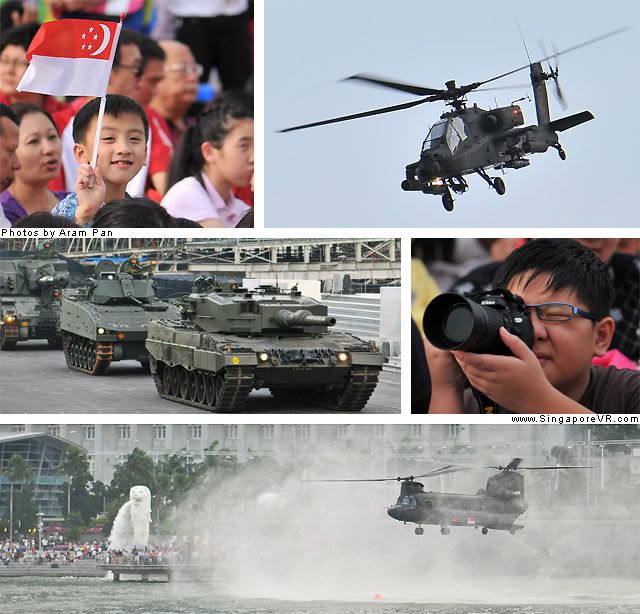
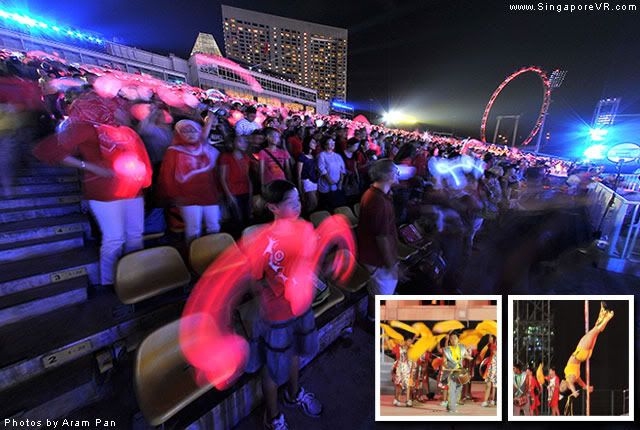
Singapore just celebrated its day of independence, and here I treat you to some highlights from the festivities:


Pictures from SingaporeVR

Very impressive. The military trains every year for this event, the one community service it performs regularly and with consistent zeal. Fireworks can only entertain us for so long, but such faithful commitment never gets old.

All in the name of the stars and stri– moon.

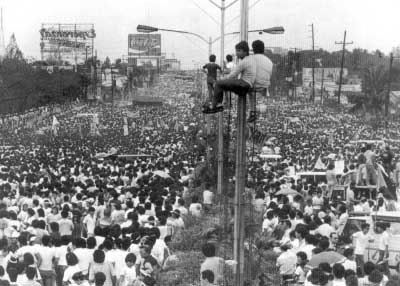
In contrast, the Philippines just observed the passing of one Corazon Aquino. No, not an FHM model, fortunately, but a former president who was a key figure in the popular revolution that ousted dictator Ferdinand Marcos. Yes, that's husband of Imelda Marcos who had that fabulous shoe collection. I'm waiting for her label to appear on the market too.

But, anyway, what was that popular revolt all about besides the usual rowdiness characteristic of Third Wold nations?


No wonder half of them are domestic workers today. Maybe they were protesting the construction of Ion on hallowed ground.

But something in me says that we have to admire the solidarity that these people had. They could have been shot at if things hadn't swung in their favour with defections sweeping through the ranks of the military. Marcos even had his 'finest hour', insisting that force was not to be employed despite the advice he got. But did the people know how it would turn out when they set off to stand up for themselves?

So maybe that's what patriotism is about: Solidarity with your fellowman and the courage to stand up as a people. And not about loyalty to the state, which is liable to be hijacked by special interests. Maybe these people, poor as they might be, know a very important thing about the essence of democracy. What is a nation primarily about after all – the piece of land and the flag, or the people who make it thrive? Maybe amidst our stability and our fortunes we have forgotten something that those people knew on that day.

So who is ‘First World' and who is 'Third World', really?

Well, we all love colourful parades. I enjoyed the ones in Disneyland. 

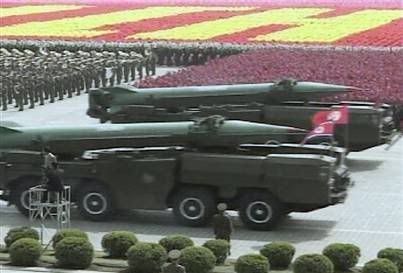
But I don't think I enjoy this sort much: