Padd Solutions

Converted by Falcon Hive


Coursework is coming to a head, so I'm just going to jot down a quick one.


Sometime last week I encountered a utilitarian objection to John Rawls' difference principle. It is put forward by economist John Harsanyi and goes like this:
Consider a society consisting of two individuals. Both of them have their material needs properly taken care of, but society still has a surplus of resources left over. This surplus can be used either to provide education in higher mathematics for individual A, who has a truly exceptional mathematical ability, and has an all-consuming interest in receiving instruction in higher mathematics. Or it could be used to provide remedial training for B, who is a severely retarded person. Such training could achieve only trivial improvements in B’s condition (he could perhaps learn how to tie his shoelaces) but presumably it would give him some minor satisfaction. Finally, suppose that it is not possible to divide up the surplus resources between the two individuals. The difference principle would require that these resources be spent on B’s remedial training, since he is the less fortunate of the two individuals. In contrast, both utilitarianism and common sense would suggest that they be spent on A.
This scenario is quite absurd, and hence I disagree that it can yield any satisfying conclusion. In a society with only two individuals, I contend that it makes little sense to give surplus resources to one person just on the basis that it would produce greater satisfaction by allowing him to learn something not directly translatable into practical advantages. Why would it matter? Why would the person care about satisfaction that can be gained from learning higher mathematics? What is the point?

In reality, people gain satisfaction for tangible reasons. A person is likely to gain satisfaction from learning higher mathematics because it allows him to further his own interests in the context of living in a complex society. Even if it is purely out of passion, it would be a passion that he seeks to share with other people (who are able to appreciate his abilities) in various ways. I find it difficult to imagine a hermit gaining much satisfaction from learning mathematics while living alone in a cave. While that may be possible, it would be the exception and not the rule.

Hence, there is no reason to hold on to a moral rule that demands that we always choose the option that we perceive as leading to higher satisfaction. Estimates of satisfaction are complex and are likely to have a social dimension. In situations like that which is described above, the choice is not a moral choice but an arbitrary one. Sticking to the utilitarian rule in this context only seems silly and not at all common sense.

In this sense, utilitarianism may be good at giving us directions, but I'm not sure those would lead us anywhere.

A while ago I talked about my scepticism towards concepts like Corporate Social Responsibility. While it's not nowadays considered nice or constructive to be dismissive of such things – we are dismissing all the good that do exist in the world, they would say – I think I gave a good enough explanation of why those are inherently absurd. But allow me to elaborate on it, with a view to what we can do.

What I'm going to say might not sound new here, but I hope it's a coherent synthesis of the ideas I have expressed, delivered concisely at a particular angle of social commentary.

A few centuries ago, it might have been feasible to appeal to a traditional regard for virtues or a sense of honour and responsibility in the powerful – noblesse oblige, the responsibility of those who have. That was a world of stratified social relations based on feudal or patriarchal links. There were strong forces of tradition that prescribe relationships between a someone of higher rank and someone of lower rank, relationships generally involving responsibility and even compassion on one side and loyalty on the other. Appeals to the ideas associated with such traditions would thus make perfect sense.

Now, I'm not looking at history with nostalgic glasses. Of course, there were plenty of inherent injustices in the old stratified societies. What I'm trying to point out is the anachronism of a method with respect to the times.

The rise of the classical liberals has destroyed the old forms of society. Social relations are no longer to be forged out of customs and slavish adherence to associated ideas. Rather, as Adam Smith suggested, they are to consist of mutual relations of self-interest. This is the bourgeois revolution. Fetters of tradition and its morality were to be removed to allow all men (and eventually women) to advance their own interests to a potentially unlimited extent. The rule of law is to be established to keep things in order, but no longer are people bound by prescribed roles and responsibilities.

The only duty one owes is to the state, the embodiment of the social contract. But the rhetoric of loyalty and virtue that is still frequently used sits uncomfortably with the new direction of political philosophy. Strictly speaking, we have a duty to the state not because of some traditional moral concept or other, but because we are bound by the common interest in a stable society.

This arrangement sounds fine and well. However, the role of the state is still a grey area. We know why the state is there, but is the existence of a raison d'être enough?

In practice, the state needs to perpetually affirm its purpose and existence through its acts, which interfere even with our daily lives. A state that does not act is a state that no one has faith in; it is naturally one that will subsequently cease to exist. Some people might wish to say otherwise, but reality attests to the fact that the only viable states are states that act. And so what the state ends up doing is a matter of concern, and with it comes the question of its role and responsibilities.

The problem, as in the case of other legal entities such as corporations, is with the fact that the state is not a person. The state is a machine consisting of multitudes of individuals and bureaucratic apparatuses with non-human systemic considerations, likely controlled by certain interests that are themselves collective groups. The state has legally-defined responsibilities, but an appeal to its sense of responsibility or to its moral sense is useless. What you might expect to move a monarch or a lord is not likely to move a modern state with highly distributed powers, especially since it is constructed from relations of mutual self-interest.

As such, appealing to morality – that might work on some individuals within the system, but it would be absurd to expect it to move the system as a whole. Chances are, that way, we will be hung out to dry waiting for our concerns to be addressed satisfactorily.

If we assume a system that is somewhat just, as Rawls does, relying on the state's legally-defined responsibilities would be enough. But I fail to see how a state that is, in reality, perpetually in the stranglehold of particular interests would ever realistically be just enough. We only need to look at the state of the world to confirm this: How many people remain hungry, poor and oppressed just because certain interests have to be kept satisfied, even in liberal democracies (keeping in mind, of course, the effect one nation has on another)?

And, if what I have said so far is correct, the satisfaction of the concerns of those who are unjustly treated cannot be achieved merely by appealing to old concepts and traditions of morality. In a society built on mutual self-interest, you are pretty much responsible for advancing your own interests. This is why those who are oppressed must organise themselves as a force to fight for their interests.

But should they act only within legally-defined limits?

I believe that they cannot always do so. Ideally, we would want obey the law to preserve stability in the society for everyone's benefit. However, the resources at the disposal of the powerful make attempts to effect change through the prescribed channels very difficult. The playing field is far from level. Thus, it is unreasonable to expect us to only exercise our political freedom by voting in elections and appealing to our political representatives.
We need other avenues, the most drastic of which is revolution. This is the practical argument for extra-legality. And since the same argument applies to the constitution, which is not necessarily just, extra-legality really amounts to extra-constitutionality.

Now, I do believe that the virtues are not completely lost. Otherwise, I could easily be construed as envisioning a world moved entirely by the force of might. However, in order to be able to appeal to them effectively, we have to take people out of their modern (liberal) institutional contexts. We have to appeal to human beings, the timeless individuals, not to citizens, soldiers or politicians. And this is the essence of the moral argument for extra-constitutionality we do not adhere merely to the laws, but also to common moral concepts that hopefully have not died out. The moral appeal would strengthen the movement. However, before the movement can speak on such a level, it has to be able to operate on a level beyond the constitutional (i.e. in keeping with the practical argument). Otherwise, it would be trapped by the legal realist loop that smothers moral thinking.

In effect, what I espouse is a belief in the freedom to fight. Neo-liberals and free marketeers believe in free competition. But, as much as they might want to deny it, they are stuck within their own rigid systems. To be truly for liberty, we cannot advocate only a free market for products. We must advocate, above all, a free market for ideas and the political actions of individuals.

Conflict of interest is a circumstance of justice, and the lack of a viable conflict of interest in real life is an indication that something is wrong. A political system where we can only vote for parties with few differences between them is recipe for perpetual injustice. We must bring back other avenues of pressing for our interests, even if they are illegal. And we must appeal to human beings outside of the control of the modern state to fight in the name of what is good and just. This is the vision of justice as struggle and dialectics.

It is what it takes to strive for justice in the kind of society we live in.


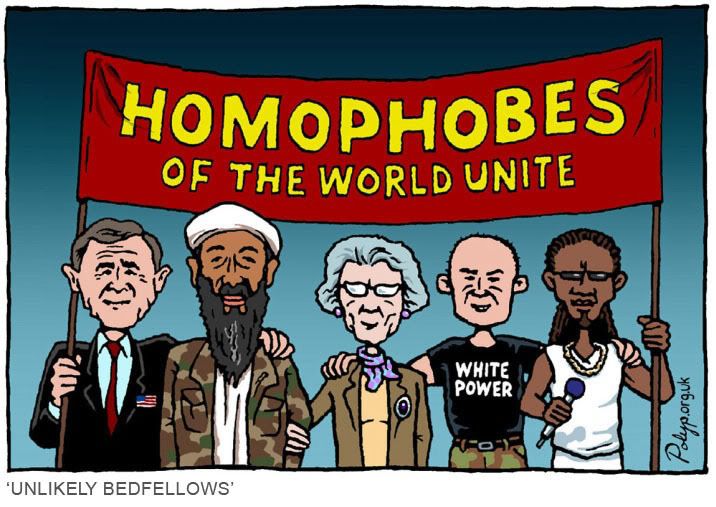
A week or two ago, the blog of someone I know received an unexpected comment. Some unknown dude (I shall presume it's a guy, since he sounds like one) seemed to have found the blog and commented, on the entry that talks about moving away from home for the year, that the author sucks and must be "a closet gay".

Well, I don't see what could justify such a comment to begin with. Is any personal reflection a sign of someone being a closet gay?

Another funny thing is the idiot seemed to have done this at work, without being aware that his IP address could be traced to his office. And apparently he works for Firebrand Interactive Ltd at North Bridge Road. Sounds like a pretty regular office worker.

So we can tentatively establish that some Singaporean office workers are juvenile. But the fact that he used the word "gay" in a derogatory manner also indicates that he is intolerant towards a sexuality that is different from his own. And I guess it would not be news to anyone who knows Singapore to say that many Singaporeans are intolerant in the homophobic sense.

Personally, I have little tolerance for the intolerant, but I like how John Rawls puts it: In the absence of a real threat to liberty, we should tolerate the intolerant because we shouldn't act unjustly just because others act unjustly. Moreover, a society that tolerates people who have no title to complain about intolerance towards them (because they preach intolerance themselves) might have a civilising influence on them over time.

In other words, we don't try to outlaw them like they try to outlaw others because we're civilised people, unlike them.

But I'm a Marxist, so I do believe that we should fight back. And we can do so by aggressively questioning the rationale of their political crusade. I'm confident that there is no way institutionalised homophobia is defensible in a modern and secular country. Who said it is immoral and why? Why is it unnatural? The clothes you wear are unnatural – do you propose having them banned for being unnatural? These are just basic questions that I've never heard a homophobe give satisfactory answers to.

And, even under the purview of freedom of speech, there are reasonable limits. Freedom of speech is not an excuse, for one, to have someone in a public position run away with her mouth. Leadership is, after all, supposed to carry responsibility, right? What would happen if public leaders started talking about their reservations regarding certain ethnic groups? What effect would that have on the society?

But I've written on this before, so besides the few points that I've raised here, I would like to leave the intolerant with something they do deserve – ridicule.

I bet they haven't spent much time thinking about what they believe. Maybe only prayed hard about it.


A very common accusation made against the left-wing is that it is too idealistic. Communism fails to take into account human nature, they like to say – it's just too impractical.

Those who are fashionably or vacuously apathetic might be especially fond of this criticism. Moreover, according to many of these people, left-wingers and 'liberals' aren't just dreamers, they are also "self-righteous" bores who are always "pontificating".

As a matter of fact, there seems to be an inherent contradiction when one says that Marxism is "idealistic". Marx is said to have turned Hegelian dialectics on its head (or back on its feet) when he transformed it from an idealist to a materialist approach. Marxists generally see matter, not ideas, as the beginning and end of reality.

So why is Marxism labelled as "idealistic"? Well, you might say, that just means that it focuses on an ideal state or has an ideal state of society as its end.

What about democracy, then? Is it not essentially an ideal state of society? A few centuries ago, many would have laughed at those who extolled the virtues of democracy. It's too ideal, they'd say – the people are too unruly to rule themselves. Compare that to the common perception of it today. Many of the same people who would dismiss Marxism as too idealistic are likely to chide authoritarian regimes for being undemocratic. There's at least a tad bit of irony there, don't you think?

But democracy doesn't really have an ideal end, you might now say. It's an achievable state that has been realised and isn't aimed at creating a utopia.

Well, has it been achieved? Is the democratic process not ongoing, repeated regularly in the form of voting exercises? Does it not have to constantly face forces that seek to usurp its procedures, perhaps even powers that want people to choose to be unfree? Is it not always in conflict with the bureaucracy, the state within the state that has its own aims and its own way of doing things?

Democracy, therefore, is an end in itself, and one that will never be 'achieved' in the simple sense of the word. Democracy is a constant struggle.

And so is socialism.

Orthodox deterministic Marxism does lay claim to a scientific view that presages an inevitable Communist society, which is preceded by a period of 'socialism', a dictatorship of the proletariat. And Leninism goes on to say that this period is brought about by a revolutionary party. But these set paths and clear milestones are not necessary elements of Marxism or of its method of historical materialism.

Some Marxists believe in the constant struggle and conflict for a just society – a class struggle, the dialectics of society. Just as the struggle for democracy never really ends, this struggle is perpetual. We make no predictions or promises about a specific kind of utopian society at the end. We know, however, that struggle is the way to progress, that entrenched traditions of injustice have to be gradually worn down. And our end is the human being, who is deserving of equality and dignity.

Gradual progress is not impossible progress. It does not call for world revolution. I believe in working within the constraints of parliamentary government, in working autonomously as individuals in resisting exploitation, as well as in extra-constitutional methods – we can and should use whatever means is necessary and beneficial without contravening the over-riding principle: The equality and dignity of human life. We work towards an end, but we do not specify a particular situation as the outcome, much less do anything and everything to achieve that outcome. Marxism isn't about gulags and purges. Marxism should be humanist and highly realistic.

So, again, what is it about the left that is so idealistic? Choosing the status quo is not being realistic. Left-wingers are the genuine realists because they are attuned to reality and the great suffering that is present, which motivates them to fight for change. They are also realists because they believe that real material life is too important to be dictated by abstract ideas. Reality bears down upon us like an inexorable force. Hunger demands food; tiredness demands rest; discomfort demands alleviation. So when we are told that we have to face poverty and deprivation because of some concept or other, we find it difficult to accept, and we fight. And that is to face reality. That is what it really means to be realistic.

Now to those apathetic types, according to whom we are always "pontificating" and being merely "faux intellectual", there's not very much that needs to be said. Of course, such comments do not constitute criticism, merely some brash lashing out that likely hides an inferiority complex. And if such comments apply to us, they would apply to anyone who has argued for anything, such as in academics. Have such comments enough merit to invalidate whole fields of inquiry, just because these people have no mind for arguments?

But I think we should be quite sympathetic to them. After all, we are opposed to the real faux intellectuals – the 'experts' who treat ideas and unintelligible categories as science. In any case, the left-wing position should not be difficult to grasp. If everything else is ignored, an essential principle can still be easily understood, one that a fireman adheres to everyday: People first, property and wealth later.


This is a sad story of political repression.

Repression always makes for a sad story, no matter what they would have you believe. That might sound amazingly obvious to those accustomed to living in a free society, but in authoritarian ones, things get rather muddled. Repression leads to stability and prosperity, the official tune goes. If the government and the people had to deal with politics, they would have less time to concentrate on the economy.

That is utterly simplistic, of course. There is no reason why healthy political discourse cannot contribute to greater stability and prosperity. As a matter of fact, political accountability is an important factor in creating stability and prosperity in the most economically developed nations. And how do we have real accountability without healthy political discourse?

Certainly, the happy story of repression is a way to justify control.

Recently, five activists in Singapore were acquitted of "participating in a procession without a valid permit", a charge brought against them for simply walking down the street with slogans written on their T-shirts. A small victory, perhaps, but what should concern people is the fact that an assembly of more than four people is illegal. Worse, the law has been changed to ban any gathering of people that is in any way political, no matter the number. And that, supposedly, is for security reasons.

I really doubt that docile Singaporeans are going to riot, especially a mere handful of them.

What seems clear is that such laws are part of a long tradition of political paranoia.

On that note, let's assume for a while that the authorities are right. Let's say that even without hostile armies ravaging its countryside like in the Russian Civil War, a country needs to crack down on dissent in order to establish a semblance of stability. How long can such a circumstance last before all legitimate reasons evaporate if the country is not to be considered a failed state?

It's like taking a loan to keep afloat. Perhaps necessary in the short run, but if one does it for 40 or 50 years, one creates an unhealthy dependence, if one is not already bankrupt.

How long has it been since Singapore needed to be paranoid about dissent? If the authorities think that they have always been doing well, why are they so afraid? And a few decades ago, they had the cover of the Cold War. Now, with the Communists out of the way, the country that stands for freedom still doesn't bat an eyelid when its ally persists in its own internal Cold War against freedom.

It is said that politics is the art of the possible. I think politics is an art where any absurdity is possible.

But what's so bad about crushing dissent if things are working fine, you might ask. The first sign of a problem is the lack of substance in the political discourse. As differing opinions are suppressed and people are indoctrinated in the official line, no effective opposition remains to put the government in check when it is blundering into a catastrophe.

Such conditions have become an entrenched reality in Singapore. A small group of elites from the same schools and institutions are constantly being pulled into the government, which is essentially synonymous with the ruling party. People who dare speak out are hit with charges of libel and various legal-political methods of silencing them. As a result, people become reluctant to speak, and whoever is not co-opted is generally unable to match the intellectual muscle of the ruling group. The political culture is dead. The existing ideas are the ideas of the ruling class, and they exist to reinforce the position of the ruling class.

Hubris and bad luck are the only ingredients needed for a disaster.

So what can be done in this situation? Perhaps change has to come slowly; perhaps gradual change can happen. Or perhaps there will be an explosion of discontent one day; perhaps there will be crowds in the streets, trying to effect immediate change.

When that happens, will the rulers themselves march out to club their opponents to death? If they are determined to continue writing the story of repression, yes, they would.

And if they succeed, the blood on their hands would merely be what is needed to grease the economy.

To those less enamoured of the economic realities of the world today, things might seem pretty bleak.

We've witnessed the destruction wrought by the big risk-takers and deregulators, those who stand for an unblinking faith in 'experts' and suit-wearing leaders; those who oppose all fetters in the name of freedom, and who think that the consequent risks can be managed.

Yet it's unlikely that these people will go away. There is a renewed consciousness of the need for regulation and moderation, but business culture remains as people continue to buy into it. There's a persistent love for the well-dressed, for achievers, success stories and unlimited accumulation – the Faustian of Spengler actualised; a penchant for concepts and the infinite with little regard for reality.

Who can stand against the colossi who bestride the world, at whose legs we merely peep about to find ourselves dishonourable graves?

From my experience, the average Joe is typically of the opinion that the old Left is a thing of the past. Didn't Communism effectively end with the collapse of the Berlin Wall? And the more astute might observe that developments such as Reaganomics and Thatcherism, as part of a general shift towards the right in the developed world, indicate that capitalism has inexorably triumphed.

History has ended, and it ended at Wall Street.

Now the opposition, it seems, is chiefly between the Right and the New Left. The latter is an umbrella for various causes ranging from women's rights to environmentalism, causes that are frequently allied but do not form a unified front. Most coherently, it is embodied by people with progressive sensibilities who are labelled as 'liberals'. These people are opposed to the markedly right-wing but are often inherently capitalistic. Thus, they are perhaps best described as left-of-centre or even centrist.

Significantly, however, they do not have a strong opposition towards the fundamental characteristics of bourgeois-capitalist thinking. They are also frequently misled by positivism, by a tendency towards abstraction and spiritualism, or by a false sense of independence. Thus, in principle, they represent merely variations of the ideas of the ruling class.

And thus, from the perspective of political ideology, their opposition is not truly dialectical. Consequently, it cannot be truly transformative.

However, I submit that to think in such terms is to deviate from dialectical materialism. As Georg Lukács put it, "It is not men’s consciousness that determines their existence, but on the contrary, their social existence that determines their consciousness." As I interpret it, this implies that the struggle against the social framework of naked capitalism follows from our economic conditions of existence. In effect, we have to look at what is made possible by economic stimuli that push people into action, rather than how ideological currents drive people.

Class struggle embodies the conflict between advancing mode of production and restraining social relations. I think the conflict is intensified when the prevailing social relations actually threaten to undermine the current mode of production. Witnessing the threat posed by modern capitalism to economic stability and survival is a wake up call for many people. Now more aware of dangers inherent in a 'free' market that is dictated by profiteering entrepreneurs, people are calling for greater regulation, smaller corporations, and the abolition of reckless risk-taking.

I think this should be regarded as a movement in the struggle. It has the potential to nudge the focus away from individuals, in the form of industry leaders, and towards the masses, brought about by greater state oversight and the increased strength of workers relative to smaller companies.

As such, I think anyone who is interested in social change should join hands and put their collective weight behind this development. Ideological currents do not often hold people together for long, and there is no use sitting down and waiting for a revolution. Marx himself seems to have disparaged Ultra-Leftists who refused to work with reformists. Left or New Left, we should be interested in improving the economic conditions of the masses, and this can be achieved in some measure by taking power away from the conmen and the charlatans who have controlled the government in past decades.

This could be a chance to undo past reverses and make another step forward.

As for the undying business culture, there is no need to resign ourselves to it. We must cultivate the seeds of resentment that have been sown. This is our side of the culture war. Now that the men in suits are down, albeit only slightly, it's time to press the advantage. We must again join forces with all who are of similar mind to show that the myth of the entrepreneurial Atlas is poison to economic well-being, that the world of business is not the world of the seeing, and that solidarity rather than selfish profit-seeking is the path of stable progress.

Let the precarious economic conditions of the day lead our way. There is hope in solidarity of action. And there is hope for a gradual progress towards a better society.


I might sometimes be guilty of this myself, but I try hard not to be. I have very little respect for people who don't do as they say, people who don't keep their word. But, of course, at the same time, I'm not sure I like Chigurh-style honour either. I guess the choice is often between two evils. As they say, there is no such thing as a free lunch; no such thing, perhaps, as genuine kindness.

Another quip that is often repeated is "Talk is cheap". It sure is. It's much cheaper to talk about integrity than to actually practice it at the cost of giving up the advantages you get by being unprincipled. And, ironically enough, when some people are caught red-handed, they'd be full of it – they'd be full of remorse, warning others not to follow their example, reshaping themselves anew as moral leaders.

But what if they had never been caught?

On a related note, you might expect that I don't believe in things like Corporate Social Responsibility. Well, no surprises here – you'd be right on the money. Corporate Social Responsibility should have a new marketing name: Bull Fucking Shit.

By definition, corporations don't have any sense of social responsibility. Anything they do is for profit or for the bottom line. Why, a company is not an individual with a moral compass. It's a collectively profit-oriented entity composed of business people who employ workers. In fact, Adam Smith, the grandfather of capitalism himself, killed the idea of Corporate Social Responsibility centuries ago by stating that it is self interest that motivates people to work; that good arises out of selfishness by virtue of the invisible hand, which ordains that more social benefit will come out of it than loss.

Of course, today, it's all about dressing it up. The concept of the invisible hand is one of the earliest moral pretences that have been constructed to justify profit-seeking and selfishness in the consciences of people. Another example is the capitalist or conservative ethic: You 'deserve' every penny you earn and don't 'deserve' every penny you don't. In other words, poor people are generally lazy and morally bankrupt people, and that's why they are poor. Evidently, circular logic is sometimes needed to forget the nagging feeling that something isn't right.

And it's actually easy to see what is wrong, if only we'd wrest ourselves from our conditioning. When selling bread, the baker might not be concerned about feeding you, being concerned instead about getting paid. Nonetheless, the baker needs your custom and you need his bread. You exist within a community whose members are interdependent and are thus inevitably working for each other's benefit. Individualism and selfishness are the main reason why there is inequality and poverty. The invisible hand is a myth, and people, by the non-principle of selfishness, go on to create systems that seek to maximise their respective individual benefits even at a terrible price to others. Is the good of a Warren Buffet greater than the good of a hundred people without adequate health care? Is the good of one American or European greater than the good of a hundred Africans?

Therefore, all the moralising hides a serious moral lapse that was born when our imaginations took a leap of faith away from the reality of interdependence.

Speaking of morality, we can probably agree that lying is generally immoral. But is the alternative then to be honest?

Sometimes people have candid moments that betray their true interests, especially when pressed. At a recent conference, a business representative warned that more regulations against corruption would force companies to maintain profits by engaging in more corruption. In a letter to the newspaper, the Singapore National Employers Federation (ST, Sept 30) resisted calls to implement fair employment practices for women, particularly pregnant women, citing the need to maintain profits. These are moments of honesty where we can clearly see that companies are not interested in society insofar as it is not profitable to be.

Does their honesty make it better? The Singapore government argues that it is better than corrupt governments in the region because it is open about paying senior politicians astronomical salaries based on salary estimates of (overvalued) private sector executives, rather than letting them engage in backroom deals. Is it right in saying so?

I contend that being honest about it is no better. Exploitation is exploitation. Injustice is injustice. Dressing them up does not change the fundamental wrongs. The only better way is to say good things and act accordingly.

That said, on a personal level, I do appreciate people who do not mince their words. It is much less tiring to deal with even outright meanness than having to guess what people's true intentions are.

Unfortunately, if we do not engage with hypocrites, some of whom might be living around us, how many people and parties do we have left to deal with? Would we be able to do anything?

Looks like we all have to be willing accomplices in this nauseating game. Personally, I have to reserve my contempt to those who have proven themselves to be completely untrustworthy. Sometimes, or perhaps most of the time, there is no choice but to single out only the worst offenders.

Sometimes, it's hard to be optimistic about this world.