Padd Solutions

Converted by Falcon Hive

Showing posts with label Marxism. Show all posts

Part I

In the second part of this discussion of Adorno and Horkheimer's The Culture Industry: Enlightenment as Mass Deception, I conclude by building on the key observations made in the first part regarding mass culture and capitalist relations of production, sketching out a slightly different theory of mass culture. The latter is subsequently applied, partly with reference to Slavoj Žižek's Shoplifters of the World Unite, to a brief analysis of the social problems facing contemporary British society (although it applies similarly to many other contemporary societies) that culminated in the disturbances that occurred in the summer of 2011.

It has previously been postulated that mass culture celebrates both consumption and success within the capitalistic paradigm, the latter which revolves around its particular social relations of production. Success in this context, however, has to be seen in relation to consumption, for the market for status and identities in a capitalist society demands equivalence, which in turn demands objective measurability. As such, success is measured by what is called 'purchasing power' and its instantiation in the form of the consumption of goods and services.

At the same time, the association between consumption and success also has its implications on consumption—while it has been suggested that consumption promises an inauthentic easy form of happiness, it is only always easy in a metaphysical sense, inasmuch as happiness as a concept, as Adorno conceives of it, is always being sought rather than readily found. In practice, consumption is by no means always attainable, particularly in forms that are socially valued and identified with success.

Yet, in spite of the relative difficulty of socially-valued consumption, mass culture must nevertheless persist in tempting audiences with it in order to maintain their interest and, consequently, the industries that depend on it. This creates a harsh paradox in which consumption is sold as an easy and attainable pleasure that is, on the contrary, more difficult to accomplish than it is made out to be, and must be so in order to maintain a degree of exclusivity that upholds the social value of consumption.

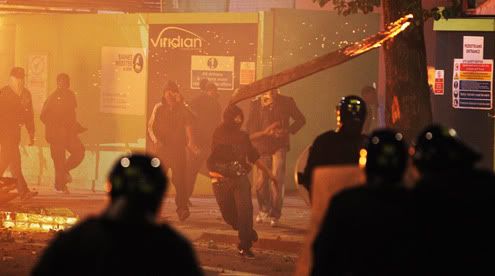
The contrast between the expectations generated by mass culture and economic realities in turn leads to social tension, as segments of society are continually being seduced by the promise of socially-valued consumption without the means to engage in it to substantial extent. And this phenomenon may have serious practical consequences for society: For example, the violence and the looting that occurred in London and a few other English cities can be understood as at least partly the result of the frustrations engendered by mass culture in its celebration of consumption and of success as measured by consumption.

That is not to say that there is a simple causal relationship between mass culture and social unrest in contemporary capitalist society. Discontent may, at least initially, emerge as movements of resistance, some of which express themselves in benign ways.

Yet what Žižek calls the "impotent rage and despair [that is] masked as a display of force" and the "consumerist desire violently enacted when unable to realise itself in the ‘proper’ way" (2011) seems manifestly connected to the influence of mass culture. The latter's power may not be as absolute as the Frankfurt School asserts. However, unless we choose to regard the looters simply as human beings who became "beasts" (Žižek, 2011) on their own accord, we must see that mass culture, in wielding significant influence over the modern psyche through the pervasiveness of mass media and through its relentless and seductive celebration of consumption, helps to create an impetus for them to go out and take what they want. Moreover, on a fundamental level, the 'anti-social' act of looting is partly one of lashing out against the fundamental tenet of capitalist society that is property rights, the legal framework that maintains the exclusivity of material ownership and socially-valued consumption.

In light of this, as a famous revolutionary once asked, what is to be done? There seems to be no option other than to continue resisting, but in a different way. While capitalism, presented to us by the messenger that is mass culture, "represents truth without meaning", giving us the freedom to choose only "between playing by the rules and (self-)destructive violence" (Žižek, 2011), we have to return to what is perhaps a less novel and less cynical way of thinking—we need to adopt a teleology of social and personal life that is both meaningful and lucidly aware of its humanity. We must become aware of the centrality not of particular things or even of transcendent things that may cloud our vision, but of human life itself and the importance of realising it in the fullest capacity possible.

I believe that this is the essence of the Frankfurt School critique of mass culture, or indeed of the Marxist critique of the capitalist relations of production. And this is a point that is not undermined by the dispute over facts about audience reception.

While cultural studies has today succeeded in appearing to undermine the Frankfurt School critique of the Culture Industry, the machinery of commodification steams ahead, more productive than ever. The intellectual world is powerless before this trend and continues to concede its influence. Numerous scholars of culture are striving to make their field at once more obscure and more accessible. They toil to create a happy vision of a world that is poised to reap the benefits of new communications technology, promising a cosmopolitan future of choice and enlightened consumption.

This vision is constructed through discourse that is sprinkled with an ever-growing list of newly-coined terms. Yet it is, at the same time, one that people can readily identify with—for who isn't ready to believe in the prospect of a brave new world, especially when the media has just informed them of the exciting new products available in the market?

Admittedly, Critical Theory does not often fare well in today's intellectual climate, a circumstance that I feel is attributable to its underpinnings in the labour theory of value, or at least in varying degrees of economic determinism. Popular conceptions of value no longer hold it as something objective or cardinal. Value is something that is purely relational and manifested in actual preferences. In other words, that people value something more than another cannot often be explained in terms of natural and tangible causes. Valuation is often a subjective affair.

In a powerful way, this undermines the Marxist critique of exchange value, not only by dispelling the labour theory of value on which the critique is based, but also by replacing the concept of use value with ordinal utility. Now we have another conception of value that is also Subject-determined and correlated with exchange value but is not equivalent to the latter. And the concept of use value seems cumbersome and obsolete beside one that is able to account for all Subject perceptions of value, including the intangible, instead of being mired in the materialist paradigm. Moreover, this conception of value is seductively democratic. After all, what can appear more empowering than a view of value that privileges people's preferences and decisions?

What this means for the Frankfurt School critique is its effective isolation as an elitist view of culture that presumes to tell people what they ought to value. If preferences are subjective, what right does anyone have to proscribe any as long as no actual harm can reasonably be alleged to result?

It is difficult to defend the Frankfurt School from such a charge. Yet I maintain that its critique of the Culture Industry still rings true, albeit in a way that may necessitate some distancing from Marxist discourse. My proposition is to look at the critique from a particularly modern perspective that revolves around expectations and hype.

If there is anything that we have learned from the last global financial crisis, it is that expectations may diverge from a more tangible reality of a situation, whatever the latter may be. Perhaps this can be seen in terms of the divergence between short-term and long-term confidence, the latter which is dependent on a stricter or more complete procedure of reasoning. But regardless of what exactly we should compare expectations to, the evidence seems to point to the existence of hype.

Hype can be understood, in that sense, as the inflating of expectations of returns relative to a more tangible measure of actual returns. Even under conventional ways of looking at the market, hype is rarely a good thing—it implies that buyers are ultimately losing out in terms of expected versus real returns to their spending. And since hype is paid for by marketing costs that are likely to figure in pricing decisions, hype also represents a potential deadweight loss.

What does this have to do with the Culture Industry? It is my contention that the Culture Industry is a major source of hype. It deals in feelings, manufacturing them in order to generate interest in things—a process that is typically subsumed under the goal of making profit. It thus becomes the primary source of trends that influence people's preferences in goods. To grasp the commercial importance of the Culture Industry under late capitalism, simply witness how advertising thrives on the products of the Culture Industry.

Moreover, this principle does not apply merely to the products of various industries, but also to more general things such as lifestyles and even happiness—the message is that spending our money on something or adopting a certain attitude or lifestyle can bring us happiness or a sense of fulfillment.

But can hype not become real if it proves to be permanent? After all, there are still many people who would be very happy to buy, for example, the latest Apple products simply on the basis of the expectations that have been generated through marketing. Thus, it would seem to be the case that these people continue to get what they expect.

Yet it remains true that no one really knows how long the ephemeral expectations that are associated with hype can last, especially on the level of the individual. All it takes is for the realisation to come, in one fine moment, that there is no basis for believing that something is as good as it has been made out to be. Much of the perceived returns would be lost in that moment, just as the perceived values of certain financial instruments evaporated a few years ago.

The lie that Culture Industry sells us does not, therefore, have to depend on a highly contentious philosophical analysis of value. Whatever the exact nature or typology of value may be, hype as the commodification of feelings can be observed in our everyday experience; and it stands clearly a means of extracting profit through the inflating of expectations.

Here I present a reading of Theodor Adorno and Max Horkheimer's The Culture Industry: Enlightenment as Mass Deception, with reference to Frederic Jameson's essays on Adorno in Late Marxism and Amresh Sinha's Adorno on Mimesis in Aesthetic Theory.

So where should we begin? The first thing to note is the fact that there is more to Adorno and Horkheimer's theory than the suggestion of mass culture as fundamentally characterised by passive consumption. That is really only a symptom (though a very important one for Adorno and Horkheimer) of the general 'malaise' of mass culture, and one that has received far too much emphasis in media studies to the detriment of the discussion of its other aspects. In light of this, I will endeavour to present a more contextual reading of this essay.


I am looking at Adorno and Horkheimer's critique of mass culture from the perspective of their critique of pleasure as it is associated with mass entertainment under late capitalism. It should be noted that Adorno and Horkheimer's analysis of pleasure "takes place within a framework of the theory of the alienated labor process" (Jameson, 1990: 145). This entails the analysis of mass culture as the colonisation and the commodification of leisure time—amusement is the prolongation of the working day insofar as it merely functions as a period of relaxation that demands no effort (hence the passivity of the consumer), which is sold to the individual worker so that he/she can continue working contentedly the next day. Pleasure is therefore seen not only as a flight from reality but also as the flight from "any last thought of resistance" (Adorno and Horkheimer, 1998).

The full implications of commodification will be brought out later. Presently, we will attend more closely to the notion of the colonisation of leisure, which involves the mechanisation of culture that reflects the mechanisation of modern economic production: The enjoyment of culture is schematised for a passive audience so that, as mentioned above, no effort is required on the part of the latter. This entails the presentation of "repetition and the familiar" (Jameson, 1990: 148) in order not to tax the audience's minds. Thus, the familiar character of the labour process is ironically reproduced in entertainment, which indicates that the monotony of "standardised operations" that characterises the working day "can be evaded only by approximation to it in one's leisure time" (Adorno and Horkheimer, 1998).

This is where media scholars' criticisms of Adorno and Horkheimer are typically focused, with their rather belaboured emphasis on the examination of the link between media consumption and power (sometimes in an effort to deny that the media wield power over the audience). As stated in the beginning, such a perspective is sorely inadequate, and this will become evident as we examine the other aspects of Adorno and Horkheimer's theory on mass culture, beginning with its aesthetic critique of pleasure.

Adorno and Horkheimer hold that pleasure/happiness is found in what is yet to be, and their charge is that the Culture Industry offers 'inauthentic' pleasure that is purported to already exist and is ready for consumption. Furthermore, Adorno postulates a conception of the artistic mimesis as pure expression, which is antithetical to the notion of 'expressing something' (Sinha, 2000). Artistic expression is hence self-identical (Sinha, 2000) and thereby incompatible with the notion of equivalence, which is so important to the process of commodity exchange. Like the mystical in Wittgenstein's philosophy, in other words, it cannot be substituted by something else. Therefore, unlike the products of the Culture Industry, it cannot be subsumed under the mechanism of substituting means for ends (Sinha, 2000), being thus quite apart from the market for identity and leisure that under late capitalism are treated as just more commodities to be exchanged.

One important insight that we can derive from Adorno's conception of art is that, for Adorno and Horkheimer, reception is identified with the capitalist mode of production, particularly in the context of commodification. This means the reception of the products of the Culture Industry has to be understood in relation to their production. The most common criticisms of Adorno and Horkheimer are heavily invested in the critique of their claims regarding reception, emboldened by evidence indicating that audiences are not passive. Thus, a good way to uphold the Frankfurt School critique, without explicitly invoking theories of power, is to bring production back into the discourse.

Equivalence is, as stated earlier, crucial for commodity exchange, and it is created through abstraction—the Marxist account of commodity exchange involves the abstraction of the use values of goods into exchange/monetary value, "allowing comparable and measurable quantities to be manipulated" (Jameson, 1990: 149). This forms a vital part of the commodification of leisure as it is the need to conform to the principle of equivalence and create monetary value that drives the production of cultural products in a manner that is similar to the production of consumer goods, leading to the creation of what Walter Benjamin calls the mechanically reproducible work of art.

But what implications does the nature of production in the Culture Industry have on consumption? Questions of quality come first to mind, but this is, understandably, shaky ground on which to stake a critique of mass culture. We need look above and beyond, at the implications of the relations of production on the consumption of mass culture as a whole and not as discrete cultural products. 

Roland Barthes asserted, mirroring Adorno's critique of pleasure, that mass-produced culture under late capitalism serves to conceal or obscure the capitalist mode of production, thereby eliminating resistance. However, this line of argument is once again susceptible to the criticism, born of audience studies, that audiences are not simply passive recipients. Indeed, I think the exact opposite is the case: Far from hiding it, the Culture Industry revels in the capitalist mode of production, showing us the promises that await us should we acquiesce to the system, namely all manner of consumer goods and the status and identities that come with them—rewards that are, however, readily available. It tempts the audience with these prizes, rather than compelling or co-opting them directly. But, crucially, it also promises the more elusive, yet-to-be prospect of success itself, embodied most vividly and blatantly by the stars it churns out as the human end-products of its capitalist mode of production. It is therefore unsurprising, though ironic in light of Adorno's linking of pleasure to readily achievable ends, that audiences are so preoccupied with stars.

Continued in Part II

Postmodern approaches to social theory emphasise multiplicity and de-centring, and these themes find their natural articulation in cultural analyses. Such analyses focus on the richness of cultural interaction and the reproduction of identities in non-linear ways, and where they concern themselves with politics and social organisation, they seek to realise this vision of cosmopolitan society—a society consisting of empowered and complex Subjects. Some theorists have even gone so far as to announce that we live in the age of the Subject.

Is this true? The last claim is especially dubious; our everyday experiences are enough to cast serious doubt on it. There are structural and physical limitations that ensure that Subject-Object relations continue to exist in force and often dominate the social terrain. Thus, trying to establish the existence or even plausibility of pure Subject-Subject relations in mass society amounts, at least under present conditions, to an exercise in wishful thinking.

Such limitations can be observed most clearly in political processes. Indeed, politics may be said to define these limitations insofar as it is considered as the necessary framework of social organisation. Politics, therefore, exercises a restrictive rule on the freedom and the pure reciprocity that would give rise to a society consisting only of relations between empowered Subjects.

The agents that enforce this rule are institutions. Institutions impose their decisions on Subjects in non-negotiable ways, and this happens every day in processes of governance. Democracy and dialogue fade away when individuals are faced with institutional decisions made under the guise of systemic necessity. Dreamers might continue to insist on the democratic possibility of changing such outcomes, but as Marx said, "Between equal rights force decides."

The will of individuals as Subjects and systemic concerns (as they are treated by institutions) are thereby locked in a Hegelian moral opposition—the dialectic is a forceful one. Even Subjects with dialogic aspirations for society need to be able to resort to confrontation in order to assert themselves in reforming or recreating institutions to carry out the vision of a cosmopolitan society.

It is no wonder, then, that non-violence and compliance are attributes that are often considered highly desirable, if not the most desirable, in liberal democracies—institutions may depend upon them to survive when there is potential conflict with the will of the demos, the collective body of Subjects.

Hence, democracy as an ideal exists only in its immutable form in a theoretical revolutionary moment, when the will of the demos is able to assert itself without institutional restriction. Echoing the structuralist critique of the metaphysics of presence, the ideal of democracy is not actually present in everyday procedures of governance and planning. There is typically only the reality of individuals acting as economic units under systems that often vaguely recognise their status as free and equal beings.

What about dialogue? Is there more that can be said about it? Indeed, the critique of dialogical interaction can be expanded from an institutional focus to the relations between Subjects within the demos or the public sphere itself. Some of these relations are no doubt power relations, but the existence of Subject-Object relations can be established beyond the influence of power and as the product of necessity as well. Once we move from small-scale interpersonal relations to mass society, it becomes difficult to avoid the constitution of Subject-Object relations. Mass communication is inherently objectifying because it is depersonalised—in addressing a mass of individuals, Subjects communicate without the ability to recognise particular and distinct Subjects as the recipients of their messages. As such, they must necessarily generalise about and even essentialise their audience, moulding the latter's image according to their messages. While dialogue is possible, it is nevertheless unable create a public sphere consisting of Subject-Subject relations as long as the whole of the mass is considered. The conversation will not be able to take into account every individual in his/her full complexity as a Subject; nor will it empower every Subject by allowing his/her unique voice to be heard fully.

So where does this leave postmodern approaches that try to construct a rhizomatic web of non-essentialising relations between Subjects? The pessimistic answer is "Nowhere"—there will always be Subject-Object relations and they will continue to have great relevance in social organisation. However, to give a more optimistic assessment, postmodernists may take a cue from modernist approaches and seek to address the actual existence of centres, instead of pretending that the Subject has got the better of them. Otherwise, like the proverbial ostrich, they can only make themselves more vulnerable to objectifying processes.

 
It might seem awfully difficult to empathise when you want something out of other people.

Indeed, the culture of selfishness that a capitalistic society fosters, for 'the good of all' (enter the invisible hand), orientates us towards the demand side of exchange. The baker does not care that you are hungry. He cares only that you are paying him good money for the bread he makes. Likewise, the buyer doesn't care if the baker has many mouths to feed in his family. He cares only that he gets the bread he wants as cheaply as he can.

This makes bourgeois culture exceedingly hostile towards perceived inefficiency in satisfying demand. We want something and we want it when we want it, the denial of which is irritating at best. The more capitalistic the society, the more hostile it is. On the producer side, this creates an atmosphere of cut-throat competition or a rat race, in which you need to offer what others can offer in order to thrive.

Unlike individual workers, however, businesses have some clout. Through political or market influence, they give themselves room to manoeuvre by ensuring that they retain some avenue for profit without always having to offer what is necessary or what is the best. Where and when they do need to compete with each other, they turn to their workers, wringing more of the latter's labour in order to increase efficiency and maximise profit.

To defend themselves, the workers have to agitate for rights and form unions to negotiate with their employers; or they could deliberately adopt inefficient practices to mitigate or spite the exploitation that they are subject to. And when they do these things, the spotlight of bourgeois wrath is turned upon them—they are seen as lazy and motivated by an unjustified sense of entitlement. This is the capitalist blame game.

Some societies may be less susceptible to such finger-pointing, but the potential for its existence is always there if we believe that human beings are inherently selfish at some level. As such, for us to rise above it, we have to actively moderate our short-sighted tendency to be selfish, to balance empathy against our desire for quick gratification. That remains virtually impossible until we stop buying into modern consumer culture—until we break the vicious cycle of capitalist ideology—for the good of ourselves as both consumers and producers.
 

Having witnessed first hand the large student protest against the UK government's decision to raise tuition fee caps, I'm neither unnerved by the sporadic violence nor disheartened by the chaos of mass action. Rather, looking at the aftermath of the day, I've become more convinced of the corruption and the absurdity of the system.

Bourgeois sensitivity towards militant action is amusing. Repeatedly, we've been treated to condemnations of acts of violence and hooliganism by the established channels of the dominant bourgeois voice. The emphasis has been on the contrast between justified peaceful protest and bad violent protest. Perhaps if those sitting in their sofas watching the telly would reach a little into their memory and recall the last large-scale peaceful protest, they might remember the time when more than a million marched against Britain's participation in the Iraq War. The government went ahead with it anyway.

So what the official mouthpieces are really advocating is mass action that can be sidelined and ignored while the elite go on with their business. God forbid that a demonstration might make the latter anxious.

Violence is inherently problematic as it is simultaneously a powerful tool of the dominant ideology. Yet this does not diminish the idiocy of refusing to recognise the violence as a politically relevant part of this mass action. Statements about how a peaceful student movement has been hijacked by violent factions is begging the question: Where do these violent people come from and what do they want? Are they simply embodiments of the semi-mythical anarchic ruffian archetype? Or are some of them—God forbid—people who are genuinely frustrated by how they are treated by the politicians and their law enforcement minions?


While people are desperately protesting their disenfranchisement in ways that they think might have an impact, the official mouthpieces are busy trying to appeal to middle class disgust towards violence. They are also painting attacks on icons of traditional authority as appalling anti-social acts. Under this 'objective' and 'reasonable' surface discourse, ideology is plainly at work, and there is nothing too absurd for its efforts.

The attack on a royal car, in particular, has received much coverage worldwide. In Britain, some channels have been very active in expressing horror at the act. The time-honoured and sacred tradition of the monarchy itself seems to be under attack. Will those protesters stop at nothing in their quest to destroy the very fabric of society? Nevertheless, the public would be glad to know that the royalty proceeded bravely and resolutely to attend the royal variety show despite the attack.

A comedian on the show couldn't have done better.

I've been thinking: Maybe I can find no answers to the big ontological or ethical-political questions; maybe there is just too much that I don't know to give my own comprehensive and interesting account of how human society should be organised. Maybe I should strive, first of all, to answer one question—how to be?

A great many thinkers have devoted much time and effort to answering this question. Camus, one of those whom I remember most clearly, gives an absurdist answer when he asks and responds to his central question: If the universe is an absurd place, why live at all?

Yet, even though he deals exhaustively with the problem of existing with the awareness of the absurd, he seems to devote little attention to the material and therefore political-economic constitution of our everyday lives. That seems to be the domain of Marxist humanist philosophy, where the question has a different formulation: How does the individual assert himself as a human subject in a society that objectifies him and his labour through processes of reification and exchange? In other words, how does one be a human being who is capable of action unencumbered by the systems of domination immanent to our commercial society?

The answer seems to be revolution, one way or another—to destroy or destructively resist the systems of domination. Yet as we live our everyday lives, it seems to me that it is often not apparent what each of us as individuals can do in that regard. Between thriving through conformity and a difficult survival in opposition to everything that our society stands for, it's quite clear what most of us would choose.

So how might we chart the happiest path in our existence, neither completely consigning ourselves to having self-destructive tendencies to give up our subjectiveness nor sacrificing ourselves as martyrs on the barricades? How do we exist as human subjects in our normal everyday lives?

Nietzsche gives a pretty compelling answer: Be a strong subject. In essence, do not bow down to the rules imposed on you by others, but strive to create your own for yourself; assert yourself as a person with minimal regard to what others want to turn you into.

This sounds like a good general principle, but how do we go about applying it? What tangible thing can we build on it and hold on to?

Moving our attention away from the will to power, which can only reproduce systems of domination and thus lead to circularity, I believe that we must live for a labour of love. In other words, instead of instrumentalising ourselves to the conventions and modes of life prescribed by society in order to live, we have to subsume the necessity of conforming under our attempts to live to work on our own magna opera. Thus, in a Marxist way, we are re-inverting the order—instead of serving the rules, we are trying to make the rules serve us.

I think this is an interesting way of thinking because it implicitly makes a few crucial points—that we are only human in doing, and that we are only subjects in being able to do what we want (in a broad and existential sense of it). And I believe these points are crucial because they inform us on how to be.

Thus the journey begins.


If it is true that we are all free, why do we consistently choose what is bad? Why does participation not lead to quality in society?

This is a question that Christianity asks in order to call to our attention true freedom in God, free of enslavement and of human weakness, which causes us to be unable to choose anything but the slavery of sin. Unfortunately, Christianity cannot be divine because it is tainted by human beings. Thus we are left to ask questions on our own, as the Church Fathers did.

Does choosing to be slaves imply freedom? Some might say yes. This absurdity and contradiction comes about through two main threads of human thought: Libertarianism and relativism gone mad. The first posits that human agency is so absolute that human beings can, if they so choose, lose it. The second would have us believe that anything can be good to someone—perhaps some people choose to be slaves because they want to be slaves, perceiving slavery as a good? Or perhaps there is no good at all, only preferences, in which case we might as well be nihilists.

Marxist thought, on the other hand, offers a human solution to this puzzle. In our apparent freedom, we perpetually choose to be unfree because of false consciousness. We are not attuned to our real interests, and therefore we choose what is bad by first allowing our freedom to be subverted in letting powerful groups tell us what we want.

"We are free to choose," they say, as they readily queue up for the next Apple product like the hungry for bread.

It is probably true that to some extent preferences are negotiated. The industries give us what we want while trying to mould our tastes to further their own interests. But, if this picture allows neither side to wield near-absolute power, why does the reality feel so stunted? Why does a relatively free market not produce the promised creativity? Why does the UK publishing industry, for example, only publish what appeals to lowest common denominators, what will attract by virtue of its harlot-like easiness?

Why can we not, for the most part, refuse the bad?

Either we are extremely stupid as free beings, or we are not truly free. I choose to believe the latter.

The fact is we are not free as long as we are enslaved by uncompromisingly non-objective conceptions of the good, or by false notions about freedom. And this is something we as free beings are responsible for—we are guilty of enslaving ourselves through our own ways of thinking.

Some scholars are quite dismissive of the Frankfurt School, thinking it an artefact of a bygone age, while they indulge in blissful proclamations about an age of freedom and choice brought about by technologies they hardly know themselves. They study every petty whim of society and profess to find all that is good with the universe in Coronation Street.

But, far from dissipating, power merely grows ever more subtle in its application. The Frankfurt School is not wrong. It has just become less easy to see what they criticised in their time.

I quite liked the first iteration of Iron Man on the big screen so I had more than half a mind to catch the sequel. However, I didn't manage to see it in the cinema. Fortunately, a long plane ride a few days ago afforded me the chance. And I wasn't disappointed.

For a superhero movie, it was refreshingly honest. We like Iron Man, or Tony Stark, because he is rich and 'cool', not because he is a brooding hero with larger-than-life psychological problems or teenage angst. And it featured a promising villain whom we can sympathise with, at least initially. And by that I mean real sympathy, not some sort of twisted admiration for a fictitious terrorist or madman.

But in some ways the things I like about the movie also form what I, on hindsight, dislike about it. In its portrayal of the hero, the movie embodies the culture and social consciousness of the present age: We celebrate the lucky ones, those 'blessed' with ability, means or just plain luck that ultimately makes them our heroes and icons. On the other hand, those whose lot in life are different but who struggle against it are 'doing the wrong thing'. And because they are, they must be bad—ruthless, barbaric or simply inhuman.

That's how it works, not the other way round. The latter doesn't even find chronological support in the movie. As I said, we can initially sympathise with the antagonist in Iron Man 2. However, in the end, because he is gradually shown to be cruel and inhuman, we are fine with the fact that the lucky hero triumphs. First we see the unlucky man, then the man who is (therefore) filled with the desire for vengeful satisfaction; because he was deprived, he must therefore become something less than human, destined to eventually be beaten back by his betters.

This parallels story arcs found in other contemporary stories such as the agonisingly bad Harry Potter series. It even has a close resemblance to the model of paternalism seen in the Agamemnon/Clytemnestra dynamic in Aeschylus' masterpiece more than two thousand years ago. Perhaps celebrity worship is a time-honoured tradition after all.

Having said all that, sometimes the guilty pleasure elicited by an honest Hollywood flick can remind ourselves what fools we are. But, then again, with the popularity of the Twilight series as it is, maybe the human capacity for self-reflection has been Eclipsed.

Now, at the risk of spoiling my ending, let me end with a thought: We study pop culture as a representation or commentary of contemporary society because studying it as art would just be depressing.


I've been reading an interesting book called The Black Swan. I'm about two-thirds of the way through now and I think I have grasped the central message of the book, which is that our ability to predict the future in social matters is highly limited.

I think this is a very interesting point, and I find myself agreeing with it. I'm not so sure, however, with the seemingly suggested conclusion that a skeptical-empirical approach (which is similar to but more comprehensive than the open-minded attitude I've talked about) is linked to the libertarian position in questions of political economy. Indeed, Hayek and the Austrian school—those proclaimed bastions of libertarian thought—receive not few words of praise in the book and almost no criticism.

The thing is, Hayek might have a good point about economics, but in his political commentary he is guilty of the same thing the book criticises heavily. As I understand it, Hayek alleges that attempts to control economic activity will lead to authoritarianism, hence the 'The Road to Serfdom'. But the evidence speaks for itself. Describing, say, modern-day Britain as authoritarian is a bit of a stretch—what more labelling it as serfdom.

The truth is economic activity in modern society will always be controlled in some (not insignificant) degree, for better or for worse. And this has not and does not seem likely to result in large-scale authoritarianism. Thus, Hayek too fails when he attempts to predict a potential socio-political trend.

But I don't want to focus my criticism on Hayek. Rather, I'd like to talk about why a libertarian position does not necessarily follow from the main point of the book.

The crux of my point is this: As many have pointed out, doing little or nothing also tends to incur costs. There is a price for instituting social programs aimed at helping the impoverished, for example; on the other hand, the alternative of inaction would also have a price.

The book says that not to form quick conclusions is an act as it requires effort. Similarly, not to do something is an act as it tends to have its own cost. Hence, the lack of certainty on the possible consequences cannot justify inaction. As the book also says, having people who take their chances is often necessary for social development.

Therefore, it is rather the case that people are justified in acting on their beliefs as long as they are acting on good faith and are constantly aware of their limitations.

This leads us to another point: It is precisely the lack of absolute certainty in social matters that prevents one from judging a certain school of thought as absolutely wrong, as long as it is not in the business of making predictions or creating concrete historical narratives. So despite, say, the book's criticism of the historicity and scientism of Marxism, a non-scientific/deterministic brand of Marxism is not as vulnerable to the same criticism. Simply put, observations that are not necessarily false cannot be called out for being false.

It turns out, therefore, that under conditions of uncertainty we have to be open-minded about things that have not been proven false. But that's hardly surprising, isn't it? Except perhaps to stubborn libertarians.


A while ago I talked about my scepticism towards concepts like Corporate Social Responsibility. While it's not nowadays considered nice or constructive to be dismissive of such things – we are dismissing all the good that do exist in the world, they would say – I think I gave a good enough explanation of why those are inherently absurd. But allow me to elaborate on it, with a view to what we can do.

What I'm going to say might not sound new here, but I hope it's a coherent synthesis of the ideas I have expressed, delivered concisely at a particular angle of social commentary.

A few centuries ago, it might have been feasible to appeal to a traditional regard for virtues or a sense of honour and responsibility in the powerful – noblesse oblige, the responsibility of those who have. That was a world of stratified social relations based on feudal or patriarchal links. There were strong forces of tradition that prescribe relationships between a someone of higher rank and someone of lower rank, relationships generally involving responsibility and even compassion on one side and loyalty on the other. Appeals to the ideas associated with such traditions would thus make perfect sense.

Now, I'm not looking at history with nostalgic glasses. Of course, there were plenty of inherent injustices in the old stratified societies. What I'm trying to point out is the anachronism of a method with respect to the times.

The rise of the classical liberals has destroyed the old forms of society. Social relations are no longer to be forged out of customs and slavish adherence to associated ideas. Rather, as Adam Smith suggested, they are to consist of mutual relations of self-interest. This is the bourgeois revolution. Fetters of tradition and its morality were to be removed to allow all men (and eventually women) to advance their own interests to a potentially unlimited extent. The rule of law is to be established to keep things in order, but no longer are people bound by prescribed roles and responsibilities.

The only duty one owes is to the state, the embodiment of the social contract. But the rhetoric of loyalty and virtue that is still frequently used sits uncomfortably with the new direction of political philosophy. Strictly speaking, we have a duty to the state not because of some traditional moral concept or other, but because we are bound by the common interest in a stable society.

This arrangement sounds fine and well. However, the role of the state is still a grey area. We know why the state is there, but is the existence of a raison d'être enough?

In practice, the state needs to perpetually affirm its purpose and existence through its acts, which interfere even with our daily lives. A state that does not act is a state that no one has faith in; it is naturally one that will subsequently cease to exist. Some people might wish to say otherwise, but reality attests to the fact that the only viable states are states that act. And so what the state ends up doing is a matter of concern, and with it comes the question of its role and responsibilities.

The problem, as in the case of other legal entities such as corporations, is with the fact that the state is not a person. The state is a machine consisting of multitudes of individuals and bureaucratic apparatuses with non-human systemic considerations, likely controlled by certain interests that are themselves collective groups. The state has legally-defined responsibilities, but an appeal to its sense of responsibility or to its moral sense is useless. What you might expect to move a monarch or a lord is not likely to move a modern state with highly distributed powers, especially since it is constructed from relations of mutual self-interest.

As such, appealing to morality – that might work on some individuals within the system, but it would be absurd to expect it to move the system as a whole. Chances are, that way, we will be hung out to dry waiting for our concerns to be addressed satisfactorily.

If we assume a system that is somewhat just, as Rawls does, relying on the state's legally-defined responsibilities would be enough. But I fail to see how a state that is, in reality, perpetually in the stranglehold of particular interests would ever realistically be just enough. We only need to look at the state of the world to confirm this: How many people remain hungry, poor and oppressed just because certain interests have to be kept satisfied, even in liberal democracies (keeping in mind, of course, the effect one nation has on another)?

And, if what I have said so far is correct, the satisfaction of the concerns of those who are unjustly treated cannot be achieved merely by appealing to old concepts and traditions of morality. In a society built on mutual self-interest, you are pretty much responsible for advancing your own interests. This is why those who are oppressed must organise themselves as a force to fight for their interests.

But should they act only within legally-defined limits?

I believe that they cannot always do so. Ideally, we would want obey the law to preserve stability in the society for everyone's benefit. However, the resources at the disposal of the powerful make attempts to effect change through the prescribed channels very difficult. The playing field is far from level. Thus, it is unreasonable to expect us to only exercise our political freedom by voting in elections and appealing to our political representatives.
We need other avenues, the most drastic of which is revolution. This is the practical argument for extra-legality. And since the same argument applies to the constitution, which is not necessarily just, extra-legality really amounts to extra-constitutionality.

Now, I do believe that the virtues are not completely lost. Otherwise, I could easily be construed as envisioning a world moved entirely by the force of might. However, in order to be able to appeal to them effectively, we have to take people out of their modern (liberal) institutional contexts. We have to appeal to human beings, the timeless individuals, not to citizens, soldiers or politicians. And this is the essence of the moral argument for extra-constitutionality – we do not adhere merely to the laws, but also to common moral concepts that hopefully have not died out. The moral appeal would strengthen the movement. However, before the movement can speak on such a level, it has to be able to operate on a level beyond the constitutional (i.e. in keeping with the practical argument). Otherwise, it would be trapped by the legal realist loop that smothers moral thinking.

In effect, what I espouse is a belief in the freedom to fight. Neo-liberals and free marketeers believe in free competition. But, as much as they might want to deny it, they are stuck within their own rigid systems. To be truly for liberty, we cannot advocate only a free market for products. We must advocate, above all, a free market for ideas and the political actions of individuals.

Conflict of interest is a circumstance of justice, and the lack of a viable conflict of interest in real life is an indication that something is wrong. A political system where we can only vote for parties with few differences between them is recipe for perpetual injustice. We must bring back other avenues of pressing for our interests, even if they are illegal. And we must appeal to human beings outside of the control of the modern state to fight in the name of what is good and just. This is the vision of justice as struggle and dialectics.

It is what it takes to strive for justice in the kind of society we live in.


A very common accusation made against the left-wing is that it is too idealistic. Communism fails to take into account human nature, they like to say – it's just too impractical.

Those who are fashionably or vacuously apathetic might be especially fond of this criticism. Moreover, according to many of these people, left-wingers and 'liberals' aren't just dreamers, they are also "self-righteous" bores who are always "pontificating".

As a matter of fact, there seems to be an inherent contradiction when one says that Marxism is "idealistic". Marx is said to have turned Hegelian dialectics on its head (or back on its feet) when he transformed it from an idealist to a materialist approach. Marxists generally see matter, not ideas, as the beginning and end of reality.

So why is Marxism labelled as "idealistic"? Well, you might say, that just means that it focuses on an ideal state or has an ideal state of society as its end.

What about democracy, then? Is it not essentially an ideal state of society? A few centuries ago, many would have laughed at those who extolled the virtues of democracy. It's too ideal, they'd say – the people are too unruly to rule themselves. Compare that to the common perception of it today. Many of the same people who would dismiss Marxism as too idealistic are likely to chide authoritarian regimes for being undemocratic. There's at least a tad bit of irony there, don't you think?

But democracy doesn't really have an ideal end, you might now say. It's an achievable state that has been realised and isn't aimed at creating a utopia.

Well, has it been achieved? Is the democratic process not ongoing, repeated regularly in the form of voting exercises? Does it not have to constantly face forces that seek to usurp its procedures, perhaps even powers that want people to choose to be unfree? Is it not always in conflict with the bureaucracy, the state within the state that has its own aims and its own way of doing things?

Democracy, therefore, is an end in itself, and one that will never be 'achieved' in the simple sense of the word. Democracy is a constant struggle.

And so is socialism.

Orthodox deterministic Marxism does lay claim to a scientific view that presages an inevitable Communist society, which is preceded by a period of 'socialism', a dictatorship of the proletariat. And Leninism goes on to say that this period is brought about by a revolutionary party. But these set paths and clear milestones are not necessary elements of Marxism or of its method of historical materialism.

Some Marxists believe in the constant struggle and conflict for a just society – a class struggle, the dialectics of society. Just as the struggle for democracy never really ends, this struggle is perpetual. We make no predictions or promises about a specific kind of utopian society at the end. We know, however, that struggle is the way to progress, that entrenched traditions of injustice have to be gradually worn down. And our end is the human being, who is deserving of equality and dignity.

Gradual progress is not impossible progress. It does not call for world revolution. I believe in working within the constraints of parliamentary government, in working autonomously as individuals in resisting exploitation, as well as in extra-constitutional methods – we can and should use whatever means is necessary and beneficial without contravening the over-riding principle: The equality and dignity of human life. We work towards an end, but we do not specify a particular situation as the outcome, much less do anything and everything to achieve that outcome. Marxism isn't about gulags and purges. Marxism should be humanist and highly realistic.

So, again, what is it about the left that is so idealistic? Choosing the status quo is not being realistic. Left-wingers are the genuine realists because they are attuned to reality and the great suffering that is present, which motivates them to fight for change. They are also realists because they believe that real material life is too important to be dictated by abstract ideas. Reality bears down upon us like an inexorable force. Hunger demands food; tiredness demands rest; discomfort demands alleviation. So when we are told that we have to face poverty and deprivation because of some concept or other, we find it difficult to accept, and we fight. And that is to face reality. That is what it really means to be realistic.

Now to those apathetic types, according to whom we are always "pontificating" and being merely "faux intellectual", there's not very much that needs to be said. Of course, such comments do not constitute criticism, merely some brash lashing out that likely hides an inferiority complex. And if such comments apply to us, they would apply to anyone who has argued for anything, such as in academics. Have such comments enough merit to invalidate whole fields of inquiry, just because these people have no mind for arguments?

But I think we should be quite sympathetic to them. After all, we are opposed to the real faux intellectuals – the 'experts' who treat ideas and unintelligible categories as science. In any case, the left-wing position should not be difficult to grasp. If everything else is ignored, an essential principle can still be easily understood, one that a fireman adheres to everyday: People first, property and wealth later.


To those less enamoured of the economic realities of the world today, things might seem pretty bleak.

We've witnessed the destruction wrought by the big risk-takers and deregulators, those who stand for an unblinking faith in 'experts' and suit-wearing leaders; those who oppose all fetters in the name of freedom, and who think that the consequent risks can be managed.

Yet it's unlikely that these people will go away. There is a renewed consciousness of the need for regulation and moderation, but business culture remains as people continue to buy into it. There's a persistent love for the well-dressed, for achievers, success stories and unlimited accumulation – the Faustian of Spengler actualised; a penchant for concepts and the infinite with little regard for reality.

Who can stand against the colossi who bestride the world, at whose legs we merely peep about to find ourselves dishonourable graves?

From my experience, the average Joe is typically of the opinion that the old Left is a thing of the past. Didn't Communism effectively end with the collapse of the Berlin Wall? And the more astute might observe that developments such as Reaganomics and Thatcherism, as part of a general shift towards the right in the developed world, indicate that capitalism has inexorably triumphed.

History has ended, and it ended at Wall Street.

Now the opposition, it seems, is chiefly between the Right and the New Left. The latter is an umbrella for various causes ranging from women's rights to environmentalism, causes that are frequently allied but do not form a unified front. Most coherently, it is embodied by people with progressive sensibilities who are labelled as 'liberals'. These people are opposed to the markedly right-wing but are often inherently capitalistic. Thus, they are perhaps best described as left-of-centre or even centrist.

Significantly, however, they do not have a strong opposition towards the fundamental characteristics of bourgeois-capitalist thinking. They are also frequently misled by positivism, by a tendency towards abstraction and spiritualism, or by a false sense of independence. Thus, in principle, they represent merely variations of the ideas of the ruling class.

And thus, from the perspective of political ideology, their opposition is not truly dialectical. Consequently, it cannot be truly transformative.

However, I submit that to think in such terms is to deviate from dialectical materialism. As Georg Lukács put it, "It is not men’s consciousness that determines their existence, but on the contrary, their social existence that determines their consciousness." As I interpret it, this implies that the struggle against the social framework of naked capitalism follows from our economic conditions of existence. In effect, we have to look at what is made possible by economic stimuli that push people into action, rather than how ideological currents drive people.

Class struggle embodies the conflict between advancing mode of production and restraining social relations. I think the conflict is intensified when the prevailing social relations actually threaten to undermine the current mode of production. Witnessing the threat posed by modern capitalism to economic stability and survival is a wake up call for many people. Now more aware of dangers inherent in a 'free' market that is dictated by profiteering entrepreneurs, people are calling for greater regulation, smaller corporations, and the abolition of reckless risk-taking.

I think this should be regarded as a movement in the struggle. It has the potential to nudge the focus away from individuals, in the form of industry leaders, and towards the masses, brought about by greater state oversight and the increased strength of workers relative to smaller companies.

As such, I think anyone who is interested in social change should join hands and put their collective weight behind this development. Ideological currents do not often hold people together for long, and there is no use sitting down and waiting for a revolution. Marx himself seems to have disparaged Ultra-Leftists who refused to work with reformists. Left or New Left, we should be interested in improving the economic conditions of the masses, and this can be achieved in some measure by taking power away from the conmen and the charlatans who have controlled the government in past decades.

This could be a chance to undo past reverses and make another step forward.

As for the undying business culture, there is no need to resign ourselves to it. We must cultivate the seeds of resentment that have been sown. This is our side of the culture war. Now that the men in suits are down, albeit only slightly, it's time to press the advantage. We must again join forces with all who are of similar mind to show that the myth of the entrepreneurial Atlas is poison to economic well-being, that the world of business is not the world of the seeing, and that solidarity rather than selfish profit-seeking is the path of stable progress.

Let the precarious economic conditions of the day lead our way. There is hope in solidarity of action. And there is hope for a gradual progress towards a better society.


I think George Orwell has covered the general reasons very well. But there are specifics that I could get into when I speak for myself. And in light of a few recent conversations and my own reflections, I think it's good to write them down now. For my future self, if nothing else.

There's actually a dualism here. One aspect is why I write how I write, and the other is why I write at all. Even though the latter precedes the former, I find it somehow more apt to talk about the former first.

I admit one of the concerns that motivated me to think about this is the prospect of having my character read from my writing. I've said that I'm an optimist – I always come back to what I've written before, if mostly only in the form of personal reflection; I always ask myself if I still think so, because I mean it all. No doubt some things will change, and there's no shame in that. However, to prove the opposite immediately is to become a joke. On that note, how am I a positive person when most of what I write is criticism or negative things? Do I not seem like a mere malcontent, a Dostoevskyite underground man who turns to cyberspace to vent his frustrations like many other ineffectual people?

Firstly, I have a dialectical and critical viewpoint. This is a school that is rooted in Hegelian dialectics, an ultimately positive stance that looks towards an end – the unity with the Absolute. In Marxist terms, it means to hold on to the hope for a better society, rejecting the notion that we should accept the status quo as a given and as the best possible path. Critique is to dispel the myths and wrongheadedness that keep us in our alienated state, preventing us from reaching for that better, more universal state. This is why being negative about the absurd and the unjust is being positive. We reject the bad because we hope for the good.

At the same time, I'm influenced by Schopenhauer's pessimism, by the idea that there can perhaps be no end point; that life is a constant flux, a never ending struggle and a cycle of creation and destruction. It sounds almost Schumpeter, but not at all. It merely informs me that we must be prepared to witness our progress destroyed, to face constant reverses and to keep rebuilding with that hope in our minds. The cycle itself is not live-giving. We are the source of our vitality through our struggles.

Thus, I want to provoke thought. Too many of us have laid it aside, having to contend as we do with the dry and mundane struggles of everyday life. Who can think of the state of society? And what influence can we possible have? The latter is a difficult question, but there is one important truth to realise: Nothing will come of nothing. If there is no beginning, there will never be progress.

This is why I write how I write.

But to speak on a more artistic level, I write in themes, which can be seen from the accompanying pictures. I have already explained the philosophical basis behind my style of writing, but I'm aware that this will not overpower the quick, sharp impressions that one gets from what is seen before the eyes. It's difficult to keep recalling the deeper reasons, and as human beings we give in to the immediate sentiments. Hence, it would be good to remember that judging the author's character from the writing is never an exact science.

I would like to be more precise, though, because I think I have to be committed to what I write. I'm not writing as an artist who is merely seeking to explore certain emotions and themes. Nothing I write is not genuine. However, reading beyond what is conveyed by the text itself cannot yield conclusions with any certainty. If the theme is rebellion, the content is certainly about rebellion, but it is not necessarily about the author being such a typical rebel – and I think this example is apt, since it references my most overt attempt to provoke a rethinking of attitudes.

Hence, lest the immediate negative sentiments simply put people off, I feel that it's time to state the purpose of my writing.

The other aspect of why I write is much more mundane, but crucial nonetheless – why do I write at all?

Although writing may appear to be completely unproductive to the very practically minded, I don't think it is. It's easy to be cynical about the fact that many do the same thing, to little or no effect. However, at the very least, I find it good practice for an activity that I enjoy and may turn into something that has more tangible results in the future.

But more importantly, yes, it allows me to give voice to my feelings, which may in another perspective be called venting. This is the most personal reason of all, one for which people should rightly feel that they don't have to be concerned. I have feelings on many matters, and living in a topsy-turvy world triggers them. It's only healthy to express them rather than bottle them up. I think this is a very legitimate reason to write, for which no one should ever be faulted. 

That is very valid, and it is very personal. But, at the same time, I hope that it is able to coexist with my more public reason for writing, which gives me the impetus to continue putting effort into what I write.

I had considered giving up. As I've mentioned, there are mundane everyday struggles to contend with, which include the concern that I might be misjudged by what I write. Who knows how a potential employer, for example, might read into it? But even as I reflected on my reasons, I found a source of inspiration that helped me to be persistent.

Well, why should we let the new age of the meek smother us?


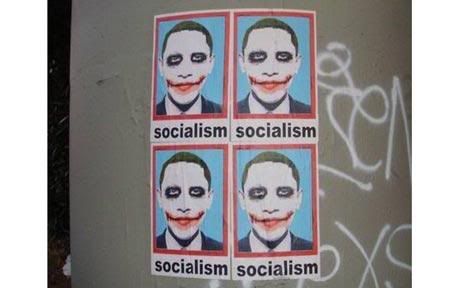
The mania about socialism has gripped America as the Obama administration reveals its true colours – mostly red, of course. A witty poster that has surfaced lately made a brilliant connection:


The Joker and socialism. Who would've thought of that? And Batman is Republican, of course. Heck, he used some crazy tracking device that looked it like it came straight out of the Department of Homeland Security. Commie Joker and holy Repub Batman!

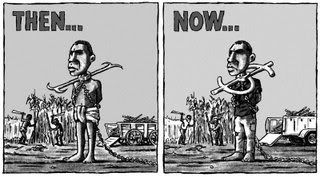
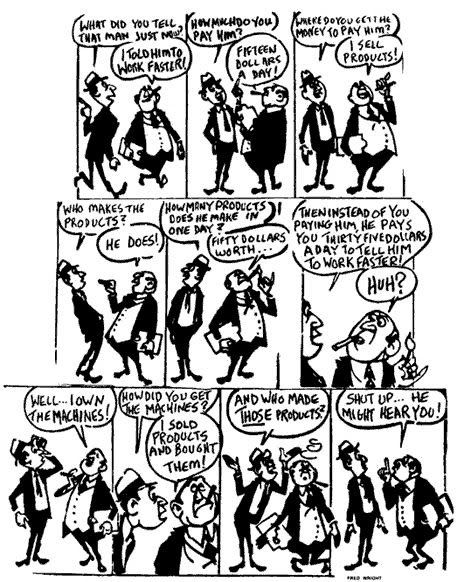
With every Joe Plumber screaming socialism whenever the Obama administration tries to expand federal regulatory powers, I decided to write a piece about socialism and what I think are socialist and what I think are not. Let me begin with an interesting cartoon:

That cartoon is very good because it encapsulates some of the fundamentals of Marxist ideas, which no doubt serve as the spring board for, if not the foundation of, socialism. So keeping it in mind, I shall offer my take on what socialism is about. It is broadly based on my own study of Marx's Capital, which is a key text in Marxist thought.


Marxism is a critique of political economy, and it is a radical one because it demonstrates ad hominem, or the characteristic of being directed towards the human subject. In Marx's words:

Theory is capable of gripping the masses as soon as it demonstrates ad hominem, and it demonstrates ad hominem as soon as it becomes radical. To be radical is to grasp the root of the matter. But, for man, the root is man himself.

Marx argued that the world of political economy is a topsy-turvy world, where economic categories and laws, which are created by man, have enslaved man and replaced him as the foci of socio-economic activity. And instead of the actual use that we have for the things we produce (i.e. focusing on our needs), we are much more concerned by how much they are valued relative to other things (i.e. focusing on the market and its operations).

This is commodification of things. Next comes the commodification of labour. Labour has a use – to produce commodities. It is bought and sold in the labour market. The value by which it goes (the wage) is not the same as the use value that the capitalist who buys it gets. The commodities that a worker produces are usually worth more in the market than the wage that the worker earns for his efforts. This creates surplus value or profit, which the capitalist enjoys.

Now, there are many reasons why this happens, and they are well covered by economics. But I contend that the Marxist critique still holds great truth. We are very focused on the intricate workings of the market, on the value of things when we exchange them, and we often lose sight of the thing behind it all – the man, who has needs, whose labour creates the commodities that are sold on the market. The subject without who nothing at all would matter because we cease to exist, since we are the subject ourselves or, failing that, because without them all economic activity would never have begun.

As I see it, a major contention is then on whether the capitalist plays a necessary role in economic activity. But even if we disagree on that issue, I think there is enough reason to pay attention to the rights of the average worker. What is the human world about but human beings? And the vast majority of human beings are not really capitalists – they still have to sell their labour to earn their wages for a living. And in this huge group of people we must include those who do not even earn wages but who, nevertheless, play important roles in human society: mothers/fathers, stay-home wives/husbands, unpaid social workers, students and children not yet in the workforce, etc.

Another big question is whether capitalism gives more than it takes. No doubt the world has gotten wealthier because of capitalism, despite the economic storms. But that is only to speak of the aggregate amount of wealth. Many people pay a heavy price each time the economy takes a hit due to man-made risks that they didn't personally take or have any control over. I think one of the things capitalism is about is rewarding risk-taking in the name of growth and development. But that should be balanced by the price that common people pay when things go awry. If risks must be taken, there must be something adequate for people to fall back on. Don't forget the common man.

I think that is the fundamental principle of socialism – the return to man. And this is why things such as universal healthcare, free or affordable education and minimum wage laws are pretty solidly socialist. Anything that violates or ignores this principle can hardly be called socialist, and things that are not necessarily based on this principle are not necessarily socialist. As such,
  • Regulation is not necessarily socialist
And, by extension, neither is big government. Plenty of Marxists are libertarian in that they see government and bureaucracy as instruments for the entrenchment of the wealthy minority. They believe in the socialist principle like their statist cousins, but they are very wary of vast and powerful governing apparatuses that can be appropriated by certain interests, and which present a strong resistance to social change from the ground up.

Besides, regulation is also significantly present in regular capitalism, and especially in non-socialist systems that emphasize control, such as Fascism.
  • Taxes are not necessarily socialist.
People all over the world pay taxes no matter what sort of system they live under, provided there is a functioning state and government.
  • High tax rates are not necessarily socialist.
Any system of social organisation can introduce high tax rates or many forms of taxes. For example, popular discontent over excessive taxation was one of the problems feudalistic monarchies had.
  • Labour unions are not necessarily socialist.
This might be more controversial. Labour unions are a very socialist idea, yes, but they can and have been hijacked by vested interests. The funniest ones are those whose leaders are appointed by the businesses whose interests they are supposed to keep in check for the benefit of the workers.
  • Obama is not socialist.
His focus is on Hope and Change, but, from the point of view of socialism, it's not very clear who has the hope or what change is in order. Most socialists would probably not count him as one of them.

I'm sure there are many more things that can be added, but this short list will have to do for this short write up. I hope, however, that I have provided a tool with which one can assess whether a policy could be regarded as socialist.


Maybe some people are just born with it, y'know – that enthusiasm that follows them wherever they go. It seems as if they're about to find a pot of gold at the next turning. Well, good for them. I think it's great. But sometimes we gotta wonder if it's true. After all some of us don't find the pill-popping sort of happiness all that worthwhile.

It's another slow day today, and with it comes too much opportunity to think. I grew up here, but increasingly I find that this place feels less and less like home. Whatever reason I have to be here seems to decay with each passing year or even month, and the result is I don't feel like I belong anywhere now.

Alienation (remember Brecht?). With such a sentiment pervading my thoughts, I find imperative to recall some things I learned over the course of the past year or so. The wonderful thing, I think, about my education is how I don't simply learn about particular subjects. In fact, I'd say that I'm neither a good philosophy student, a good politics student nor (especially) a good economics student. It's shaping up to be something like the professional toilet that is the Liberal Arts. I realise that its legacy will be how I think and how I am – and those will probably be the keys to the future.

And a great truth that I learned from many of the books I read and the lessons I had is our alienation from ourselves and our surroundings. Apt enough considering my present situation. Who are we and why are we here? These aren't questions that common wisdom devotes a lot of attention to. It is said that where there's a will there's a way. But Schopenhauer and the Buddhists taught that where there's will there's suffering. How well do we know ourselves and our purpose? And, consequently, do we act accordingly?

I will offer no other purpose here other than to be happy. Perhaps, to be more precise, to be eudaimon. What are we doing to achieve that end? Or, perhaps more pertinently, why do we do what we are doing now? Is it in accordance with our purpose? And do we really understand ourselves when we make decisions?

For that matter, I think we might never. But the first step is to recognise that we don't, to realise that we are our own worst enemy, that we have to constantly struggle against ourselves to achieve our purpose. The first step to finding our way is to realise that we're lost – as individuals and as a whole society. Our situation is expressly disconcerting. That is why I am a pessimist.

And here we return to the question of why. Knowing that we're often misguided, we must ask ourselves why we do what we do. Why do we desire this and that? Why do we work? Why do we spend? What is our reason for doing something? Is that really our purpose?

Do we really want this and that?

If people ask themselves why, they probably wouldn't be building a few more shopping malls with the same bunch of shops. They probably wouldn't be working hard to pay credit card bills for things they don't need.

Why are we letting others tell us what we want, what our purpose is? Why do we just listen to people who tell us what exactly we have to do to achieve our purpose? "Buy this and life will be perfect." As the Marxist critique suggests, why do we care so much about the exchange or the relative value of things and so little about what use we really have for them?

Maybe we find that we do want something. Then we should ask ourselves why as well. Does wanting something make us happy, or does it make us miserable? As we must sometimes not listen to others, we must sometimes not listen to ourselves. As I said, we are fighting against ourselves, struggling with our own will. Learning to let go is as important as learning to be determined.

But the good news is we don't have to renounce the world or our will. As long as we realise our purpose and constantly ask ourselves whether what we do is in accordance with it, we don't have to be constantly lost.

And, on the other hand, realising our purpose also changes how we choose to see things. The truth is nothing to celebrate about, but we don't have to crushed by it. We can nevertheless celebrate life, appreciate the things in it, big and small. We can transcend the bleak world of things by understanding it and choosing to see the good that it contains. Thus we would overcome our pitiful selves, who are slaves to the topsy-turvy world – we become Übermenschen.

The right way lies in the combination of understanding reality and celebrating what we have as per our purpose; in living in our time, understanding its fatal flaws and working towards a better future. This sounds almost like it's coming from a good Hegelian man. That is why I am optimistic.