Padd Solutions

Converted by Falcon Hive

Showing posts with label religion. Show all posts

Some people claim to appreciate creation, but they don't seem to grasp just how vast the universe is. 

Our awesome sun, the local star, is about as large as 1.3 million Earths. There are about 300 billion stars in our galaxy, the Milky Way. There are at least one hundred billion galaxies in the observable universe. 

Is it likely that amidst all of this, we are the only sapient beings to have ever graced the universe? Isn't it simply cosmic arrogance to assume that there's one creator who made all of this just for us? That this creator babysits us and personally tends to our every need? And that he has an enemy, an antithesis, who attacks us personally? 

I think that's a laugh. 

That is not to say that secular thought escapes this problem. Since the Enlightenment, secularism is still plagued with the idea that humanity is the pinnacle of all life, which has partly resulted in our modern psychology of extreme socioeconomic (and sociopathic) narcissism.

How I wish I lived a thousand or a few thousand years from now, when we have finally learned that such thinking is follywhen we have discovered greater secrets of the universe that allows us to grasp, once and for all, that it is false. That spirit of discovery, the willingness to learn things that are beyond the scope of our everyday lives, would seem to be both the proper spiritual and scientific attitude.

Is that even conceivable to those for whom the End is always nigh? To even speak of a thousand years from now in front of some would appear to be heresy. As heliocentrism perhaps was a long time ago in an age far, far away.


I think I've had just about enough.

Often, people believe lies because they like the sound of them. It has been said that our minds are hardwired to look for patterns, even where there are none. In addition, we lock on to some of these patterns and superimpose them on things that we subsequently see. We let preconceived notions determine how we experience the world.

Certainly, such phenomena are not necessarily bad; to some extent they may even be important in helping us make sense of the world. At the same time, however, they lead us to all kinds of falsehood by making us insensitive to our actual experiences. They impose a mental processing system by which we make sense of and even twist these experiences to suit our preconceived notions.

The genius philosopher Wittgenstein devoted part of his life's work to quashing traditional philosophical thinking that falls into such a pattern. To quote a recent New York Times article on the subject:
..the non-empirical (“armchair”) character of philosophical investigation—its focus on conceptual truth—is in tension with [the goal of discovering actual truth].  That’s because our concepts exhibit a highly theory-resistant complexity and variability. They evolved, not for the sake of science and its objectives, but rather in order to cater to the interacting contingencies of our nature, our culture, our environment, our communicative needs and our other purposes.
Letting premade concepts filter our experience can inure us to authentic experiencing, compelling us into thinking that our experiences conform to those concepts. I believe that this is what makes people automatically assume that there is a god and that certain experiences are divine and must have had certain effects. It's what makes people believe in miracles that can happen any time they want. 


The scientific-minded may just cite the lack of conclusive evidence for the occurrence of miracles, but this objection goes beyond that. It highlights how we, fundamentally, look at the world around us in an inauthentic way and why we are capable of seizing upon lies and integrating them into our reality. It demystifies what is at once an act of cosmic arrogance and wilful ignorance. 

And the most egregious cases of this act are what I just can't stand anymore.

Child's play

@ 15:54 , , , 0 comments


Luck is superstition—at least when it suggests the existence of a god in the machine, a capricious supernatural force that determines one's fortunes. That said, luck could be a descriptive term, merely used in reference to circumstances that are perceived to be out of one's control. The first kind of luck, a prescriptive understanding of luck, should rationally be relegated to the level of superstition.

But what about the work of providence, or what people often call blessings? How much stock can we really put into that concept in our everyday lives?

It is convenient and perhaps sometimes truly beneficial to claim that, yes, one is specifically blessed in a particular matter. But here too a distinction needs to be made between a descriptive use of the word and a prescriptive one. A descriptive use could, for example, be meant to express gratitude. A prescriptive use of it would, however, go further in implicitly claiming, in a definitive way, that one is indeed personally helped by a higher power in a particular instance.

Such a claim probably stems from a desire to feel that one's every want and need is taken care of by a higher power, or that one has direct access to or a favour-based personal relationship with a deity.  

I find such notions as presumptuous or childish as they sound. Our desires don't simply translate into reality. And if we accept that a higher power exists, and that this power deserves our devotion, the appropriate attitude would be subordinate our needs and wants to its will. Even trying to think up a win-win scenario strikes me as being arrogant and wrong.

However, just as many believe in luck as a metaphysical force, so do many believers subscribe to the idea that God blesses them in every human and banal matter that they are concerned with. I think that is a very simplistic expression of faith, one that resembles young children's belief in Santa Claus or in their parents' unfailing ability to grant their every wish. I think we need to grow up from such notions and learn to find faith that does not need constant reassurance.


Watching Spielberg's Lincoln feels at first like watching a distant, momentous time–a time from which our banal modern lives with its host of "First World problems" are far removed.

But then I realised that there are still freedoms to fight for today, and in Singapore some of those are gay rights. There is still a law against homosexuality in Singapore which stands for an unwarranted intrusion of the state into people's private lives. And there is still significant support for that law, especially among the religious. To put it simply, these people are wrong; I'll tell you why.

Firstly, those who support the law are unable to give good evidence that the repeal of such a law would negatively affect society in any significant way. Why would it deprive any groups of rights when it actually helps a currently marginalised group? Do people have a right to ban something they don't like? And how would it destroy the family structure? Would birth rates decline significantly if homosexuality is no longer illegal? Or would it simply cause more people to lead immoral lives?

This last question is really the crux of the matter–those people have a moral objection to homosexuality. That's alright, but what makes homosexuality so special that they want to prohibit it by law? Why do they not seek to ban other sins such as gambling, prostitution or binge drinking with the same vigour and vociferousness?

Conservatives tend to put some stock in the ideas of personal responsibility and self-control. And where sins do not cause direct harm to others, they don't like to advocate such sweeping legal interventions as outright bans. However, the same position is not adopted towards homosexuality, and thus their opinion on its legality seems out of character and even irrational.

Moreover, it's foolish to insist on imposing your faith-based moral code on the legal system. Far from being a dirty word, the notion of secularism should, in law and in politics, be upheld by religious groups. Pluralism is bound up with secularism, for without the latter, a dominant religious group could persecute other groups. For example, Islamic countries may try to forbid or restrict Christian worship. A non-secular system would only benefit whichever group happens to be the most powerful. Thus, and thinking about fellow believers who are persecuted in other parts of the world, how could the religious fail to uphold secularism?

The bottom line is religion should not be brought into the debate about the law. At the same time, the non-religious arguments for keeping the ban have so far been unable to go beyond baseless talking points and wild theories about the consequences the law's repeal. Without good arguments backed by solid empirical evidence, there is simply no case for criminalising a whole swath of the population over their private choices.


Maybe this is why one should not simply inflict the world upon a potential life.

Everyday people are born, persons of flesh and blood who live and die by their physical bodies. But men of God teach that the flesh is vulgar; and some believe them. They believe that we should live not for this world, but for the next.

Think about the children born to people who hold such beliefs. From a young age they are taught that the world is a vulgar place, from whose vulgarity they need to be insulated. The unbelievers, people who are worldly and are therefore vulgar should hence be kept at arm's length. On the other hand, there are safe places filled with people who think like them, places on which divine grace shines in a special manner. These children are to grow up within the circles found there, and they are to beget children within those circles when they have grown up.

This may indeed turn out to be the good life for some of them. For a few, however, the mixture of such teachings and a dash of naivety might result in lives that are worse off.

Experience might indicate that such beliefs need to be re-examined. People may not prove to be necessarily vulgar, or men of God might prove to be just as vulgar. Or perhaps the term vulgar itself has to be re-evaluated. Yet for some of these children, naivety may prevent them from adjusting their expectations according to the reality that they experience. They were taught to insulate themselves, and in the course of their formative years they isolate themselves.

A further subgroup of them might grow up relatively oblivious to the problem that they are facing, or they might remain nevertheless firmly entrenched in the beliefs they have been taught. Others, however, might realise that the task of living has been made more difficult. Having being taught to look forward to another world, they know little about how to live in this one.

Then they begin to doubt. They question what they have been taught and why it brings them pain. What good is it to gain the world but lose one's soul, one might ask? At this rate, some of those children can gain neither. If souls actually exist, that is—we know the world exists from experience, but the existence of souls is not so clear.

So what can be done to prevent this scenario? Maybe we should worry about what happens in this life first. Or maybe we should not simply seek to propagate our beliefs through our children's lives—that should be written into a contract that parents-to-be should be made to sign.


If it is true that we are all free, why do we consistently choose what is bad? Why does participation not lead to quality in society?

This is a question that Christianity asks in order to call to our attention true freedom in God, free of enslavement and of human weakness, which causes us to be unable to choose anything but the slavery of sin. Unfortunately, Christianity cannot be divine because it is tainted by human beings. Thus we are left to ask questions on our own, as the Church Fathers did.

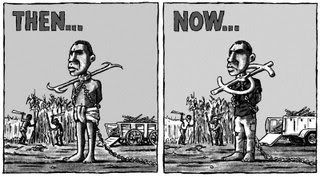
Does choosing to be slaves imply freedom? Some might say yes. This absurdity and contradiction comes about through two main threads of human thought: Libertarianism and relativism gone mad. The first posits that human agency is so absolute that human beings can, if they so choose, lose it. The second would have us believe that anything can be good to someone—perhaps some people choose to be slaves because they want to be slaves, perceiving slavery as a good? Or perhaps there is no good at all, only preferences, in which case we might as well be nihilists.

Marxist thought, on the other hand, offers a human solution to this puzzle. In our apparent freedom, we perpetually choose to be unfree because of false consciousness. We are not attuned to our real interests, and therefore we choose what is bad by first allowing our freedom to be subverted in letting powerful groups tell us what we want.

"We are free to choose," they say, as they readily queue up for the next Apple product like the hungry for bread.

It is probably true that to some extent preferences are negotiated. The industries give us what we want while trying to mould our tastes to further their own interests. But, if this picture allows neither side to wield near-absolute power, why does the reality feel so stunted? Why does a relatively free market not produce the promised creativity? Why does the UK publishing industry, for example, only publish what appeals to lowest common denominators, what will attract by virtue of its harlot-like easiness?

Why can we not, for the most part, refuse the bad?

Either we are extremely stupid as free beings, or we are not truly free. I choose to believe the latter.

The fact is we are not free as long as we are enslaved by uncompromisingly non-objective conceptions of the good, or by false notions about freedom. And this is something we as free beings are responsible for—we are guilty of enslaving ourselves through our own ways of thinking.

Some scholars are quite dismissive of the Frankfurt School, thinking it an artefact of a bygone age, while they indulge in blissful proclamations about an age of freedom and choice brought about by technologies they hardly know themselves. They study every petty whim of society and profess to find all that is good with the universe in Coronation Street.

But, far from dissipating, power merely grows ever more subtle in its application. The Frankfurt School is not wrong. It has just become less easy to see what they criticised in their time.

A God delusion?

@ 10:42 , , 0 comments


I suppose this is covered by the law of economy.


But let's not talk logic here. Let's speak intuitively, so that our hearts and minds can truly engage with the issue. So this is now an existential question: Is there a 'why' in the grand scheme of things?

When I sit and listen to a sermon in a church, I am often treated to a theistic perspective of the universe. On the face of it, that seems fine. If we are honestly agnostic, a theistic perspective cannot simply be discounted.

But it gets very complex. In the Christian perspective, God has a very elaborate plan for the universe and our souls. Moreover, how this plan relates to our everyday lives is rather obscure. Hence the many books needed to explain it—and even then we are often left wondering. "Well, God's ways are sometimes hidden to us," we are told.

I'm skeptical. It seems to me that centuries of (both Jewish and Christian) doctrinal issues and debate have created a worldview with many—probably fragile—moving parts. And we don't even need to get into differences between sects and denominations.

Looking at it from the outside, it seems that the only way someone can comfortably accept such a tangle of 'truths' is if one is already primed to accept it—if one is, for prior personal reasons, already willing to accept the faith. Or, in Christian parlance, if the Holy Spirit has opened one's heart.

I see what you did there.

So even in a matter of faith existence precedes essence—the existence of the desire comes before the meaty stuff that concerns the truth of it.

And therefore, if we are skeptical of a cosmological plan, especially a very complex one, we'd probably make the same observation about the universe. There is no 'why'; it simply exists as it is. The whys belong to the domain of human beings. It is our fate and our prerogative.


I guess there is comfort in thinking that there is a grand architect, a Divine Provider who guides us. Well, it's not an unacceptable notion. I just wonder if it has to come with the incredible complexity that organised religion tends to construct.

David's Sling

@ 01:34 , , 0 comments


It's the small things that sometimes trip up the giant.


For big problems, there are big answers. In the case of arguments against theism, for example, there is the problem of evil, which many theologians have spent much time answering. Whether or not they succeed entirely is quite beside the point here. The fact that there are substantial answers would suffice to keep theism afloat.

For small problems, however, the big answers often can't fit. Or they might simply be unable to cover every small problem.

Let's consider the notion of intelligent design. Why would there be any great imperfection (such as the existence of suffering) in the world if it was designed by an all-powerful and benevolent God? Well, a Christian might answer, God has a plan—perhaps we need to experience these large imperfections in order to grow spiritually.

But let's take a small problem. Let's say we ask why many of us continue (long after our less evolved ancestors) to grow extra teeth when our jaws might be too small to accommodate them. Would it not be absurd to say, as the answer to such a question, that "God has a plan" or that "It is because we have fallen into sin"?

To give a big answer to such a small problem would indeed strike most people as ridiculous. God planned human beings' teeth issues so that they would grow spiritually? This problem is a consequence or perhaps a punishment for falling into sin?

I suspect, therefore, that most believers would, owing to its lack of magnitude, simply shrug the problem off. However, it does not go away, and after we've accumulated enough of such problems we begin to build a strong case against intelligent design: If intelligent design is true, why do so many small imperfections exist that are clearly too trivial to serve a larger cosmic purpose?

You can't even neatly package some of these small problems as part of the larger problem of suffering—a major flaw can exist by design, but the existence of many small disconnected flaws can only point to carelessness or the lack of deliberation. The meaning of 'intelligent' would thereby become lost if one still insists that intelligent design is true regardless.

So, ultimately, a cosmic scheme involving a deity with a plan simply isn't good at coming up with explanations for small factual phenomena; although it's always tentative, science can.


The question of religious faith is something very difficult to untangle in a coherent manner. And I address it despite warnings from within and without. One would hope that this question can be addressed without evoking judgemental reactions, but I don't know if that is possible. I think the best thing I can do is to be as non-judgemental as possible on my own part. And so I write this, as I had written my previous entry, with the caveat that this is what I think without claiming that it is necessarily true. But, at the same time, in support of what I'm writing, I'd like to say that it is derived from years of experience interacting with believers (it's also worth mentioning here that my views might be more relevant to Christianity than any other faith, since the vast majority of my experiences are with it), as well as a fair measure of reasoning. In other words, I'm not doing this like Ronny Tan. And now that I've mentioned it, that's a good place to start.

I'm mildly amused by the reactions to the Ronny Tan incident in Singapore. The issue itself, however, is of little interest to me—I know evangelistic rhetoric well enough not to be surprised. The point is I see no reason why we should pay attention to some ignorant or dissembling provocateur. I mean, in a similar way, who cares about what Westboro Baptist Church says next? If these people are vested with authority in state institutional positions, then we can talk about them being irresponsible, as with the case of Thio Li Ann. Otherwise, if we think that something said from a pulpit we don't sit below is complete nonsense, the best thing to do is to ignore it. That doesn't mean it's not important to address mistaken beliefs propagated by such rubbish. That means we ought to focus on the underlying problem, not on the nonsense itself. Hence, all the righteous anger that has emerged in reaction to what was said only seems childish and misguided. It adds nothing valuable whatsoever.

And the underlying problem is what I'm going to be referring to here: The fact that religious faith seems to have become synonymous with opted ignorance.

Recently, I've come across a notion of God that I find very appealing: God is excellence
—and it isn't just referring to moral excellence. This implies that to be faithful followers we must try as best as possible to approximate God's perfect excellence. This is very interesting, but it also raises problems with religious faith and what it means to be faithful as we have encountered them.

Here is where I've been quite consistently disappointed by the religious community. I've met quite a few perfectly decent and intelligent people who say ridiculous things that are patently false simply because their worldview is coloured by their unquestioned beliefs. Even amongst congregations that profess to be intellectually inclined, I'm seldom ever impressed by the actual intellectual capabilities of their members. They may know their apologetics and hermeneutics very well, but they know very little about things outside their religious framework. And a good part of the reason for this is they don't see external knowledge as anything near as valuable as knowledge acquired within the faith. In other words, they are relatively dismissive of a vast amount of existing knowledge, things that could make the positions they have learned untenable (and many of them don't want to know it precisely because they are afraid of this).

I don't mean to say that believers are necessarily ignorant. Certainly, I'm not young enough to know everything either. However, I'm quite willing to learn from anything. And that is what I mean by intellectual capabilities: The unrestricted willingness to learn and the products of that willingness. Even many of the believers who are actively engaged in the pursuit of knowledge are unable to achieve this. Their pursuit of knowledge is frequently channelled by their religious sympathies, directed towards some things that conform to their beliefs and away from others that do not. And this tendency is even couched in moral terms—basically, hear no evil.

Now, I might be accused of having too much faith, ironically, in the ability of human reason to divine the truth. Of course, human minds are not perfect. But this doesn't mean reason flies out of the window. As a scholar during the Enlightenment might say, God gave us a brain, so we should use it. Indeed, even speaking within the religious framework, when people talk glowingly about the "leap of faith", I'm not sure they know what they're talking about. They are often unaware that the concept is not such a central part of established Christian schools of thought. There is plenty of emphasis on reason and rationality, which, I should add, is why people traditionally asked for signs; they wanted evidence, and the desire for evidence to support your beliefs is manifestly rational.

Similarly, when some believers talk about concepts such as "spiritual war", they are unaware that the notion borders on the heretical. And it's bad enough that believers don't know enough about their own theology, there are some groups that have virtually no theological grounding! Thus, the problem of intellectual inexcellence constitutes a vast malady amongst believers—that of a lack of inquisitiveness. They are content to be told what they like to hear and to be told that they like to hear it. And this is supposedly justified by the concept of faith or "simple faith".

One might say that that's true for any system of beliefs. But you could change your political views, for example, and it might not cost you anything. On the other hand, if you're convinced that the matter concerns your immortal soul, the equation changes.

To be fair, I've known a few believers whom I respect greatly. However, these people seem to be rare exceptions, and that is why I'm not sure whether one can be religious and be open-minded at the same time. It's a fine balance, and even the most excellence-oriented believer is quite likely to trip up. After all, if there are two things that might be true and they contradict each other, you'd simply lean towards whichever one your faith dictates.

So, as Kierkegaard was, I am sceptical towards the idea of congregations or indeed of organised religion. If a community of believers is supposed to help you nurture your faith, it certainly hasn't done mine any favours with what I've seen; so what's the point? Unlike Kierkegaard, however, I'm not willing to make the leap of faith. My willingness to learn seems to overcome that.


What I'm going to talk about this time is certainly a controversial topic. And I think must state clearly that this is my opinion. I don't like saying that because I don't like how opinions are commonly regarded (i.e. as either equally right or equally wrong). But as I cannot claim to have a very informed opinion on this matter, it's better to be humble when there's reason to be, isn't it?

Recently, France has moved towards partially banning the burqa in public places. Of course this has provoked both outrage and approval, often across traditional political lines. I'm not exactly going to take a side on this issue, since my own position straddles both sides of the debate somewhat. I think that this is not a good move, especially with how it has been portrayed by its proponents—I'm not a fan of European views on foreign cultures and integration. However, I don't agree with those who say that this is a clear violation of the freedom of conscience as I disagree that the veil is Islamic.

And I say that because I have a generally positive view of Islam, which can be more progressive than Christianity in issues of social justice (as the Christian conservative majority seeks to prove daily). The notion of an Islamic veil, therefore, sits uncomfortably with me.

Ultimately, the argument boils down to whether hadiths should be seen as binding and what implications this has on one's faith and devotion. In the article, an imam answers the former in the negative, stating there is nothing in the Quran that directs women to cover their faces. And I agree with him. I think that Islam is primarily based on the Quran and that hadiths, as a secondary source on the words and deeds of the Prophet, are a matter of tradition. Thus, I don't think they can be binding, and they should certainly not reflect on the strength of one's faith and devotion.

However, as a more detailed treatment of Islamic doctrine is beyond my ability, I shall offer a logical and ethical argument for this view. There are, I'm sure, many practices based on religious traditions that are uncontroversially disallowed in modern societies. Female genital mutilation is one good example. Of course, not all of them are based on such an old and supposedly weighty set of traditions. But if an ancient and important religious authority did prescribe the practice of female genital mutilation, does that make it more acceptable? (Of course, this question presumes at least some degree of moral realism; I am assuming that we don't think something is right just because people think that it is, or that moral statements merely reflect our emotions)

I also find it disturbing that people are using the notion of freedom to support repressive ideas and practices. Is the veil even really worn for the purposes of modesty today? Cultural norms have changed, and I think the only reason why the veil remains in a lot of places is the patriarchal traditions that some Muslims subscribe to. Besides, if it is about modesty, why do men not wear it as well?

The only good thing that I've heard about it (found here) is that it potentially renders the issue of female looks irrelevant to career prospects in jobs that don't technically require good looks. However, communities that place great importance on it also don't tend to value women's education and work as much as men's. That certainly has implications on the notion that it serves as a gender equaliser.

And as with any other issue, to shout about freedom in arguing for the acceptance of repressive things is inherently contradictory. The logical conclusion of such a view would be akin to the extreme libertarian view, as espoused by Robert Nozick, that someone is free to sell him/herself into slavery. The contradiction in such a line of thinking should be clear, and if we subscribe to the notion of fundamental rights we cannot at the same time think that people can give them up. If that is the case, they wouldn't be 'fundamental'; the argument is thus self-defeating.

Hence, also noting that the ban is after all only partial, I disagree with a lot of the criticisms of this move. But, having said that, I do think that it is misguided in the way it has been conceived and recommended. Even if equality is to be merely paid lip-service, the legislation shouldn't have been expressly aimed at Muslims. Otherwise, it sends a message that xenophobia plays a part in the decision. And if you like to think in slippery slopes, you can imagine what sort of precedent this might set on the issue of integration.