Padd Solutions

Converted by Falcon Hive

Showing posts with label politics. Show all posts

This post is a political commentary I wrote as the editor of sociopolitical site Inconvenient Questions. It also appeared on Yahoo News.

----------

Asking unhappy people to leave is a favourite debating tactic of some Singaporeans. If you care about Singapore, however, such an approach is ultimately counterproductive. It also goes against the grain of the Government’s current approach towards Singaporeans moving overseas.

That line above or something similar is what you would invariably see if you read enough comments about local issues on social media. It is the rebuttal of choice of some ‘patriots’, wielded against critics who are unhappy about one thing or another in this country.

Admittedly, the lure of greener pastures can be very tempting and many Singaporeans appear to think so. In a survey conducted in 2012, more than half of Singaporeans (56%, to be exact) say they would migrate if given a choice.

One could jump through hoops to explain away this result, or even question the credibility of the survey. But while it is debateable whether or not the majority of Singaporeans are really unhappy here, such a statistic should concern those who care about the future of our country. After all, what is left of a country when most of its people are no longer willing to stay?

This issue of commitment is even more salient for countries like ours that rely on regular citizens to maintain its security. Singapore’s deterrent against foreign aggression depends in large part on its relatively large reserve force comprising Singaporeans who have been called up for National Service. If we are not committed to defending the country when the need arises, the result could be disastrous. Thus, it is vital that Singaporeans of all stripes remain invested in the fate of our nation.

Hence, telling people to leave if they are unhappy is not a forward-thinking approach for those who really care about Singapore’s future. What any true patriot should be doing instead is to ask how they can keep as many Singaporeans as possible interested in, and engaged with, the country’s progress.


Abraham Lincoln once famously said, “A house divided against itself cannot stand.” (Photo: Wes Dickinson)

But there is another problem with asking people to leave: It also goes against the spirit of Government policy towards the issue of Singaporeans moving out.

In a recent trip to New York, Prime Minister Lee Hsien Loong met with overseas Singaporeans there and told them to “Keep in touch with home, keep in touch with us… and one day come back home to Singapore.” His gentle exhortation is a long way away from then Prime Minister Goh Chok Tong’s rebuke – almost 15 years ago – calling some overseas Singaporeans “quitters”.  This new approach indicates that the Government is keen not on pushing Singaporeans out and cutting off ties, but on having us remain emotionally invested in our country even if we leave.

Indeed, the Government’s Overseas Singaporean Unit works with other agencies such as Contact Singapore to ensure that overseas Singaporeans are kept engaged. Considering that our Government has such a rational approach towards keeping Singaporeans as close to the country as possible – if not physically, then at least emotionally – should this not be supported by those who truly believe in the Government’s wisdom?

Finally, equality, a value that is mentioned in our national pledge, means everyone’s voice carries weight – even if you vehemently disagree with what some people say. Asking people to leave if they are unhappy is to deny that their voice matters and is therefore a rejection of equality. No matter how one looks at it, that cannot be the right or productive approach.

It must be said that political discussions among Singaporeans might not become much more rational or less acrimonious than they are now. Nevertheless, it is still better to talk to those who disagree than to ask them to get out of the country. After all, if there is no one left to debate politics and policies with, Singapore will probably be the poorer for it.
This post is a political commentary I wrote as the editor of sociopolitical site Inconvenient Questions. It also appeared on Yahoo News.

----------

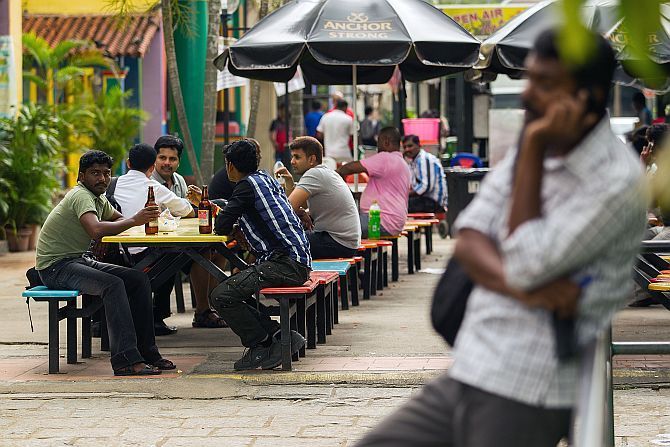
The furore following Member of Parliament Denise Phua’s statement describing congregations of foreign workers as “walking time-bombs” reflects Singapore’s ambivalence towards the presence of foreigners. Representing her constituency of Jalan Besar, Ms Phua had proposed fencing off communal areas to keep foreign workers out, no doubt in response to concerns from local citizens. While our society needs the services of foreign workers, many Singaporeans are uneasy about the impact of their influx on matters ranging from safety to the condition of local culture.

So where do we go from here? To start with, perhaps it would be useful look at the example of the most well-known immigrant society of all – The United States of America.

A hundred years ago, immigrants first arriving at New York City would have disembarked in full view of the Statue of Liberty, a monument that Franklin D. Roosevelt honoured in 1936 as an icon of immigration. Today, 80 years later, aspiring American presidential candidate Donald Trump is able to capitalise on a groundswell of discontent with immigration for his campaign.

How did a nation of immigrants and the richest country in the world end up with this much disdain for something that lies at the foundation of its society?

The truth is (new) immigration has always been an issue among the American public. Recent immigrants have often been looked at as a threat to American values. If this sounds familiar to us in Singapore, that would be because the theme of cultural difference is universal. And, just as ironically, we too are a nation built on immigration.

By now, multiracialism and multiculturalism are no longer radical ideas. Yet many modern societies are struggling with the question of immigration, a perennial issue punctuated by shocks such as terrorism and the influx of refugees. In Singapore, where a nation of millions must live together in a tight space, this question is perhaps even more salient. Can our society handle large numbers of immigrants?

With the non-resident population making up slightly more than a quarter of the total population, Singaporeans are naturally concerned about the competition for jobs, the erosion of national identity and overcrowding. As the arrest of 27 Bangladeshi workers under the ISA reminds us, there are also concerns about security and the threat of radicalised groups or criminals finding their way into the country.

Most of these problems could be seen as matters of governance, things that can perhaps be left to experts and officials. However, something that our penchant for hard-headed policymaking and planning alone cannot resolve is the issue of Singapore’s culture and identity. We need to decide as a society what our culture and identity will look like in the coming decades, and this is a process that has no correct answers.


Foreign workers enjoying their break in Little India. (Photo: Nicky Loh)

There are three distinct paths that we can go down. One is the American ‘melting pot’ model of conflict and natural assimilation: There is little or no government intervention and immigrants are left to form self-reliant enclaves. Historically, these groups were often hostile to each other and to the ‘locals’, even spawning violent gangs that featured notorious characters such as Al Capone. Only after generations did these groups eventually assimilate into American society, becoming part of the tapestry of American culture with contributions such as Italian American cuisine and common Yiddish loanwords like ‘chutzpah’.

This path is the least likely to be deliberately chosen in Singapore due to our size and perceived vulnerability to any social instability or disharmony that might result.

The second way is to define what Singaporean culture and identity are and use them as benchmarks for ‘Singaporeanness’ in assimilating immigrants. This could be done by returning to classic or mythologised ideas of what it means to be Singaporean or by synthesising those ideas today. There is a tendency for members of the public to engage in this when they treat qualities such as the ability to speak Singlish correctly as identity markers and yardsticks for ‘Singaporeanness’. Similarly, when Member of Parliament Darryl David proposed that English proficiency should be a criterion for citizenship, he was essentially advocating the same path.

While it might be the most intuitive method for many Singaporeans, this path is also likely to be exclusionary as it sets a high bar for assimilation for immigrants, many of whom come from cultures that are very different from ours. If integration is a goal, this method might even make the process more difficult.

The third path is to include immigrants’ culture as part of a new and evolving Singaporean identity. This would entail fusing elements of the different cultures with local Singapore culture to create an inclusive model. For example, local languages and Singlish could expand to include Mainland Chinese, Filipino or Bangladeshi words, while food from the different immigrant communities could be included as staples of local cuisine.

From the perspective of integration, this would be the easiest path as it allows immigrants to retain their identity to some extent and feel a sense of familiarity towards local culture. However, in practice, it would likely encounter difficulties arising from resentment among local Singaporeans, many of whom might feel that the local culture is being watered down.

In the end, the likelihood is no matter how we go about trying to resolve the question of our culture and identity, our approach will end up being an amalgamation of these three paths. Nonetheless, one of them will likely be the dominant path, and that will determine much of what our sense of community and social fabric will be like in the decades to come.

With so many things that are happening and that have happened, I've decided to fire up my blog again.

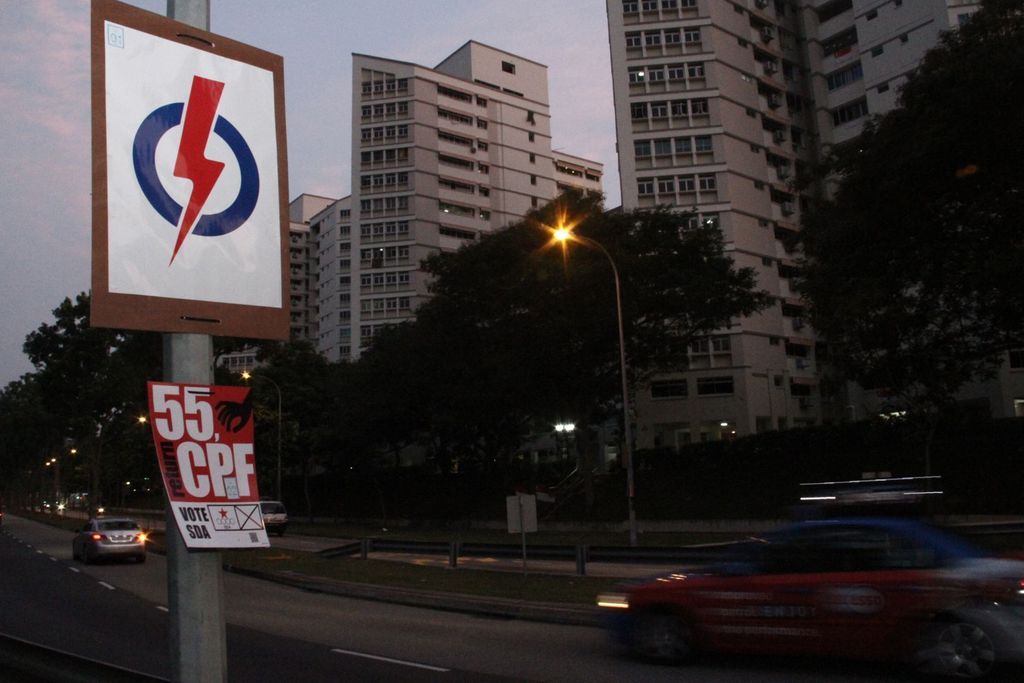
Singapore is going into election day, and the media has been abuzz with election-related news and discussions. The parties in the opposition have received unprecedentedly positive attention this election cycle, and the role of social media in contemporary politics is undoubtedly the primary contributing factor.

My social media is full of messages in support of the opposition, although there certainly are enough supporters of the ruling party as well (especially the wealthier, conservative or typically apolitical people). It actually seems to have become quite a norm. And judging from the attendance at the opposition rallies, the sentiment on the ground is also pretty warm.

I think Singapore politics will see exciting days ahead. Like it or not, we are seeing a trend where we can expect more successful politicians to be those who have their ears closer to the ground. There are more debates among the public, and politicians of all stripes will have to be responsive to public sentiment, balancing traditional rationality with an appeal to citizens' passions.

But unlike conservative ideologues in Singapore, I will not hasten to trot out the label 'populism' here, because responsiveness and accountability to the electorate is part and parcel of a democratic system. 

Too often, modern audiences are fixated on procedural democracy—on the process of holding elections—as well as on the representative part of democracy. However, the traditional idea of democracy was not usually limited to having an elected aristocracy. In democratic thinking, the people are meant to have a say in how they are governed. There is populism, and then there is democracy; the latter does not necessarily translate to the former just because one party no longer has a free hand to rule as they see fit.

Understandably, many in Singapore will feel some trepidation about the opening of the floodgates. Are we as a society ready for the full democratic experience? Will we be able to maintain current levels of prosperity when the ruling party no longer dominates local politics with impunity?

No matter who is in charge, the future will remain uncertain. As the financiers say, past success is not indicative of future performance. For now, it's time to prepare ourselves for societal change.


Watching Spielberg's Lincoln feels at first like watching a distant, momentous time–a time from which our banal modern lives with its host of "First World problems" are far removed.

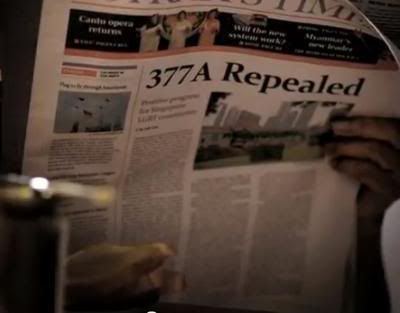
But then I realised that there are still freedoms to fight for today, and in Singapore some of those are gay rights. There is still a law against homosexuality in Singapore which stands for an unwarranted intrusion of the state into people's private lives. And there is still significant support for that law, especially among the religious. To put it simply, these people are wrong; I'll tell you why.

Firstly, those who support the law are unable to give good evidence that the repeal of such a law would negatively affect society in any significant way. Why would it deprive any groups of rights when it actually helps a currently marginalised group? Do people have a right to ban something they don't like? And how would it destroy the family structure? Would birth rates decline significantly if homosexuality is no longer illegal? Or would it simply cause more people to lead immoral lives?

This last question is really the crux of the matter–those people have a moral objection to homosexuality. That's alright, but what makes homosexuality so special that they want to prohibit it by law? Why do they not seek to ban other sins such as gambling, prostitution or binge drinking with the same vigour and vociferousness?

Conservatives tend to put some stock in the ideas of personal responsibility and self-control. And where sins do not cause direct harm to others, they don't like to advocate such sweeping legal interventions as outright bans. However, the same position is not adopted towards homosexuality, and thus their opinion on its legality seems out of character and even irrational.

Moreover, it's foolish to insist on imposing your faith-based moral code on the legal system. Far from being a dirty word, the notion of secularism should, in law and in politics, be upheld by religious groups. Pluralism is bound up with secularism, for without the latter, a dominant religious group could persecute other groups. For example, Islamic countries may try to forbid or restrict Christian worship. A non-secular system would only benefit whichever group happens to be the most powerful. Thus, and thinking about fellow believers who are persecuted in other parts of the world, how could the religious fail to uphold secularism?

The bottom line is religion should not be brought into the debate about the law. At the same time, the non-religious arguments for keeping the ban have so far been unable to go beyond baseless talking points and wild theories about the consequences the law's repeal. Without good arguments backed by solid empirical evidence, there is simply no case for criminalising a whole swath of the population over their private choices.


I'd finally gotten round to seeing The Dark Knight Rises last month, and, frankly, I enjoyed it. As such, although the film—like Nolan's other works—did not leave me with much of a lasting impression, I will not be too critical of it, acknowledging the film for what it is: An encapsulation of Hollywood at its flashiest.

Certainly, one may detect proto-fascist undertones in the film. The Dark Knight Rises tells us, after all, that raw violence and not money or influence is the ultimate source of power—Bruce Wayne's wealth and position may get him all his fancy gadgets, but he could not defeat Bane until he trained himself up physically and prevailed against his adversary in a slugging match.

Nevertheless, I will not go as far as to say that The Dark Knight Rises' politics are regressive or backward. For one, the film strikes me as partly an attempt to articulate a contemporary brand of political consciousness; although it does so in a traditional comic-book-hero fashion, hence the seemingly more backward elements in its symbolisms. The film's favouring of muscle power over sophisticated methods could, for example, simply be explained by the film's comic book roots.

The Batman of the Nolan films is also very much a traditional comic book hero. He is basically benevolent, despite his psychological scars and his initial motivation to seek vengeance. And he fights for a supposedly universal sense of justice while remaining outside of the political and legal systems. The latter is an especially important aspect in The Dark Knight Rises, and it has been given a contemporary twist: The legal and political system of Gotham are structurally unable to solve the city's serious crime problem, and it's thanks to the work of a vigilante hero that the city is saved—a narrative that banks heavily on today's post-crises distrust of traditional institutions.

But Batman isn't just Batman; he is also Bruce Wayne, whose wealth and technological expertise can save the world in their own right. How he uses or does not use them is bound to be interesting. And it turns out that he chooses not to use them except in aid of his role as the vigilante hero—all because of his fear that someone might misuse whatever technological marvel he came up with that could, on the other hand, have untold benefits for humankind.

Not only that, while fighting crime as Batman, the wealthy and powerful Bruce Wayne does little or nothing to transform the legal and political systems that are part of Gotham's problem. As such, Bruce Wayne/Batman stands for the contemporary reluctance to rock the boat too hard, representing our bitterness towards the capitalist/democratic system that is, at the same time, tempered by an unwillingness to cast it aside. Nolan's Batman is thus the hero of today: A benevolent but broadly non-interventionist patriarch, shaking his head at the excesses of late capitalist society but letting it go on nonetheless, only scraping at the mould on the rotting meat. If anything, the world must be "ready" for utopia before it can be given it—or, more correctly, it must ready itself, because he is too cynical to help it along.

Where radical movement and revolution are represented in the film, they are portrayed as simply a big con job perpetrated by the terrorist Bane, who is not actually interested in emancipating the people. Even then, when Bane's motives are finally revealed, the film plainly steers clear of any portrayal of ideological conflict. The origins of the war (on terror) can ultimately be attributed to family drama, a perennial bourgeois favourite of a genre since when novels were the most prevalent form of mass entertainment.

Thus, it's difficult not to see the film as reactionary, a middle class abrogation of things like the Occupy movement, or perhaps even a vision in a Tea Party reverie with Bruce Wayne standing in for the Koch brothers. However, it is probably overstating the case to say, for example, that the film advocates fascist politics or plain old feudalism. After all, I would hesitate to attribute a nefarious genius to a politically-flat director like Nolan. Instead, I would suggest that the film was primarily made to entertain and, like many other films, to make money, and that its haphazard politics are merely an accident, the result of the film being made in contemporary times.

Thinking that way certainly helped me switch off and enjoy the mindless entertainment while it lasted.

Please subvert

@ 16:08 , , , , 0 comments


Art and patronage has a complicated relationship. The reason is simple: Whoever pays for and facilitates the creation of art tends to influence the direction of art.

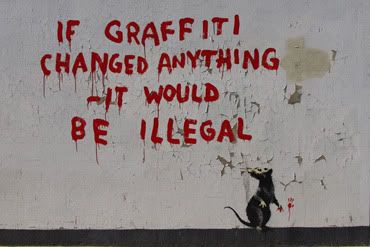
While this may be an ordinary thing in the art market, where artworks are freely hawked like any other commodity, it presents a problem for political art of the subversive kind. Art that receives state patronage is by definition art that is approved by the state; it therefore has limited subversive potential. Subversive art must hence be art that is not explicitly approved by the state; and an artistic object or act that is extra-legal is thus a good candidate for subversive art.

The arrest of the 'Sticker Lady' in Singapore and the subsequent online furore provides a good entry point for a discussion about the relationship between the state and subversive art.

From the point of view of the state, what she did was an act of vandalism or (if the distinction matters) at least that of the defacing of public property; to many, it was art. These are irreconcilable viewpoints not just because the state is not the best arbiter of what is and what is not art, which is a complex debate not suited to the dry legalist realm of discourse, but also because what she did is so compelling by virtue of the fact that it was an act of defiance of the law—in other words it spoke to its audience because it was subversive.

So, in that sense, demanding that the government recognise what she did as art and not a crime is quite beside the point. And, by extension, turning this into an issue of national policy on art and creativity is the wrong way to go about it; without a consensus that what she did was worthy of official recognition, the conversation would quickly reach a dead end. Instead, what we can do is to question the penalty against such acts and debate the implications of a harsh penalty on freedom of expression. Realistically speaking, what she did would always be legally deemed as a crime, but the enforcement of the relevant laws could certainly be toned down.

Why is a review the legal penalty for vandalism important? Firstly, a harsh penalty for vandalism is indicative of an authoritarian political culture that is not tolerant of dissenting voices, especially when this penalty is disproportionately heavy compared to penalties for other more severe crimes.

Secondly, if we want art of every kind to flourish, including subversive art, then it follows that we should try to reduce the heavy-handed prosecution of some kinds of art. Demanding that the authorities recognise subversive art is contradictory, but asking them to be less stern towards it is not.

Finally, this would also serve as a tangible and actionable goal that extends beyond this incident–a larger goal that could actually be reached without the debate being hopelessly mired in arguments about art and vandalism.


Doing some research on the public discourse surrounding last year's racist tram incident in the UK, I was prompted to ponder the rise of xenophobic sentiments in Singapore. 

As held in diaspora studies, there is no such thing as a mythical, unchanging homeland. A people's conception of their homeland is formed through experience: What you grow up knowing as your home will be the home that you know. That may seem obvious and tautological; yet people persist in perceiving their homeland as a thing unchanging, when, in reality, their conception of the homeland is simply that which they have learned.

As such, if you're used to the idea of a homogeneous or monocultural homeland, that is how you would conceive of your homeland; that is the image in which you might want to remake your country.

At the very least, Singaporeans are accustomed to the idea of multi-racialism. It has been drilled into us since we were young. Those with a libertarian bent may deride such education as plain indoctrination, but, in truth, it is hardly alien to the process of socialisation that every normal member of society goes through as he/she grows up. And it works. Of course, racism still exists, but there is no popular challenge to idea of Singapore as a multi-racial society.

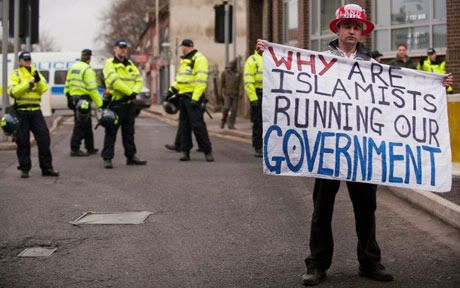
Yet it has not saved Singapore from the tensions and culture shock associated with immigration, as immigrants from 'alien' cultures have become numerous enough to have a perceived impact on the local way of life. 

Further fuelling the tensions is the political situation, the official support for mass immigration, which sets up a bitter conflict between the authorities and citizens who feel that their grievances are being ignored. While I believe that an open immigration policy is, as typically held by liberal political philosophy, morally right, Singapore's immigration policy is firmly rooted in neoliberalism. In line with the country's ideology of 'pragmatism', immigration is to be supported on the basis of its necessity for economic growth. 

This ideology reduces not only immigrants into economic units, it does the same to the locals, who must embrace cutthroat competition. Wages are driven down and the economic worth of immigrants, especially that of the wealthy among them, is emphasised. The latter is clearly demonstrated by the Chinese evening daily's headline on the recent accident involving a reckless Ferrari driver from China. While hardly relevant to the tragic incident, the newspaper opted to announce the wealth and prestige of the driver first, perhaps to pre-empt local anger, ever-simmering as it was, towards Chinese immigrants. 

What the headline ends up doing is intensifying the existing social tensions, as locals once again feel that they are being treated as mere economic units whose worth is incessantly being compared to the immigrants'. And the fact that local media is tightly controlled by the authorities lends whatever the former prints an air of official legitimacy—it certainly means the authorities cannot conveniently push the blame away. 

Thus, the knee-jerk xenophobia among the public, while deplorable, should be understood as a by-product of the neoliberal race to the bottom, which has exacerbated social inequality in the name of economic growth. And as long as growth takes precedence over social justice and a fair distribution of rights and responsibilities, the government will continue to give ammunition to the xenophobes; which is a pity, since an open immigration policy could work without driving down local living standards and causing so much resentment, if only the government would speak the right language of multiculturalism, abandon the neoliberal religion and adopt better labour regulations. 


Some people have idealised views of how they can change the world or their surroundings. It's good that these people have dreams, but even if those dreams can be translated into action, it's worth asking if the action would make any real difference. If not, then it would be quite silly for them to think that they are actually doing something.

Recently, as part of their school project, a group of students in Singapore decided to reach out to foreign workers who are employed to do 'low-skilled' jobs. As a result of this outreach, the students have put up an account of the workers' daily lives and their struggle to earn in a living in a society composed mostly of people of entirely different classes from them, a society that mostly ignores their existence.

This is a wonderful attempt at raising social awareness. But, unfortunately, it stops there. I find the students' recommendations for future action particularly uninspiring. The following is what they advocate, in full:
All i want to say, is that we should really learn to appreciate and accept them as our equal. Maybe the next time we see them, we could perhaps just give them a simple smile, or even a word of thanks, to show our appreciation for what they are doing, I'm sure it would make their day. Or at the very least, the next time we see them, we can just try not to pull an ugly face or walk away.

Thank you for taking time to read this, and although every share would not get a dollar donated or anything, but every share is a step closer to a warmer, more accepting society.
It seems not a little naive and condescending to acknowledge that low-skilled foreign workers are economically marginalised while acting as though social acceptance and recognition are going to improve their lot. Yes, levels of social awareness are painfully low in Singapore such that having any is quite commendable. But, having become aware, what are you going to do about the system and the government that author such oppression?

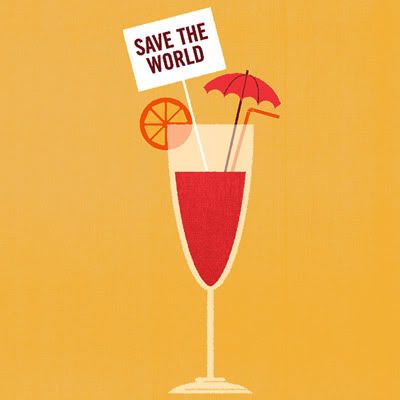
I find the above project to be the humanitarian equivalent of "sending positive vibes" to help people who are faced with problems. It tries to engender good sentiments but does nothing in reality. While these workers may appreciate your reaching out to them, the failure to even mention political and economic solutions makes this gesture seem almost as hollow as the act of spamming of "Kony 2012" on the Internet, a recent example of slacktivism. Raising awareness becomes simply a way to soothe your own conscience when you're not prepared to ask the tough questions and talk about real measures to create change.

So stop just smiling like fools in a photo op—bare your teeth and attack injustice at its source.

Illustration by Frank Chimero

Singapore is a bit like a child who was bullied and looked down on by its peers—it grew up having something to prove.

The insecurities of Singaporean society are a reflection of the insecurities of its founding fathers. And as all deep psychological traumas go, the result is a pathological pattern of behaviour—in this case, the perpetual post-Separation obsession with proving that it can prosper without natural resources and an initial industrial base.

To this end, Singapore has transformed itself into a rentier state in all but name. And the resource that is rented: Human labour. Factories and offices in Singapore are in principle no different from the sweatshops of the Third World, riding on loose or non-existent labour laws and wage legislation that help make the country competitive as a magnet for foreign investment. Politically, in order to facilitate this path of economic development, security and stability have been prioritised over other goals such as democracy and social justice—again, much in the manner of the archetypal rentier state.

What sets Singapore apart from other rentier states that rely on renting its workforce to foreign investors is the kind of industries it seeks to attract. Thus, a significant part of the workforce has to be trained and educated enough to do the kind of work that those industries require, but not in a manner that is enough to enable them to challenge the country's socio-economic trajectory.

That is the essence of Singapore's famous economic and political pragmatism.

However, popular dissatisfaction with its immigration policy and with falling standards in the provision of public services point to a parallel but related trend in the country's political and economic stance.

Even the most diligent of workers may not be able to stomach the fate of forever being a mere cog in the economic machine. Hence, as a form of compensation for their dedication to the government's vision, citizens were promised comfortable middle class lifestyles that were ensured by the provision of subsidised high-quality public services. This is one of the reasons why the government has invested heavily in the country's healthcare and transportation infrastructuresthings that are, incidentally, important in maintaining the productivity of the workforce.

This social compact has held until fairly recently. As Singapore increasingly aligned itself with the neoliberal paradigm, however, the old wisdom of labour market liberalisation—which also happens to be a core tenet of neoliberalism—was eventually joined by the move towards the privatisation of state-owned enterprises.

With this move, naturally, came an increased emphasis on profitability, which has been blamed for the fall in service standards in the country's public transportation system, as demonstrated by the recent and unprecedented major disruptions to urban rail services.  At the same time, fares continue to increase, which only helps to lend credence to the notion that the privatisation of public transport has not been in the public's interest.

In addition, as an extension of its stance towards the labour market, Singapore is importing large numbers of cheap workers in its continuing effort to keep labour costs low, thereby contributing to overcrowding and adding to the stress on the country's infrastructure.

Thus, Singaporeans can no longer expect the nanny state to take care of them. Now, all we get in return for our hard work and dedication are promises that are no longer backed by concrete socio-economic support structures. We may have been a first-class rentier state before, but now, with increasing income inequality and decreasing welfare, there is less and less to separate us from the neighbouring states we so enjoy looking down on.

Can things change? Perhaps with the aid of the vast sums of public money that is currently given to the government's investment bankers with little or no public oversight. Will things change? Probably not if we are counting on the old guard to make it happen.

Unfortunately, at the rate we are going, change probably won't come soon enough. Add in the uncertainty in the global economy and the prospect of slower growth, and you know we're in for a rough ride. 

So, in light of our predicament, let me say this: Welcome to the 21st century, ladies and gentlemen. The worst is yet to be.


The difficulty of praxis in art is compounded by the intrusion of the empirical or the purely practical. The definition of art is a political matter; it is bound up with the power to dictate or influence what is considered art and what is not. Perhaps the philosophy of art can exist in parallel with the power structures that, in our reality, define art and the beautiful. However, one gets the feeling that praxis should still entail the reconciling of aesthetic theory with aesthetics in practice, if not overcome the latter altoghether.

The trouble for aesthetic theory is, even if it has revealed the secret of the beautiful and why art is art, it frequently does not account for the practical preoccupation with the medium as a crucial determinant of what can be considered art. A digital image is at most 'art' in a much more qualified sense than is a painting on a canvas. This is because it does not in itself (without relying on the reputation of the artist or on physical installations), by virtue of its medium, typically garner the kind of recognition as an artwork that comes with socially-bestowed value and that can provide the artist with the material means to continue his work.

A way of dealing with this reality is to call for an anti-elitist view of art that disregards or devalues the importance of the art establishment, the respected institutions that serve as gatekeepers for universally-recognised art. Such a view would not discriminate between career artists and those who are not or between one medium and another.

Yet, as suggested earlier, this conception of art would only exist in parallel with the politics of art in practice. Praxis becomes viable but constrained, maintaining itself only by the act of a splintering, by taking itself away from dominant trends.

What is needed is an aesthetic theory that critically engages with the politics of art and, in a dialectical fashion, brings theory and practice together under an all-encompassing praxis. If the medium indeed plays a part in deciding what is art and what is not, such a theory would, as is done in Hegel's philosophy of art, explore the essential elements of art and show how they create qualitative differences between different media. However, it would also have to be cognisant of and explicate the power relations that mediate social perceptions of art.

In this sense, only a synthesis between aesthetic theory and the sociology of art can provide an all-encompassing praxis for art.


More technocratic or elitist discourses on governance often bring up concepts like 'the big picture' or the 'the long view'. I won't dispute the fact that these terms have meanings (albeit relative ones). But they don't seem as clear as they are made out to be in those instances. It's always worth asking what the big picture or the long view is, and how anyone knows what it is. Otherwise, it would only serve as a cover that allows the powerful to explain things away with a wave of the hand.

The problem in thinking in terms of the big picture becomes clear when there are competing claims about the same reality, typically with some grounded in experienced reality and others in more abstract or socially-constructed terms. For example, it is possible to enjoy a period of posted economic growth and rising nominal (or even real) wages while having people report decreasing standards of living in their everyday experience. Of course, facts grounded in experienced reality are often fragmentary and contentious—they are typically anecdotal and it is easy to find examples that contradict each other. To the rationally-minded, such facts might therefore be unquestionably devalued.

However, this does not mean that they are necessarily untrue or unreal. Everyone sees reality through the veil of a particular (and partly self-imposed) perspective. However, this reality is also the reality that each of us knows. It's cold comfort to be told that some abstraction or another person's reality can free our perceptions from the constraints of the experienced. What we experience is necessarily treated as true because we experience it. That is a fundamental tautology in epistemology.

Of course, ontologically this is a problematic position. Yet in practical matters, the empirical is the most directly relevant to the individual. Small epistemologically-determined problems can culminate in an ontological crisis. After a certain point, we just don't know if a claim that has been 'proven' to be ontologically true is indeed true. It becomes increasingly difficult, for example, to hold on to a traditionally held view that something is good when we are finding so many little things that are wrong with it.

The epistemological/ontological divide translates into a small picture/big picture divide in the socio-economic realm. What I call the 'small picture' is obvious enough to each individual, as it concerns the present and immediate reality around him. But how do we derive the big picture? Are we able to see how all the small things, consisting as they are of an insurmountable mountain of conflicting data, form the big picture? The long view is even more complicated as time constantly introduces change.

What people wind up doing is simplifying the reality that they see. They abstract reality, deriving theories, numbers and indicators to allow them take stock of it in a convenient and concise way. When they need to think about the future, they make projections based on these abstractions. This is a powerful and useful method, but it's not without its risks. If experienced reality is affected by perspective, what exempts our visions of the big picture from the same influence? In fact, most if not all attempts at abstracting reality are acts of interpretationwe are interpreting reality according to a certain framework or paradigm.

In governance, the tendency to abstract and derive the big picture for policy purposes has led governments to pursue numbers. They rely on indicators to measure the effectiveness of their policy, the welfare of the people and virtually everything that pertains to their business. This is often a necessary measure in their position, yet the problem with these indicators is that they are interpretive. The real problem, however, comes when people are not aware of this. Numbers and abstractions become totalitarian teleologies, imposing an "iron cage", as Max Weber put it, of rationalism on the lives of individuals. And worst of all, they become held as 'truth'.

The elitism regarding the big picture is a manifestation of this rationalist arrogance and its obliteration of the hermeneutic. What individuals think and feel is completely unimportant beside the data. Unfortunately, the people who champion the big picture often neglect to ask how the data is derived. Emptily they claim to be bastions of reason and lovers of wisdom, and those who disagree they declare to be contrarian or oppositional. Hence, the position of the unthinking rationalist is readily assumed by the most dangerous ignorant people of allthe pseudo-educated, the body of the reactionary middle class.

I don't care much for procedural politics in general. My aspirations for social and political change are a little bit on the 'pie-in-the-sky' side. This is not to say, though, that I don't care to vote. Voting is important for some rather obscure reasons to do with the technicalities of particular representative democratic systems, barring some really exciting circumstancesand this comes from someone who normally likes pretty obscure stuff. Real life seems rather too important and straightforward for obscure reasoning, but in the absence of strong reasons to believe otherwise, citizens should exercise their voting rights.

So that is to say that I am normally pretty agnostic towards voting, but I am leaning more for it than against it. Now let me explain why I don't think voting is anywhere near the limit or the be-all-end-all of the exercise of one's capacity as a political (in the bona fide classical sense) individual.

In order to do so, it looks like I have to first explain why I have little faith in the electoral process as a mechanism for social and political change anyway. Perhaps I live under somewhat exceptional circumstances, but I have seen the election of new governments fail spectacularly to institute much meaningful change. In a country like Singapore, where institutions can be expected to be particularly sticky or conservative, the electoral process certainly doesn't inspire me with much hope.

I am not familiar with comparative and more empirical theories of democracy, and so I turn to bigger narratives to find reasons why it is the case that elections are not normally game-changing. There is a myth defended by the older stuffy liberals (sometimes known as conservatives) that voting is the ultimate exercise of one's capacity as a responsible political agent. This is the myth we are brought up to believe, which may explain the religious seriousness with which some attend to the matter of voting in elections. However, reflecting Habermas' narrative of the decline of the public sphere, elections constitute a dated procedure handed down from ages past, an old gentlemen's game that has been massified but nevertheless expected to retain the same significance for each individual voter. Meanwhile, as the actualisation of the sovereign will of the people, it is actively being circumvented in modern times by influential political organisations with direct access to policy makers and by purported political exigencies that are subject to little public scrutiny. In other words, your votes as individuals pale in significance to how much power and influence is wielded by a political elite, whose mandate to rule over you is ironically affirmed by your votes.

The only way forward, under present constraints of the prevailing democratic systems, seems to be in trying to match the direct policy-making influence of powerful organisations. We are in need of a large civil society consisting of citizen activists who would fight for the causes they believe in. The only way forward is through citizen advocacy groups, unions and active everyday participation in politics. The days of waiting for elections and for your representatives in parliament to make your voices heard are over, if they were ever there. Only then can the public put itself on the same playing field as elite organisations in determining the character of governance.

In a sense, the conservatives have it right: Don't trust the authorities. But that does not mean we should minimise governmentthe government does many beneficial things after all; it means we should have a civil society to match. This, if anything, is the true meaning of a big society.

For this to happen, however, there must be a lively as well as a quality culture of political participation in society. It takes a certain amount of awareness, political wisdom and community spirit amongst citizens to institute a strong civil society. Unfortunately, the current state of Singapore's society and its public discourse does not inspire me with much hope in this either at present. Nevertheless, the stirrings in the public, if rather too naively focused on the electoral process, might be a sign of the beginnings of change. This may also be somewhat 'pie-in-the-sky', but, ultimately, I think one should be optimistic and look forward to real change.


Postmodern approaches to social theory emphasise multiplicity and de-centring, and these themes find their natural articulation in cultural analyses. Such analyses focus on the richness of cultural interaction and the reproduction of identities in non-linear ways, and where they concern themselves with politics and social organisation, they seek to realise this vision of cosmopolitan society—a society consisting of empowered and complex Subjects. Some theorists have even gone so far as to announce that we live in the age of the Subject.

Is this true? The last claim is especially dubious; our everyday experiences are enough to cast serious doubt on it. There are structural and physical limitations that ensure that Subject-Object relations continue to exist in force and often dominate the social terrain. Thus, trying to establish the existence or even plausibility of pure Subject-Subject relations in mass society amounts, at least under present conditions, to an exercise in wishful thinking.

Such limitations can be observed most clearly in political processes. Indeed, politics may be said to define these limitations insofar as it is considered as the necessary framework of social organisation. Politics, therefore, exercises a restrictive rule on the freedom and the pure reciprocity that would give rise to a society consisting only of relations between empowered Subjects.

The agents that enforce this rule are institutions. Institutions impose their decisions on Subjects in non-negotiable ways, and this happens every day in processes of governance. Democracy and dialogue fade away when individuals are faced with institutional decisions made under the guise of systemic necessity. Dreamers might continue to insist on the democratic possibility of changing such outcomes, but as Marx said, "Between equal rights force decides."

The will of individuals as Subjects and systemic concerns (as they are treated by institutions) are thereby locked in a Hegelian moral opposition—the dialectic is a forceful one. Even Subjects with dialogic aspirations for society need to be able to resort to confrontation in order to assert themselves in reforming or recreating institutions to carry out the vision of a cosmopolitan society.

It is no wonder, then, that non-violence and compliance are attributes that are often considered highly desirable, if not the most desirable, in liberal democracies—institutions may depend upon them to survive when there is potential conflict with the will of the demos, the collective body of Subjects.

Hence, democracy as an ideal exists only in its immutable form in a theoretical revolutionary moment, when the will of the demos is able to assert itself without institutional restriction. Echoing the structuralist critique of the metaphysics of presence, the ideal of democracy is not actually present in everyday procedures of governance and planning. There is typically only the reality of individuals acting as economic units under systems that often vaguely recognise their status as free and equal beings.

What about dialogue? Is there more that can be said about it? Indeed, the critique of dialogical interaction can be expanded from an institutional focus to the relations between Subjects within the demos or the public sphere itself. Some of these relations are no doubt power relations, but the existence of Subject-Object relations can be established beyond the influence of power and as the product of necessity as well. Once we move from small-scale interpersonal relations to mass society, it becomes difficult to avoid the constitution of Subject-Object relations. Mass communication is inherently objectifying because it is depersonalised—in addressing a mass of individuals, Subjects communicate without the ability to recognise particular and distinct Subjects as the recipients of their messages. As such, they must necessarily generalise about and even essentialise their audience, moulding the latter's image according to their messages. While dialogue is possible, it is nevertheless unable create a public sphere consisting of Subject-Subject relations as long as the whole of the mass is considered. The conversation will not be able to take into account every individual in his/her full complexity as a Subject; nor will it empower every Subject by allowing his/her unique voice to be heard fully.

So where does this leave postmodern approaches that try to construct a rhizomatic web of non-essentialising relations between Subjects? The pessimistic answer is "Nowhere"—there will always be Subject-Object relations and they will continue to have great relevance in social organisation. However, to give a more optimistic assessment, postmodernists may take a cue from modernist approaches and seek to address the actual existence of centres, instead of pretending that the Subject has got the better of them. Otherwise, like the proverbial ostrich, they can only make themselves more vulnerable to objectifying processes.


I wonder how often the pronouncement that "It's all relative anyway" is accompanied by the knowledge of why exactly that is so. Perhaps utterance without precise understanding is somewhat apt within a relativist paradigm. In any case, it would certainly be apt to draw upon one philosophical tradition, which grounds beliefs on a particular theoretical basis, in order to explain and mitigate the notion that truth is relative. Hence, I want to look at structuralism and its take on the crisis of foundationalism.

The structuralist critique of foundationalism and the metaphysics of presence revolves around the arbitrariness of the link between the signifier and the signified. Essentially, it denies that inherent ideas or mental states accompany the utterance of words such as to supply the words with fixed and unmistakeable meanings. The arbitrary nature of the signifier/signified connection, however, does not imply that individuals simply decide what they mean when they say something. Meanings are decided, subject to perpetual change, through the relations of words with one another, governed by principles that constitute a language (by which I mean langue or a system of signification) and that are beyond the simple agency of individuals.

The implication is that truth claims are problematic insofar as the instability and arbitrariness of meaning make the communication of claims about objective or universal truths impossible—meanings and the truths they are supposed to convey do not necessarily translate from language to language or, depending on which philosopher you are reading, between communities that speak different languages based on the respective forms of life that characterise them. And if thought is a form of internal communication insofar as it is constructed linguistically, then it seems to follow that it is impossible to apprehend objective truths that must by nature correspond perfectly in the minds of all individuals.

Thus, there appears to be two aspects to the problem, one communicative and the other epistemological. In downplaying the practical implications of relativism, I will focus on the communicative aspect as it seems more directly applicable to our everyday lives. This seems, at any rate, appropriate in view of the linguistic orientation of the structuralist critique. Moreover, communication that is not crippled by relativism may help address the epistemological dimension to the problem, so it might be useful to deal with the communicative aspect first.

What indications are there that meanings are not hopelessly relative and mutually unintelligible when we communicate with each other? For one, there is the interesting fact that individuals who may be regarded as belonging to different communities are capable of being ‘on the same page’ while communicating to each other, even when they are making truth claims. This may be attributed on a broader level to experiences that are common to all human beings, which may, for example, make certain ethical propositions more or less universally acceptable. Even if we were to narrow down the scope of our analysis, we would find that shared experiences that constitute what is called ‘intersubjectivity’ do not permit us to neatly categorise people into distinct communities that draw on exclusive pools of meanings. We often share experiences with one another and thereby establish common grounds of shared meanings that cut across all divisions that traditionally delineate communities.

As part of our daily experience, communication in turn helps us find and perpetuate such common grounds. The act of communicating the structuralist critique of foundationalism itself presupposes shared meanings that are communicated in an effort to create a larger common ground with a potentially vast group of individuals from a range of different communities. Hence, intersubjectivity is arguably an inevitable outcome of communication.

This suggests that even if the epistemological side of the problem proves intractable, even if we can never really know whether objective truths exist, we can get by pretty well without being mutually unintelligible to an extent that cripples communication. And part of our process of getting by would undoubtedly involve having beliefs in ‘objective’ truths that we share with others who are able to empathise with the reasons for those beliefs.

Furthermore, communication can help us to come to know more about objective truths through processes of discourse, as theorists of communicative rationality might argue. In this sense, as I have mentioned earlier, the communicative aspect may be said to precede the epistemological.

Most importantly, however, the fact that we are able to communicate with a diverse range of individuals from different communities means that the relativity of truth, whether it is itself objectively true, is almost irrelevant to our daily practices in a modern liberal society. And in times when the notion of multiculturalism is under sustained attack, it reminds us that there is likely no water-tight philosophical reason for not being able to coexist and communicate with each other.


The world of experts is a perplexing one. And that's partly because you wouldn't know what it's really about unless you are an expert yourself. 

One might think that the role of the expert can be democratised in the modern world, devolved to a larger base of 'common man' experts in a context where knowledge is widely available, thanks to a trend that can perhaps be traced from the invention of the printing press to the advent of mass literacy and most recently to the development of information technology. Apparently not.

The philosopher Ludwig Wittgenstein referred to "that whereof we cannot speak", a tacit kind of knowledge that agents draw upon in order to interpret meanings in a language, knowledge that can only be apprehended in its instantiation as part and parcel of practices that comprise social life. This knowledge, therefore, cannot simply be codified and read off the pages of a book or passed through any communicative medium. It has to be lived.

A field of expertise may be regarded as a kind of language, if we apply principles from structural linguistics to the wider realm of social theory. And it makes sense in this instance. Experts are experts not just because they have read a large number of texts on a subject, though that certainly helps; they are experts because they have been extensively engaged in a body of knowledge and have participated in the social activities that are central to the production and reproduction of the knowledge and the field. They literally know it inside-out.

I find the field of politics especially interesting because, rather than just interwoven with power relations in the Foucauldian sense, most knowledge pertaining to the field deals directly with power. It is therefore very relevant to everyone's lives. Are there experts in politics? Michael Oakeshott certainly thought so. Politicians, people who know the 'art' of politics through extensive experience in it, are supposedly the experts, notwithstanding their dodgy reputations and their sometimes alarming ignorance of basic facts. However, taking a cue from the title's reference to Max Weber's Politics as a Vocation, we have to be slightly careful: Are politicians the experts, or does the label more accurately apply to the political bosses?

Oakeshott seems to have had in mind the statesman rather than the campaigning or vocational politician, although the ability to acquire and retain power in a democratic context is certainly implicit in his conception. So let us treat politics in the sense that relates to governance and whatever political manoeuvring is necessary to govern a society. 

A kind of elite theory of democracy that this notion of political expertise implies is consistent with a rationalisation of representative democracy. Representative democracy is held to be superior to direct democracy because 'a government by the people' is mediated by the people's representatives, the politicians, who presumably know more about what governing is really about.  

I don't wish to argue for or against the notion of politics as tacit knowledge here, although I think it's undeniably true to some extent. Instead, I want to offer a critique of expertise as a myth, whereby the expert becomes a high priest of knowledge who is to be consulted and heeded, as augurs were, in an uncritical and almost superstitious manner. In other words, we sometimes think too highly of experts. And with their own interests in mind, they seldom want to correct us. Rather, they readily assume the robes of the high priest. 

I've talked about instances where experts treat a given subject matter in isolation, causing them to draw bad conclusions. Here, I have in mind experts who do not even understand what they are talking about. We can have a significant amount of certainty about their ignorance when it comes to very recent political events, as insufficient time has passed to allow for an extensive body of reliable knowledge on it to emerge. 

The Harvard professor who was dead wrong about the North African/Middle Eastern political upheavals comes to mind here. Yet we still see experts coming forward to offer their expert opinion on this very topic, even as events are still unfolding. It might not matter so much if they were merely at risk of being wrong, but they are also party to the framing of the present struggles of real people as political theatre, as a spectacle for entertainment or as a commodified platform for making a point. And these experts congregate or belong altogether in the media, eager to broadcast their messages to a wide audience partly because this may further their careers.

Therefore, I much prefer the historian's perspective—at the very least, the intervening dimension of time allows for observation that is more respectful and accurate. This notion has some implications on the question of whether politicians can be trusted as experts. 

Not having the luxury of dealing with content that is mediated by time and yet (unlike many experts in the media) having to deal with it all the same, politicians are frequently engaging in necessary guess work. Tacit knowledge could certainly help in making ‘educated' guesses, but given the incentives involved, we don't always know whether they want to make guesses for the benefit of the public. This suggests that while it's generally pretty stupid to tell scientists that they are wrong about things like climate change, this is not the case with politicians. Experts in the natural sciences are in a completely different class compared to experts in politics when it comes to certainty in their knowledge, as well as when it comes to their integrity, occasional scandals notwithstanding. 

Hence, for the sake of a publicly-oriented participatory democracy, we should feel free to take up the role of the common man political expert. It's only for our own good.

 
It might seem awfully difficult to empathise when you want something out of other people.

Indeed, the culture of selfishness that a capitalistic society fosters, for 'the good of all' (enter the invisible hand), orientates us towards the demand side of exchange. The baker does not care that you are hungry. He cares only that you are paying him good money for the bread he makes. Likewise, the buyer doesn't care if the baker has many mouths to feed in his family. He cares only that he gets the bread he wants as cheaply as he can.

This makes bourgeois culture exceedingly hostile towards perceived inefficiency in satisfying demand. We want something and we want it when we want it, the denial of which is irritating at best. The more capitalistic the society, the more hostile it is. On the producer side, this creates an atmosphere of cut-throat competition or a rat race, in which you need to offer what others can offer in order to thrive.

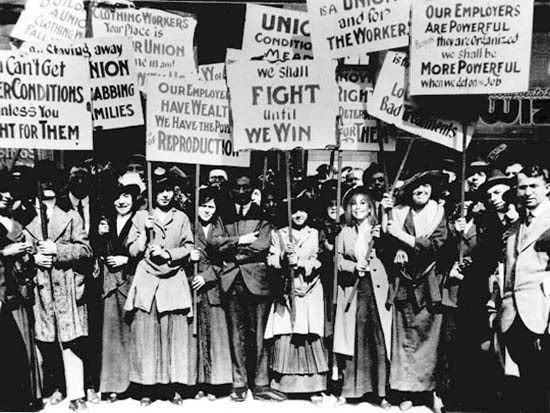
Unlike individual workers, however, businesses have some clout. Through political or market influence, they give themselves room to manoeuvre by ensuring that they retain some avenue for profit without always having to offer what is necessary or what is the best. Where and when they do need to compete with each other, they turn to their workers, wringing more of the latter's labour in order to increase efficiency and maximise profit.

To defend themselves, the workers have to agitate for rights and form unions to negotiate with their employers; or they could deliberately adopt inefficient practices to mitigate or spite the exploitation that they are subject to. And when they do these things, the spotlight of bourgeois wrath is turned upon them—they are seen as lazy and motivated by an unjustified sense of entitlement. This is the capitalist blame game.

Some societies may be less susceptible to such finger-pointing, but the potential for its existence is always there if we believe that human beings are inherently selfish at some level. As such, for us to rise above it, we have to actively moderate our short-sighted tendency to be selfish, to balance empathy against our desire for quick gratification. That remains virtually impossible until we stop buying into modern consumer culture—until we break the vicious cycle of capitalist ideology—for the good of ourselves as both consumers and producers.
 

Having had a few garbled conversations with people where I've had to play the solitary role of a Wikileaks apologist, I'd like to do this systematically. (On a side note, who would have thought that it's Wikileaks that needs to have apologists, not the powerful organisations whose much more serious wrongdoings the former tries to uncover. This shows just how powerful ideology is in getting even ordinary people, who have little to nothing invested in it, to support the cause of governments and corporations.)


Let me begin with a very simple one-sentence argument, which I will expand on: The problem with secrets is that we cannot know and therefore make an informed judgement on them. Thus, people who are condemning Wikileaks for leaking out some 'inappropriate' information have the logic backwards, so to speak. You only know some things were inappropriate for release and are therefore condemning Wikileaks because they have been released.

Secrets, therefore, present a particularly tricky ethical problem because by definition they cannot be known, thus defying any attempt at rational analysis by which a sound ethical position can be arrived at. You cannot make an informed judgement on things that are secret, the knowledge of which is not available to you. Strange how this almost Mosaic principle in neo-classical economics is so often ignored in the neo-liberal world, for all its talk about free markets and the ubiquity of utilitarian decision making processes, which stress the ability to make informed judgements in order to maximise utility.

So you can rail against Wikileaks, but it doesn't seem to make much sense to be fundamentally opposed to its modus operandi as long as you are relying on the knowledge of the content of what it released. Also, asking Wikileaks to filter the information it gets before going public is to ask it to be yet another gatekeeper for information that only a select few can know, which seems to contradict its very raison d'être.

To reinforce this point and illustrate it in simple practical terms, let's take a look at the essential argument that the consequentialist stance entails:
Wikileaks leaked the diplomatic cables. Having seen them, I am capable of deciding for myself whether some cables should not have been made public. Therefore, I think Wikileaks was wrong to release some of them.
The second premise sits uncomfortably with an objection to the leaking of the information, which is after all being used to arrive at the conclusion. Thus, it would have to be removed in order to be consistent, which would necessitate a modification of the argument:
Wikileaks leaked the diplomatic cables. Therefore, Wikileaks is wrong.
Clearly, the argument becomes arbitrary. At best, it is inadequate—some premises and assumptions have to be filled in to make any sense of it. One way of doing so is to add "The authorities say that Wikileaks is wrong to do so" between the two sentences, thereby grounding one's ethical stance simply on what the authorities say.

Alternatively, one could acknowledge that basing one's opposition on a consequentialist argument (essentially, that leaking the cables is 'not a good thing to do') is unworkable, instead opposing Wikileaks' action on deontological grounds for 'not being the right thing to do' in principle. This position would then require a further argument regarding the ethical principles that Wikileaks have violated through the act of leaking the cables.

However, from I've seen so far, arguments to that effect seem to rely on treating public officials as private individuals who must be afforded privacy in their correspondence to each other through diplomatic channels. This argument is absurd because as long as public officials are using official channels to communicate to each other, they are performing roles on a public capacity. Therefore, the concept of privacy does not apply to them in such instances. Privacy applies to private individuals, and, as things stand, it may not even apply to the more public aspects of private individuals' lives, such as on the internet and at work. Confidentiality would be the more appropriate concept to use in this case, and it is governed by a different set of principles altogether.

Evidently, there is much work to be done disentangling some of the basic concepts and ideas involved in taking a stance on the Wikileaks issue. Being aware of the fundamental problem with secrets, I can nevertheless imagine that there are indeed certain situations where absolute transparency is not viable, especially where it directly endangers lives. However, in order to formulate rational beliefs about issues of public information, we first need to know what concepts to apply, where not to apply them and what principles may accordingly be invoked. This is what should be discussed out there in the public sphere, but I guess there won't be a slot on prime time programming as long as the public is preoccupied with blind furore over the leaks.

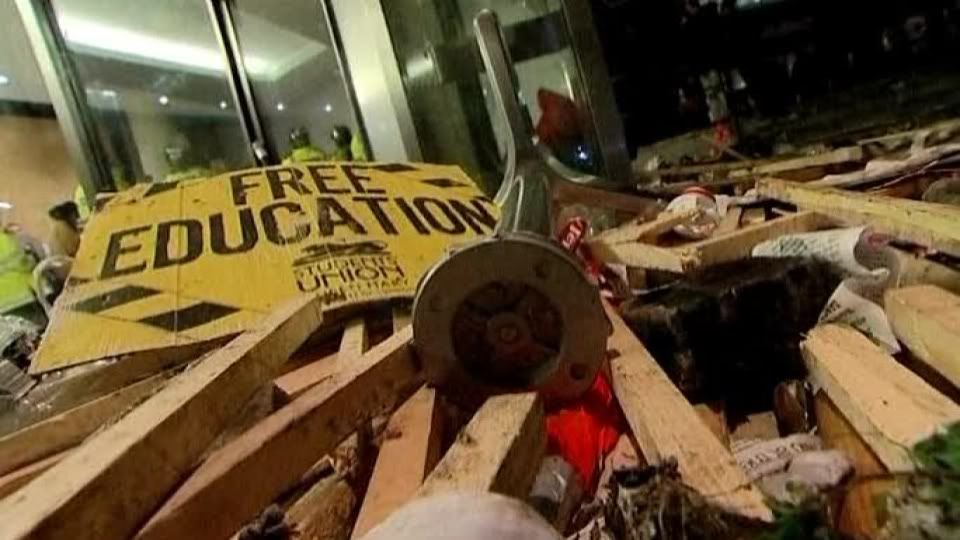
Having witnessed first hand the large student protest against the UK government's decision to raise tuition fee caps, I'm neither unnerved by the sporadic violence nor disheartened by the chaos of mass action. Rather, looking at the aftermath of the day, I've become more convinced of the corruption and the absurdity of the system.

Bourgeois sensitivity towards militant action is amusing. Repeatedly, we've been treated to condemnations of acts of violence and hooliganism by the established channels of the dominant bourgeois voice. The emphasis has been on the contrast between justified peaceful protest and bad violent protest. Perhaps if those sitting in their sofas watching the telly would reach a little into their memory and recall the last large-scale peaceful protest, they might remember the time when more than a million marched against Britain's participation in the Iraq War. The government went ahead with it anyway.

So what the official mouthpieces are really advocating is mass action that can be sidelined and ignored while the elite go on with their business. God forbid that a demonstration might make the latter anxious.

Violence is inherently problematic as it is simultaneously a powerful tool of the dominant ideology. Yet this does not diminish the idiocy of refusing to recognise the violence as a politically relevant part of this mass action. Statements about how a peaceful student movement has been hijacked by violent factions is begging the question: Where do these violent people come from and what do they want? Are they simply embodiments of the semi-mythical anarchic ruffian archetype? Or are some of them—God forbid—people who are genuinely frustrated by how they are treated by the politicians and their law enforcement minions?


While people are desperately protesting their disenfranchisement in ways that they think might have an impact, the official mouthpieces are busy trying to appeal to middle class disgust towards violence. They are also painting attacks on icons of traditional authority as appalling anti-social acts. Under this 'objective' and 'reasonable' surface discourse, ideology is plainly at work, and there is nothing too absurd for its efforts.

The attack on a royal car, in particular, has received much coverage worldwide. In Britain, some channels have been very active in expressing horror at the act. The time-honoured and sacred tradition of the monarchy itself seems to be under attack. Will those protesters stop at nothing in their quest to destroy the very fabric of society? Nevertheless, the public would be glad to know that the royalty proceeded bravely and resolutely to attend the royal variety show despite the attack.

A comedian on the show couldn't have done better.

This letter is a synthesis of my arguments in an extended on-line debate with a member of an older generation. The debate pertains to the political situation in Singapore, but I believe my arguments can also be applied to the context of some of today's so-called liberal democracies, particularly the United Kingdom.

---

Dear Sir,

In the past year, I have witnessed growing discontent in the two societies that I am part of. There is increasing resentment against the ruling elite that stems from economic grievances. Yet, as apt as this may seem from a Marxist point of view, I think much of the resentment is not as productive as one might hope.

In saying this, I appear to be critical of criticisms from the ground, but this neither suggests that I am on your side nor that I have an intellectually elitist viewpoint. I just don't think the criticisms are radical enough.

I'm saying that simpler socio-economic complaints belie the real issue of our need to take back our agency. I'm also saying that we shouldn't get sidetracked into pseudo-xenophobic discussions about immigration. Many European countries are getting mired in this situation and it basically only allows the disaffected to expend their energy on something that wouldn't help them in the longer run. They can restrict immigration, but it wouldn't solve the fundamental problems in their society.

Essentially, the root of the problem is the fact that the people have been patronised all along by the government. I believe what many of us also believe—that our democracy is dysfunctional. You know why the government doesn't listen to us? Because it doesn't really have to. How are we even going to debate public policy properly when the government holds all the cards? And our own culture, mentality and method of opposition are contributing to this. We ourselves are guilty for letting this continue.

One reason might be that we are engaging in politics of wish-fulfilment. We look to the government to fulfil our wants and needs, and we give it pretty much a free hand as long as it can do this. That may sound par the course in politics, but that's also why we're so easily duped. In the next election, the ruling elite would come up with some bones to toss our way, and the majority of us would lap it all up and once again perpetuate the system. Who really holds the power—whether it's the bureaucrats, the politicians or the people—never really mattered to us. And no matter what evasive answers one might give about the necessity of a true participatory democracy, nothing changes the fact that it is what enables the people to govern themselves. If we don't want it, then we can't really cry when we are ignored by the ruling power. We have to blame ourselves for that.

To be fair, it's not entirely our fault. Our psychology is the product of the system. But that's all in the past. The government might have justified a top-down system because of the need to develop. However, now that we have developed to a large extent, what is pretty much the same system is still being kept around in the name of continued economic growth. When will this stop? That is the present question, and only we can come up with the answer.

On the economic aspect of social organisation, I agree that material interests are legitimate interests, but not when we run away with them and forget everything else. Now that times are hard, people are unhappy—that's a perfectly valid sentiment. But what about when times were good? Did we care about how things were done?

A true participatory democracy cannot guarantee that we meet our desired material goals, especially when we set the bar higher and higher. However, what it does guarantee is that we have a real say and that we as a people run our country. The overly risk-averse state of mind is what makes us captives of the system—we want rights and we want to be heard, but we won't take the necessary material risks to make our country our own.

The basic reactionary position is to deny that there is a real fundamental problem, or at least to justify the current system by pointing out that other systems have problems too. Yes, there is an empirical basis for making the latter claim. But does that mean that every society is simply stuck with its own set of problems? I'm saying that there is a possible way forward through changing the system. And systemic change is worth looking at because the problem is structural—it has to do with mechanisms of feedback and control.

There is no panacea for all problems, but we can choose to do something about them instead of simply suffering perpetual injury.

I doubt, however, that you will understand this line of reasoning as long as you choose to regard it as yet another normative point of view in a relativist political paradigm. It doesn't simply boil down to a subjective choice of political and moral values. Advocates of participatory democracy have valid and positive points to make about issues of power and participation as long as democracy serves as our political ideal.

On a final note, you might point to an uncertain future as the defining problem, but so does the ruling elite. And their proposed solution is to band together under their banner to work for the common good.

Yet there is an alternative, one that neither you nor they are willing to entertain. But perhaps under a system that clearly favours one particular brand of hegemonic discourse it's not surprising that we are not really being heard. Just like many of those who have simpler grievances.