Padd Solutions

Converted by Falcon Hive


This letter is a synthesis of my arguments in an extended on-line debate with a member of an older generation. The debate pertains to the political situation in Singapore, but I believe my arguments can also be applied to the context of some of today's so-called liberal democracies, particularly the United Kingdom.

---

Dear Sir,

In the past year, I have witnessed growing discontent in the two societies that I am part of. There is increasing resentment against the ruling elite that stems from economic grievances. Yet, as apt as this may seem from a Marxist point of view, I think much of the resentment is not as productive as one might hope.

In saying this, I appear to be critical of criticisms from the ground, but this neither suggests that I am on your side nor that I have an intellectually elitist viewpoint. I just don't think the criticisms are radical enough.

I'm saying that simpler socio-economic complaints belie the real issue of our need to take back our agency. I'm also saying that we shouldn't get sidetracked into pseudo-xenophobic discussions about immigration. Many European countries are getting mired in this situation and it basically only allows the disaffected to expend their energy on something that wouldn't help them in the longer run. They can restrict immigration, but it wouldn't solve the fundamental problems in their society.

Essentially, the root of the problem is the fact that the people have been patronised all along by the government. I believe what many of us also believe—that our democracy is dysfunctional. You know why the government doesn't listen to us? Because it doesn't really have to. How are we even going to debate public policy properly when the government holds all the cards? And our own culture, mentality and method of opposition are contributing to this. We ourselves are guilty for letting this continue.

One reason might be that we are engaging in politics of wish-fulfilment. We look to the government to fulfil our wants and needs, and we give it pretty much a free hand as long as it can do this. That may sound par the course in politics, but that's also why we're so easily duped. In the next election, the ruling elite would come up with some bones to toss our way, and the majority of us would lap it all up and once again perpetuate the system. Who really holds the power—whether it's the bureaucrats, the politicians or the people—never really mattered to us. And no matter what evasive answers one might give about the necessity of a true participatory democracy, nothing changes the fact that it is what enables the people to govern themselves. If we don't want it, then we can't really cry when we are ignored by the ruling power. We have to blame ourselves for that.

To be fair, it's not entirely our fault. Our psychology is the product of the system. But that's all in the past. The government might have justified a top-down system because of the need to develop. However, now that we have developed to a large extent, what is pretty much the same system is still being kept around in the name of continued economic growth. When will this stop? That is the present question, and only we can come up with the answer.

On the economic aspect of social organisation, I agree that material interests are legitimate interests, but not when we run away with them and forget everything else. Now that times are hard, people are unhappy—that's a perfectly valid sentiment. But what about when times were good? Did we care about how things were done?

A true participatory democracy cannot guarantee that we meet our desired material goals, especially when we set the bar higher and higher. However, what it does guarantee is that we have a real say and that we as a people run our country. The overly risk-averse state of mind is what makes us captives of the system—we want rights and we want to be heard, but we won't take the necessary material risks to make our country our own.

The basic reactionary position is to deny that there is a real fundamental problem, or at least to justify the current system by pointing out that other systems have problems too. Yes, there is an empirical basis for making the latter claim. But does that mean that every society is simply stuck with its own set of problems? I'm saying that there is a possible way forward through changing the system. And systemic change is worth looking at because the problem is structural—it has to do with mechanisms of feedback and control.

There is no panacea for all problems, but we can choose to do something about them instead of simply suffering perpetual injury.

I doubt, however, that you will understand this line of reasoning as long as you choose to regard it as yet another normative point of view in a relativist political paradigm. It doesn't simply boil down to a subjective choice of political and moral values. Advocates of participatory democracy have valid and positive points to make about issues of power and participation as long as democracy serves as our political ideal.

On a final note, you might point to an uncertain future as the defining problem, but so does the ruling elite. And their proposed solution is to band together under their banner to work for the common good.

Yet there is an alternative, one that neither you nor they are willing to entertain. But perhaps under a system that clearly favours one particular brand of hegemonic discourse it's not surprising that we are not really being heard. Just like many of those who have simpler grievances.


There are some things that are perhaps confusing or seemingly very contentious in what I wrote about last. Therefore there is a need to qualify it or, more precisely, to delve into the unspoken claims behind some of the statements made. Most importantly, I think, I must talk about my perspective on choice, freedom of choice and the critique of choice.

I've written some time ago about the ability to question the choice of others. I argued that the sovereignty of the subject is illusory, since choices are often externally induced rather generated by an authentic individual will. I should add that whether there is such a thing as authentic individual will does not pose a problem to this view. In fact, if there is no such thing as authentic individual will, if choices are therefore entirely a matter of persuasion, all the more it should be possible to legitimately debate subjective choice.

There are two new things that I want to bring up here: Firstly, I want argue for the existence of general or common conceptions of what constitutes bad choices. Secondly, I want to question the non-invasiveness of subjective personal choice.

Some might disagree fiercely that what I consider bad are truly bad in any objective sense. Some might go on to say that there is nothing objective about taste. I'd like to question this last statement. Indeed, my position stems from my scepticism regarding absolute relativism even in the notoriously personal and subjective realm of tastes.

As such, I'm not so much positive of the existence of one correct theory of the good as I am sceptical of the notion that people cannot commonly share certain conceptions about what is bad. It may be impossibly difficult to find a general enough conception of the good with which we can objectively judge all choices, but it's a lot easier to find general ideas about what is bad with which we can legitimately argue that certain choices are bad.

This is a lot more obvious for choices with real material, physical and psychological consequences, but if we can establish this in the realm of tastes, it's probably safe to say that it's a solid claim. Are there instances where people commonly regard certain cultural products as lacking in quality? I think so. When I talk to people about reality TV shows, for example, I find that many would admit that certain shows are "trashy" or "bad", even if they admit to having a 'guilty pleasure' in watching them.

Perhaps this is too anecdotal, and perhaps there is a correlation between such sentiment and education level or class. However, there is still something to be said about this phenomenon.

Firstly, this implies that pleasure and people's conception of the good do sometimes diverge. Thus, it seems to contradict the central thesis of traditional hedonistic Utilitarianism, which is ironically a very popular mode of thinking. As such, good and bad is not merely a question of what consequences a choice brings in terms of utility or pleasure.

Secondly, though one might convincingly argue that common perceptions on what cultural products are bad could simply be explained by the fact that people have been told by the 'experts' about what could be considered good and what could not, all is not lost. At first glance, this may seem to corroborate the notion that nothing is objective, that what seems objective is simply the imposition of a subjective viewpoint. Yet, no matter what we think of some of those 'experts', there tends to be a process of discourse that generates and moderates the opinions offered within serious critical analyses of cultural products. Discourse, whether it is realised through an actual debate or through the influence of intellectual traditions that play off one another, lends criticism credibility as something greater than simply a collection of individualist subjective viewpoints.

Therefore, it might be that what is considered bad is something whose merits cannot be seriously analysed and discussed. Hence, it is mostly examined, if at all, merely as a symptom of a cultural trend, tending on its own to fall outside the process of discourse. What is good is a question that is debated, perhaps endlessly, in the discourse, but what is bad simply falls outside of it. The reverse is not true; what falls outside of the discourse is not necessarily bad. However, at least we now have somewhere to begin in deciding what is bad—by asking why some things don't come up in serious discussion on their own merits.

This is a bold argument, and it might come off as some kind of intellectual snobbery. But I would add that it's not necessarily a sin to enjoy something simply for any kind of pleasure that it gives. The problem is when the vast majority of what is offered can only be enjoyed in terms of the overt pleasure that it brings. Thus we come to the issue of the invasiveness of subjective choice.

If you want to do business, half the job would be done for you if you appeal to what people want. Does this mean, however, that consumer choice is paramount in production and marketing decisions? In fact, the very nature of marketing is antithetical to consumer choice. But the power of capital is not so much in forcing you to consume what you do not want, but in making you consume what you want all the time and, in the process, making you want to consume associated products as well.

Thus, the companies appeal to the lowest common denominator in order to increase sales. And they do not let your attention wander, for the sales of other cultural products and physical goods, upon which billions of units of exchange value ride, depend upon your near-undivided attention.

This is how capital imposes a near-monolithic culture on our tastes, by giving us what we want, but on their own terms and hindering our ability to emancipate ourselves from the pre-determined choices that we as consumers and members of modern society are expected to make.

But the burden of creating these circumstances does not lie on inhuman capital alone. In continuing to make the same kind of choices, we are also guilty of imposing on society a narrow range of tastes as the determinant of the cultural products that are available. Hence, our subjective choices are invasive in that, collectively, they deny other people and society at large choices that are emancipated from the dominant cultural milieu, while at the same time bulldozing through any question of quality in favour of focusing on the levels of pleasure obtained from cultural products.

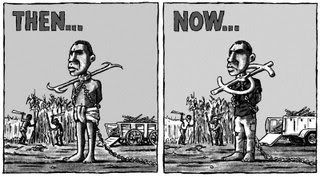
Hence, like slaves who have never apprehended the notion of freedom or like the benighted denizens of Plato’s cave, we perpetually choose to live within the same kind of paradigm, not knowing what else lies outside of it, including things that convincingly possess qualitative value. The market may give us choices, but as long as we are unable to escape the paradigm of pleasure, we know that we are still fundamentally unfree.


If it is true that we are all free, why do we consistently choose what is bad? Why does participation not lead to quality in society?

This is a question that Christianity asks in order to call to our attention true freedom in God, free of enslavement and of human weakness, which causes us to be unable to choose anything but the slavery of sin. Unfortunately, Christianity cannot be divine because it is tainted by human beings. Thus we are left to ask questions on our own, as the Church Fathers did.

Does choosing to be slaves imply freedom? Some might say yes. This absurdity and contradiction comes about through two main threads of human thought: Libertarianism and relativism gone mad. The first posits that human agency is so absolute that human beings can, if they so choose, lose it. The second would have us believe that anything can be good to someone—perhaps some people choose to be slaves because they want to be slaves, perceiving slavery as a good? Or perhaps there is no good at all, only preferences, in which case we might as well be nihilists.

Marxist thought, on the other hand, offers a human solution to this puzzle. In our apparent freedom, we perpetually choose to be unfree because of false consciousness. We are not attuned to our real interests, and therefore we choose what is bad by first allowing our freedom to be subverted in letting powerful groups tell us what we want.

"We are free to choose," they say, as they readily queue up for the next Apple product like the hungry for bread.

It is probably true that to some extent preferences are negotiated. The industries give us what we want while trying to mould our tastes to further their own interests. But, if this picture allows neither side to wield near-absolute power, why does the reality feel so stunted? Why does a relatively free market not produce the promised creativity? Why does the UK publishing industry, for example, only publish what appeals to lowest common denominators, what will attract by virtue of its harlot-like easiness?

Why can we not, for the most part, refuse the bad?

Either we are extremely stupid as free beings, or we are not truly free. I choose to believe the latter.

The fact is we are not free as long as we are enslaved by uncompromisingly non-objective conceptions of the good, or by false notions about freedom. And this is something we as free beings are responsible for—we are guilty of enslaving ourselves through our own ways of thinking.

Some scholars are quite dismissive of the Frankfurt School, thinking it an artefact of a bygone age, while they indulge in blissful proclamations about an age of freedom and choice brought about by technologies they hardly know themselves. They study every petty whim of society and profess to find all that is good with the universe in Coronation Street.

But, far from dissipating, power merely grows ever more subtle in its application. The Frankfurt School is not wrong. It has just become less easy to see what they criticised in their time.

Somewhat unsatisfied with the conclusion of a seminar and in a fit of madness, I decided to post my thoughts on the course forum, which I quote below:
Hi, people. I'm sure all of us had our discussions on this topic in our seminars, where, unfortunately, there wasn't much time to get more in-depth. I'm fairly interested in this topic, so I just want to (hopefully) continue those discussions a little by adding a few thoughts. I think the internet has the potential to be the source of a new Habermasian public sphere, but not in its entirety.

In my seminar group, we were drawn into a debate with arguments for and against the internet as a new public sphere, and I don't think that does the complex issue justice. From a Habermasian perspective, I don't think the internet can in itself become a new public sphere. I believe this is because a Kantian approach grounds rationality in humanity; that is to say, the basis of rationality is found in our ability as persons to apprehend rational concepts and arguments (i.e. our having practical reason). In turn, public discourse is grounded on rationality and can only be carried out if we let our rationality take precedence and thereby respect one another as rational beings, which is where the equality (or non-relevance) of status comes in - what matters is not our background and individual social status, but our universal capacity to reason.

To see public discourse as purely a contest of disembodied arguments is, I think, to miss the point a little. The human aspect is highly important because our capacity to reason is also what makes us able to be rationally persuaded by others and thereby reach a consensus. For this we need some kind of reciprocity, the ability to give each other credit for being right where it is appropriate. The problem with the internet is that, as a depersonalised community that people can opt in and out of easily and where individuals can hide behind a veil of anonymity, it does not lend itself to the kind of reciprocity needed for rational debate. Instead, people tend to become personifications of their arguments and are thus objectified. Internet debates are so fragmented and pointless because consensus is something that is reached by persons, not by objects or strawmen on which are pinned various viewpoints and arguments.

As such, although the internet does give people a platform for expressing their views with less of an eye to status and negative real-life consequences, it also tends to throw out the human (in the Kantian sense) aspect of discourse. Thus, I think there are a few criteria that must be satisfied before a new public sphere can be constituted from the internet:

1) Any proper debate must be moderated to ensure that the participants respect each other.

2) There must be some way for the participants to maintain credibility so that they would respect each other and no one's views would simply be dismissed.

3) There must be regularity, both of participants and of debate, since reciprocity is not achieved in one-off engagements but in a continuous relationship.

There are probably more, but these are what I can think of for now.

This way, a new public sphere can come from within the internet, even though the internet itself cannot be from my understanding of Habermas' theory.

So, will we show the rational efficacy of the internet and debate a little more on this topic?
Fittingly enough, no one responded. From this experience, I can make two observations: First, the Internet can't seem to hold a rational debate to save itself, even within a university environment. Second, professors don't tend to care much for contributions if those do not fall neatly within the programme.


I quite liked the first iteration of Iron Man on the big screen so I had more than half a mind to catch the sequel. However, I didn't manage to see it in the cinema. Fortunately, a long plane ride a few days ago afforded me the chance. And I wasn't disappointed.

For a superhero movie, it was refreshingly honest. We like Iron Man, or Tony Stark, because he is rich and 'cool', not because he is a brooding hero with larger-than-life psychological problems or teenage angst. And it featured a promising villain whom we can sympathise with, at least initially. And by that I mean real sympathy, not some sort of twisted admiration for a fictitious terrorist or madman.

But in some ways the things I like about the movie also form what I, on hindsight, dislike about it. In its portrayal of the hero, the movie embodies the culture and social consciousness of the present age: We celebrate the lucky ones, those 'blessed' with ability, means or just plain luck that ultimately makes them our heroes and icons. On the other hand, those whose lot in life are different but who struggle against it are 'doing the wrong thing'. And because they are, they must be bad—ruthless, barbaric or simply inhuman.

That's how it works, not the other way round. The latter doesn't even find chronological support in the movie. As I said, we can initially sympathise with the antagonist in Iron Man 2. However, in the end, because he is gradually shown to be cruel and inhuman, we are fine with the fact that the lucky hero triumphs. First we see the unlucky man, then the man who is (therefore) filled with the desire for vengeful satisfaction; because he was deprived, he must therefore become something less than human, destined to eventually be beaten back by his betters.

This parallels story arcs found in other contemporary stories such as the agonisingly bad Harry Potter series. It even has a close resemblance to the model of paternalism seen in the Agamemnon/Clytemnestra dynamic in Aeschylus' masterpiece more than two thousand years ago. Perhaps celebrity worship is a time-honoured tradition after all.

Having said all that, sometimes the guilty pleasure elicited by an honest Hollywood flick can remind ourselves what fools we are. But, then again, with the popularity of the Twilight series as it is, maybe the human capacity for self-reflection has been Eclipsed.

Now, at the risk of spoiling my ending, let me end with a thought: We study pop culture as a representation or commentary of contemporary society because studying it as art would just be depressing.


A resilient society, especially in this fast-moving age, is said to be one where the losers are allowed to be eliminated and new winners are ready to usurp the positions of those whose time has passed. Indeed, evolution (and not just the biological kind) seems to conform to this picture, with losers constantly being eliminated and the winners' positions being ever threatened by new challenges. And interestingly, the latter is what most people are blind to. The winners don't usually win forever.

This picture is a positive one for society as a whole—there is continuity and everyone collectively has some chance. However, it is not one that is fair to individuals. Every person has aspirations; many want to carve their own niche. Unfortunately, most would not get there, and those who do may not stay there for very long. You may aspire to be an Alexander and become a Pyrrhus, only to die ignominiously in the streets of Argos.

Hence, while it is often to our benefit to labour under the impression that we as individuals carry weight, the reality is we can really only expect to be infinitesimal parts of the big picture. Our individual selves might matter little, while the primordial life force will thrive—Nietzsche's very vision of the Dionysian.

When we celebrate the Dionysian, we become conscious of the continuity of the whole and disregard our own individual fates. In fact, this often constitutes the essence of national projects: To work for and celebrate the success of the nation, whether or not you as a part stand to benefit yourself.

Nevertheless, self-abrogation, though often encouraged and edified by the community, will not make everyone content. Hence the illusions under which many of us labour. We need the heroic myth, the Apollonian tale of human endeavour that holds the promise of what is possible for ourselves.

This is often a necessary lie, without which we might be left despairing. Yet, again, it is one we can see past easily as we acknowledge that only a small number can attain even a shadow of the promise. Meanwhile, those whom we hail as titans of the day could soon become of no consequence, another noteworthy addendum. We are so obsessed with the present that we don't realise the heroes of today might become distant memories tomorrow. Nor do we realise that many of these 'movers and shakers' do not have the impact we attribute to them today.

Thus, wanting to make your mark on the world is virtually a pipe dream. But does that mean we can and should hope instead to make a mark in the lives of a few people? It's certainly more realistic, but we should still be wary. If we depend on others for our fulfilment, we might still be in for a rude awakening.

Arguably, and I agree with this point, finding fulfilment in our lives almost always requires the participation of other people. Nevertheless, I believe that a life too dependent on others is a life not worth living. Better seek our own happiness, with or without the involvement of others.

These are things that I have in mind as I contemplate a trip to the Orkhon Gol and the Altai Mountains, to the hinterland of those nomads who roamed the vast steppes for thousands of years. Who would know better about lives full of constant movement and change? How many people can claim to know the solitude of the infinite like the top of their saddles? Which society can better demonstrate the survival of the whole through the unquestioning generosity of the individual?

And yet these nomads, full of vigour and survival wisdom, ride at the very margins the modern world. There, in a different plane of existence that reflects all our lives, like the realm of Ideas.


Social groups are often formed around common subjects or content, but much less frequently do the latter remain the defining characteristics of those same groups.

What do I mean? To get to the point, I am referring to the problem of identification: I believe that although identification with a group is initially inseparable from agreement with its formative tenets, and the two may always remain tied to some extent, there will probably come a point where identification with the outward image of the group becomes the members' main connection to it.

Indeed, we see this very often in history and in daily life. While a nation may have been founded on principles of liberty, for example, its citizens eventually become patriots first and defenders of liberty second. And national identity, in particular, rests very heavily on the nation's outward image—on names and symbols, including flags, pledges, anthems and various other markers of identity.

Such markers of identity, which collectively form the outward image of the group, become a checklist for identification. We become concerned with questions such as "How American are you?" or "How Christian are you?" without simultaneously contemplating what those identities really entail, or might have entailed before they became nigh empty shells.

This problem is what has allowed the corruption of social groups. It is what allowed corporations to successfully court counter-culture groups such as the hippies and the hipsters, for instance, as their identity markers turned towards the domains of lifestyle and fashion. Sometimes it has even allowed groups to do an about-face and turn against everything they had stood for without loss of identity and credibility. Just look at many revolutionary governments in history, or the changing economic doctrines of Communist China.

I think the chief cause of it lies in the need for the human brain to be able to recognise easily. An evolutionary scientist might say that this has its roots in our ancestors' need to quickly recognise predators and prey. We need to recognise easily and therefore our brain takes shortcuts. We pick out certain convenient markers and associate them with the corresponding things.

On the other hand, remembering the actual content behind a group's identity requires us to remember lists or arguments that often don't come readily to mind. This unwieldy information is stored somewhere in our brain and has to be found again. Compare this to the quick and easy identification offered by markers; it's no surprise that our brains favour the latter.

Nowhere is the problem of identification better exemplified than in the world of politics. The existence of party whips in 'free' countries (a relatively benign force for party discipline), which maintain the loyalty of party members, point to a common culture that prioritises identity (i.e. in accordance with its markers) over substance. It might be worth noting that it would be unreasonable to presume instead that the whip is the constant defender of the party's tenets, as it is answerable to the ever-changing leadership.

Even without such formal enforcement, the very act of adopting a certain political label often necessitates conformity in order to be accepted and recognised within the group. So it is with other kinds of social groups.

And, in case I have not stressed this enough, for most people conformity is measured by one's adherence to the markers of identity.