Padd Solutions

Converted by Falcon Hive


In my previous job, I often wondered why we had to travel by air to meet clients.

On one hand, my company was very used to video conferencing. We worked with teams scattered around the globe—some in Europe, some in South Asia, and others in North America. My own team was spread across Asia-Pacific, and so were our clients. Some clients, notably tech companies, were perfectly comfortable with video calls, and we did plenty of online training to take our clients through how to use our products.

On the other hand, some clients were not, and that might mean we had to fly somewhere to have meetings, sometimes just for a few hours. And that often meant ten times the amount of time spent getting to meetings and having them versus if we had just had a video conference—and God knows how many times bigger the carbon footprint.

The company might be global and online, but a local, physical presence was sometimes demanded of it.

Fast forward to today, the world is in the grip of a pandemic. Suddenly, almost everything had to be done remotely, whether people like it or not. By now, I have had quite a lot of experience using Zoom and other video conferencing and presentation tools, and I find myself doling out advice here and there to people who are trying them out for the first time, including church groups who are moving their meetings online. Well, Jesus did say, "For where two or three gather together in My name, there am I with them." It's certainly interesting to think about Jesus lurking in the background on Zoom.

And, on that note, it's much easier to be a silent participant when you are not physically present.


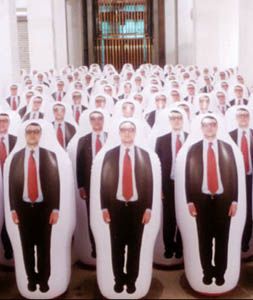
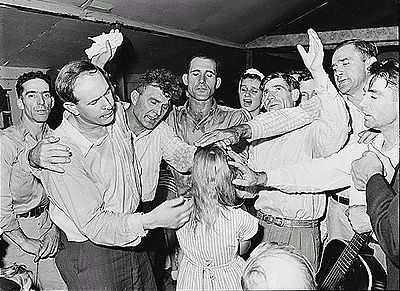
Yawning or coughing during a meeting? (Photo: yanalya - www.freepik.com)

Let's face it, doing something remotely is often not as effective as being present while you're doing it—whether that means time being wasted unproductively doing everything else at home, or people simply being disengaged while having an online meeting with disembodied voices. Yes, that's the price we pay for our lack of physical presence in a purposeful environment. And, of course, it's a price we can often afford to pay if we take into account the material, environmental, psychological and health costs of having to always be in an office to get something done.

But there is a price. And in the current rush to proclaim the goodness of doing things remotely, the faddish world is rushing headlong into a different extreme.

As I go through every social media posting like everyone else these days, I'm quite amazed by the sudden explosion in the number of proud introverts. Have I just never noticed, or have introverts become very extroverted about their introversion now that they have a good excuse?

I'm an introvert too, at least according to various personality tests, but I find myself kind of sad about people using the virus as a reason to fall silent and quietly drop their participation in group activities because these activities no longer involve their physical presence. I'm probably guilty of that myself. I suppose, at the end of the day, we are sensory beings, and the lack of physical tangibility might confuse our minds and our perception.

As my past study in the philosophy of mind suggests, we learn about the world through our sensory-motor functions, and hence anything that does not engage most or all of our senses may seem less real and, as such, less important to us.
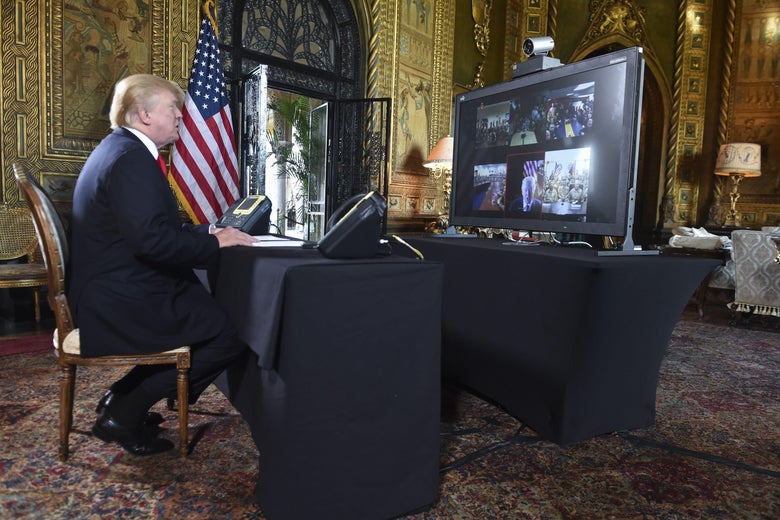


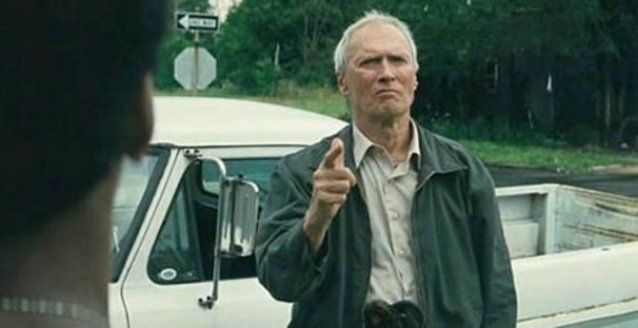
Trump knows what to do (Photo: Nicholas Kamm - Getty Images)

So what does this mean in the days of #StayHome? Doing things remotely is great, and I wish people had embraced it more willingly earlier, but it does require that we invest effort into making sure we are doing things like we would if we were physically present. It means not turning into ghosts just because we can more easily evade notice. It means not letting our introvert selves turn us into phantoms of a dark basement, whose voice can only occasionally be heard.

Make remote working great again. Shut down the borders to bad home-based habits.

(Okay, I'll stop now.)


Top image created by makyzz - www.freepik.com

This post is a social commentary I wrote as the editor of sociopolitical site Inconvenient Questions.

----------


There is an inherent tension between preservation and development. Has Singapore leaned too much towards development in its quest for economic progress? Could this tendency have eroded Singaporeans’ sense of connection to their country?

A controversy over building the Cross Island MRT Line through part of Singapore’s Central Catchment Nature Reserve flared up recently. The government has promised to consult the public and conduct careful studies before arriving at a decision, but some are not convinced that it is willing to compromise on cost.

Yet others are asking why nature lovers are so up-in-arms about this issue. Should they not be supportive of the government’s balanced approach? Are they just being irrational treehuggers?

Facts and practical arguments aside, and indeed those are not yet settled at this point, I can understand the groundswell of anger at the prospect of damaging the nature reserve. The feeling of loss is something that Singaporeans have often experienced with regard to their surroundings, and it may not get any easier each time.

As a Singaporean, one of the strategies for coping with life in Singapore is not to get too attached to your surroundings. You may love that spot, that structure, that area or that forest; the next thing you know, they might have been altered permanently or even removed.

The reasons for this can be both public and private. Spiralling rental costs have eliminated some of our favourite haunts—places like Borders bookstore at Wheelock Place, for example. Property developers keen to ensure ever-increasing rents have also gone to great lengths to ‘upgrade’ and change familiar surroundings.

In other instances, the inexorable march of public machinery—literally and figuratively— have ripped the living proof of our memories out of existence, such as in the case of the old National Library building. If part of the Central Catchment Nature Reserve will ultimately be damaged by the construction of a new MRT line, who should really be surprised at that outcome?


A casualty of the ever-forward march of progress: The old National Library building. (Photo: Timothy)

Sometimes we may wonder whether all this is necessary or unavoidable. Certainly, the
authorities would be inclined to say “Yes”: We cannot afford to stay still, and the desire for
preservation has to be balanced with the need for development
.

But if almost no place and no sliver of sentimental attachment is sacred, if we must always
be prepared to sacrifice these things at the altar of economic progress, then who can blame
people for feeling little connection to the country they live in?


Could we seek solace in artistic forms of expression? Has much of that not also been
meticulously pruned away to satisfy both a pragmatic worldview and a narrow vision of an
orderly society? So where else can we anchor our desire for meaning in being Singaporean
that goes beyond just our location and our passports?


For many of us, the answer would be family and friends—we want to live in Singapore
because they are here. But people are more mobile than ever, and communications
technology is getting better by the day. Not being here or not having a Singapore passport
does not necessarily mean losing touch with family and friends.


We may need the time and opportunity to be attached to our surroundings in order to better
appreciate what it means to live here and to be ‘locals’. Top-down feel good campaigns or
spontaneous exhortations to shout “Majulah!” can feel empty and forced. As important, if
not more important, to our sense of identity as a people are natural outgrowths of sentiment
stemming from the places, customs and languages that we live with—things that have all
been affected by at least one official campaign or another.


As things stand, the relationship for many is merely a marriage of convenience—if we really
question ourselves, how many of us are here only because the country is safe and
prosperous? What happens when there is a better prospect out there?


It is not that we can always choose to preserve everything, or that some trade-off between
identity and growth is not necessary. However, we must recognise our national ideology for
what it is; and hard pragmatism does not come without a cost. When we wonder why, as
some people do, potentially more than 50% of Singaporeans want to leave or why many
would not die for the country, we should acknowledge that the lack of personal connection
may be a price our nation pays for taking this path.


Top image created by Liyana Yeo; photo of MacRitchie Reservoir by RickDeye.

This post is a political commentary I wrote as the editor of sociopolitical site Inconvenient Questions. It also appeared on Yahoo News.

----------

Asking unhappy people to leave is a favourite debating tactic of some Singaporeans. If you care about Singapore, however, such an approach is ultimately counterproductive. It also goes against the grain of the Government’s current approach towards Singaporeans moving overseas.

That line above or something similar is what you would invariably see if you read enough comments about local issues on social media. It is the rebuttal of choice of some ‘patriots’, wielded against critics who are unhappy about one thing or another in this country.

Admittedly, the lure of greener pastures can be very tempting and many Singaporeans appear to think so. In a survey conducted in 2012, more than half of Singaporeans (56%, to be exact) say they would migrate if given a choice.

One could jump through hoops to explain away this result, or even question the credibility of the survey. But while it is debateable whether or not the majority of Singaporeans are really unhappy here, such a statistic should concern those who care about the future of our country. After all, what is left of a country when most of its people are no longer willing to stay?

This issue of commitment is even more salient for countries like ours that rely on regular citizens to maintain its security. Singapore’s deterrent against foreign aggression depends in large part on its relatively large reserve force comprising Singaporeans who have been called up for National Service. If we are not committed to defending the country when the need arises, the result could be disastrous. Thus, it is vital that Singaporeans of all stripes remain invested in the fate of our nation.

Hence, telling people to leave if they are unhappy is not a forward-thinking approach for those who really care about Singapore’s future. What any true patriot should be doing instead is to ask how they can keep as many Singaporeans as possible interested in, and engaged with, the country’s progress.


Abraham Lincoln once famously said, “A house divided against itself cannot stand.” (Photo: Wes Dickinson)

But there is another problem with asking people to leave: It also goes against the spirit of Government policy towards the issue of Singaporeans moving out.

In a recent trip to New York, Prime Minister Lee Hsien Loong met with overseas Singaporeans there and told them to “Keep in touch with home, keep in touch with us… and one day come back home to Singapore.” His gentle exhortation is a long way away from then Prime Minister Goh Chok Tong’s rebuke – almost 15 years ago – calling some overseas Singaporeans “quitters”.  This new approach indicates that the Government is keen not on pushing Singaporeans out and cutting off ties, but on having us remain emotionally invested in our country even if we leave.

Indeed, the Government’s Overseas Singaporean Unit works with other agencies such as Contact Singapore to ensure that overseas Singaporeans are kept engaged. Considering that our Government has such a rational approach towards keeping Singaporeans as close to the country as possible – if not physically, then at least emotionally – should this not be supported by those who truly believe in the Government’s wisdom?

Finally, equality, a value that is mentioned in our national pledge, means everyone’s voice carries weight – even if you vehemently disagree with what some people say. Asking people to leave if they are unhappy is to deny that their voice matters and is therefore a rejection of equality. No matter how one looks at it, that cannot be the right or productive approach.

It must be said that political discussions among Singaporeans might not become much more rational or less acrimonious than they are now. Nevertheless, it is still better to talk to those who disagree than to ask them to get out of the country. After all, if there is no one left to debate politics and policies with, Singapore will probably be the poorer for it.

This post is a political commentary I wrote as the editor of sociopolitical site Inconvenient Questions. It also appeared on Yahoo News.

----------

The furore following Member of Parliament Denise Phua’s statement describing congregations of foreign workers as “walking time-bombs” reflects Singapore’s ambivalence towards the presence of foreigners. Representing her constituency of Jalan Besar, Ms Phua had proposed fencing off communal areas to keep foreign workers out, no doubt in response to concerns from local citizens. While our society needs the services of foreign workers, many Singaporeans are uneasy about the impact of their influx on matters ranging from safety to the condition of local culture.

So where do we go from here? To start with, perhaps it would be useful look at the example of the most well-known immigrant society of all – The United States of America.

A hundred years ago, immigrants first arriving at New York City would have disembarked in full view of the Statue of Liberty, a monument that Franklin D. Roosevelt honoured in 1936 as an icon of immigration. Today, 80 years later, aspiring American presidential candidate Donald Trump is able to capitalise on a groundswell of discontent with immigration for his campaign.

How did a nation of immigrants and the richest country in the world end up with this much disdain for something that lies at the foundation of its society?

The truth is (new) immigration has always been an issue among the American public. Recent immigrants have often been looked at as a threat to American values. If this sounds familiar to us in Singapore, that would be because the theme of cultural difference is universal. And, just as ironically, we too are a nation built on immigration.

By now, multiracialism and multiculturalism are no longer radical ideas. Yet many modern societies are struggling with the question of immigration, a perennial issue punctuated by shocks such as terrorism and the influx of refugees. In Singapore, where a nation of millions must live together in a tight space, this question is perhaps even more salient. Can our society handle large numbers of immigrants?

With the non-resident population making up slightly more than a quarter of the total population, Singaporeans are naturally concerned about the competition for jobs, the erosion of national identity and overcrowding. As the arrest of 27 Bangladeshi workers under the ISA reminds us, there are also concerns about security and the threat of radicalised groups or criminals finding their way into the country.

Most of these problems could be seen as matters of governance, things that can perhaps be left to experts and officials. However, something that our penchant for hard-headed policymaking and planning alone cannot resolve is the issue of Singapore’s culture and identity. We need to decide as a society what our culture and identity will look like in the coming decades, and this is a process that has no correct answers.


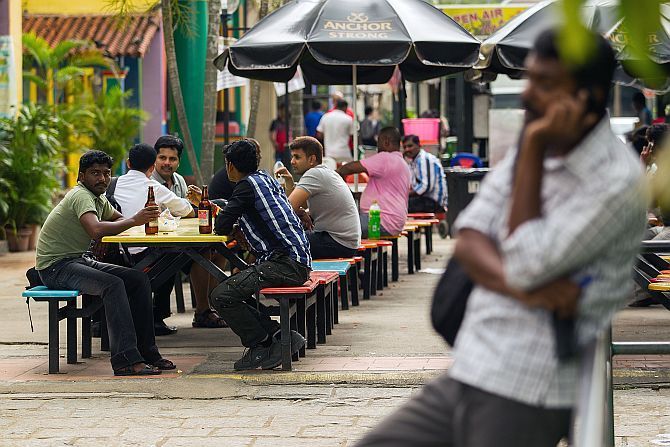
Foreign workers enjoying their break in Little India. (Photo: Nicky Loh)

There are three distinct paths that we can go down. One is the American ‘melting pot’ model of conflict and natural assimilation: There is little or no government intervention and immigrants are left to form self-reliant enclaves. Historically, these groups were often hostile to each other and to the ‘locals’, even spawning violent gangs that featured notorious characters such as Al Capone. Only after generations did these groups eventually assimilate into American society, becoming part of the tapestry of American culture with contributions such as Italian American cuisine and common Yiddish loanwords like ‘chutzpah’.

This path is the least likely to be deliberately chosen in Singapore due to our size and perceived vulnerability to any social instability or disharmony that might result.

The second way is to define what Singaporean culture and identity are and use them as benchmarks for ‘Singaporeanness’ in assimilating immigrants. This could be done by returning to classic or mythologised ideas of what it means to be Singaporean or by synthesising those ideas today. There is a tendency for members of the public to engage in this when they treat qualities such as the ability to speak Singlish correctly as identity markers and yardsticks for ‘Singaporeanness’. Similarly, when Member of Parliament Darryl David proposed that English proficiency should be a criterion for citizenship, he was essentially advocating the same path.

While it might be the most intuitive method for many Singaporeans, this path is also likely to be exclusionary as it sets a high bar for assimilation for immigrants, many of whom come from cultures that are very different from ours. If integration is a goal, this method might even make the process more difficult.

The third path is to include immigrants’ culture as part of a new and evolving Singaporean identity. This would entail fusing elements of the different cultures with local Singapore culture to create an inclusive model. For example, local languages and Singlish could expand to include Mainland Chinese, Filipino or Bangladeshi words, while food from the different immigrant communities could be included as staples of local cuisine.

From the perspective of integration, this would be the easiest path as it allows immigrants to retain their identity to some extent and feel a sense of familiarity towards local culture. However, in practice, it would likely encounter difficulties arising from resentment among local Singaporeans, many of whom might feel that the local culture is being watered down.

In the end, the likelihood is no matter how we go about trying to resolve the question of our culture and identity, our approach will end up being an amalgamation of these three paths. Nonetheless, one of them will likely be the dominant path, and that will determine much of what our sense of community and social fabric will be like in the decades to come.

With so many things that are happening and that have happened, I've decided to fire up my blog again.

Singapore is going into election day, and the media has been abuzz with election-related news and discussions. The parties in the opposition have received unprecedentedly positive attention this election cycle, and the role of social media in contemporary politics is undoubtedly the primary contributing factor.

My social media is full of messages in support of the opposition, although there certainly are enough supporters of the ruling party as well (especially the wealthier, conservative or typically apolitical people). It actually seems to have become quite a norm. And judging from the attendance at the opposition rallies, the sentiment on the ground is also pretty warm.

I think Singapore politics will see exciting days ahead. Like it or not, we are seeing a trend where we can expect more successful politicians to be those who have their ears closer to the ground. There are more debates among the public, and politicians of all stripes will have to be responsive to public sentiment, balancing traditional rationality with an appeal to citizens' passions.

But unlike conservative ideologues in Singapore, I will not hasten to trot out the label 'populism' here, because responsiveness and accountability to the electorate is part and parcel of a democratic system. 

Too often, modern audiences are fixated on procedural democracy—on the process of holding elections—as well as on the representative part of democracy. However, the traditional idea of democracy was not usually limited to having an elected aristocracy. In democratic thinking, the people are meant to have a say in how they are governed. There is populism, and then there is democracy; the latter does not necessarily translate to the former just because one party no longer has a free hand to rule as they see fit.

Understandably, many in Singapore will feel some trepidation about the opening of the floodgates. Are we as a society ready for the full democratic experience? Will we be able to maintain current levels of prosperity when the ruling party no longer dominates local politics with impunity?

No matter who is in charge, the future will remain uncertain. As the financiers say, past success is not indicative of future performance. For now, it's time to prepare ourselves for societal change.


Many things are more deterministic than we think. We are not so different from who we used to be. Even societies may persist with their old ways, unbeknownst to its members, long after the reins have changed hands.

Simply put, we are constrained by our past choices and directions—a phenomenon known as path dependency. We cannot simply change the direction in which we are moving at any time of our choosing because we cannot will away the present consequences and implications of the past.

Hence, while we often wonder why a problem cannot be fixed, the answer can be found in history.

Why is creativity and entrepreneurship so underdeveloped in this society, for example? That is to a large extent a colonial legacy. Colonial governments were focused on the extraction of resources and the development of trade in the colonies for the benefit of the empire. These required the establishment of strong bureaucracies and civil services to administrate the territories in a stable and efficient way. Hence, education in a colony was geared towards training local elites to be obedient but skilled administrators, not towards developing critical thinkers, leaders and entrepreneurs. This system was then found to be convenient by the new government of the independent colony, who continued to have need of able administrators and to desire stability and quick prosperity. The system, therefore, remains entrenched.

So there's the answer. We cannot so easily abandon what we were—the past casts long shadows on any probable future.

Water to whine

@ 07:46 0 comments


There are no such things as miracles on demand.

The number of people I know who believe in miraculous healing powers, administered by almost anyone, supposedly at almost any time of their choosing, is actually rather alarming. Magical thinking is a pretty universal phenomenon, but I'd also attribute the prevalence of such beliefs here to a cultural predisposition towards superstition. Still, it boggles the mind how so many intelligent, well-educated young people could buy into this.

I have no prima facie problems with faith. I respect a lot of people who have faith. To me, even though the tenor of many people's beliefs seems to indicate the opposite (the popular stance is to subordinate reason to faith), faith can co-exist with reason. But for that to happen, we must first discard the fantastic but convenient elements that are so popular precisely because they act as the opiate of the masses—after all, who doesn't want to have magically easier lives?

If miracle healing is a real thing, and a fairly commonplace one at that, the social and economic repercussions would most certainly spill over to other parts of society. It wouldn't be just a thing mostly discussed in circles of people who do not question its veracity. It would have major implications on mass healthcare. Surely if people sincerely mean well when they administer these supposed powers and there are many people willing to be healed (Lord knows they are—if it works, faith is no object to many who really want to be rid of their pain and suffering), we would see waves of healing ripple through society. We would see scientists studying the phenomena in droves and not simply conduct the occasional inconclusive studies that cannot prove that it is more than a placebo.

But that is not happening. Why? Perhaps because miracle healing is only 'proven' when examined through the lens of personal empirical observation that is influenced by the desire to believe that it is real in the first place. And modern life can be so alienating and objectifying, that it is no surprise people want to believe there is more—that they can do something where modern technology often fails, and that there is an almighty Nanny take care of your every need from high above.

That is not what I respect in faith, and it is a juvenile form of faith that I don't think any thinking person of faith should endorse.


Recently, someone asked, "Do the humanities have a future?" They certainly do have a future, but I'm not optimistic it would be something that I would consider to be good.

Not everyone thinks the same way, though. In the first place, their notion of what is good for the humanities is different. Some cite the proportionately higher numbers of humanities graduates employed in management roles as a sign that the humanities are in a good place. Others reporting less stellar outlooks note that someone with a humanities degree still tends to earn more than someone without a degree, and that when the economy picks up, questions regarding the future of the humanities will die down again as graduates have a much easier time finding work.

However, these seem to be rather odd things to say where the humanities are concerned. In modern society, common wisdom has it that education and industry should function symbiotically, with schools feeding industry with the manpower and skilled personnel that it needs. But the humanities often impart a very different worldview, one where human life is far richer than simply work life; one where the goal of learning is not just to make money or to become a useful cog in the industrial machine.

If one takes the lessons from the humanities seriously, then one would be quite ill-suited for the kind of life where economic concerns are to be privileged above everything else. One would therefore be at a disadvantage in an environment driven overwhelmingly by competition for economic advancement. Thus, someone who has a bad career progression in modern industrial society, or someone who is consumed by internal conflict, seems quite a natural product of education in the humanities today.

So if the success of the humanities is to be measured by society by how well their graduates are advancing themselves economically, then I'd say that the future of the humanities is bleak indeed. How can it be otherwise, when they are made to produce what they were ideologically never supposed to produce?


Some people claim to appreciate creation, but they don't seem to grasp just how vast the universe is. 

Our awesome sun, the local star, is about as large as 1.3 million Earths. There are about 300 billion stars in our galaxy, the Milky Way. There are at least one hundred billion galaxies in the observable universe. 

Is it likely that amidst all of this, we are the only sapient beings to have ever graced the universe? Isn't it simply cosmic arrogance to assume that there's one creator who made all of this just for us? That this creator babysits us and personally tends to our every need? And that he has an enemy, an antithesis, who attacks us personally? 

I think that's a laugh. 

That is not to say that secular thought escapes this problem. Since the Enlightenment, secularism is still plagued with the idea that humanity is the pinnacle of all life, which has partly resulted in our modern psychology of extreme socioeconomic (and sociopathic) narcissism.

How I wish I lived a thousand or a few thousand years from now, when we have finally learned that such thinking is follywhen we have discovered greater secrets of the universe that allows us to grasp, once and for all, that it is false. That spirit of discovery, the willingness to learn things that are beyond the scope of our everyday lives, would seem to be both the proper spiritual and scientific attitude.

Is that even conceivable to those for whom the End is always nigh? To even speak of a thousand years from now in front of some would appear to be heresy. As heliocentrism perhaps was a long time ago in an age far, far away.

O tempora, o mores!

@ 15:59 , , 0 comments


I was recently asked one of those questions by old people that went like this: "Is it true that young people these days are more sensitive and need to be handled gently?" My reply was that that really isn't true, or at least that's beside the point. What is true is that the younger generation today expect to be treated with respect. And, obviously, not all young people are pampered, witless kids anyway.

Certainly, the hollow and delusional pronouncements made by the dreamier ones, like the many vacuous 'Gen Y manifestos', don't do anything to help. What needs to be done is to give a proper account of the general trends in which the younger generations find themselves, and not speculate about how individual upbringing contributes to the collective character of the youth.

Complaining that young people don't have the right qualities, that they are lazy and addicted to easy living, is a recurring behaviour and tradition that dates back to ancient times. Socrates was supposed to have said, "Children nowadays are tyrants. They contradict their parents, gobble their food, and tyrannise their teachers." And such quotes from the ancients, whether or not they are verifiable, have been trotted out for centuries, suggesting that concerns about the morals and behaviour of youth are certainly not a new thing.

In this light, all the talk about the "entitled generation" seems myopic, even navel-gazing. And it overlooks the fact that the younger generations do deal with their own problems, as such perks as stable employment and certainty increasingly become a thing of the past.

What is actually happening, then, is that society seems to be getting more used to living with the idea of democratisation.  Our political and social systems are beginning to cast off the mantle of the old patriarchal, authoritarian structures, and the wide availability of information today means the elders have less of a monopoly on knowledge through their experience. This means the youth of today feel less need to be silent and quiescent before their elders and their ‘betters’. Consequently, they expect more respect from their fellow human beings and have less unquestioning respect for authority. That is why shouting at them doesn't have the effect that you were expecting.

It seems to me a positive thing if people respected each other more no matter who they are. Thus, it seems that this is something that the older generations can learn from the youth of today. Are they willing to accept this, though, or will they stick to their guns? How they react would show which generation is in fact the better one.


Notorious tiger mom and law professor Amy Chua wrote recently on the drivers of success. Particularly interesting is the seemingly paradoxical interplay between a superiority complex and a perpetual sense of insecurity. The former underlies and induces the latter, creating a constant need to prove oneself and live up to the belief in one's greatness.

As is the case whenever psychology is transposed onto socio-cultural phenomena, Chua's account is problematically simplistic and may not actually be accurate at all. But at least on the level of the individual, there's some truth in the magic of that interplay. Nevertheless, there's a caveat—it's a double-edged sword that can cut you as much as it can help you cut a path to success.

The motivation that the interplay between a superiority complex and the sense of insecurity evokes is indeed quite strong. But it can also induce despair and a subsequent retreat from a challenge in order to avoid the cognitive dissonance that might occur in the event of failure. In other words, rather than be proven not as superior as you believe yourself to be, you might prefer to avoid difficult things.

And that's not yet accounting for its effects on happiness. Last year, a study showed that social media use is correlated with lower levels of happiness, as users compare the positive images of other people's lives that they see with their own invariably imperfect lives. I imagine a similar problem also applies here: While success and hard work do induce happiness, the constant feeling of inadequacy that often results from comparing oneself to others in trying to maintain the belief in one's superiority would undoubtedly have a negative impact on one's happiness.

So, ultimately, the question is, is it worth it? Would you trade happiness for success? Or is it the case that, recalling J.S. Mill's distinction between happiness and contentment, success brings the ultimate happiness that can overcome the perpetual pain felt during the journey?

These are not questions that neat, simplistic recipes for success can answer.

Why do people celebrate the new year? It only marks the end of the holiday season; it means jumping back into the rat race that had so occupied you for most of the past year. Yes, the days can be full of excitement at times, but it's like the rush of battle—you don't want to get back to it so soon.

So will there be any new opportunities that you could not have seized this past year? Are you hoping, vainly, for something new to happen to you?

It occurs to me that it's much better to live for the day knowing that the year after next year after next, you would have lost your youth or vitality. That great year you're looking forward to? It's the year you've been looking forward to again and again, never to actually arrive. And one fine day, your life would have passed with barely a whimper.

It's funny that the brash can spout "happy new year" and "carpe diem" in the same breath, should their lonely neurons just fire accordingly. "Happy new year" is the symptom of a malaise afflicting our forward-looking society, which overlooks everything that happens in between now and that shiny imaginary future.

No, it probably won't be a happy new year unless you've had a happy year. And no, it won't be the new year that brings you happiness—if you play your cards right, it's you who will.


What is a legitimate want in our society?

Living in a materialistic society at once obsessed with survival and with accumulating wealth like Singapore, legitimate wants seem to stop at the fulfillment of one's basic material needs–one has no right to demand anything else beyond that, and what is excluded ranges from things like political freedom to self-fulfillment. Those who have the basic needs fulfilled are by definition speaking from a position of privilege and can therefore never claim to be wronged by the system.

But the fact of the matter is people want different things. Some may indeed be happy with a safe and mundane life where they just work and spend their money; others may not be. Labeling those who are not as "ungrateful" or asking them to leave is simply a demonstration of the inability to see outside of the box that you have placed your mind in.

Yes, in a society with a developed economy, all of us can be said to speak from a somewhat privileged position. Most of us are privileged in that we don't actually need to be overly concerned with our survival (despite the political scaremongering). Our issues can be described as, quite literally, 'First World problems'.

Be that as it may, the problem of having a narrow range of legitimate wants has to do the goals of national development. As long as the state ideology is predicated on the notion of development as a single-track route to economic prosperity, our state and our society would be unable to comprehend the multiplicity of human goals. And because of that, our society would continue to be keen on imposing the same goals for everyone. And this is precisely why, on one hand, people are feeling stifled and, on the other, there are retorts that label such people as "ungrateful".

So, in this light, perhaps we need to be careful in referring to issues beyond basic material needs as 'First World problems'. While it may conventionally be correct, the term is misleading at the same time, as it assumes that 'First World' is a kind of privileged position that everyone in the world aspires or must aspire to. That is manifestly untrue. Yes, it's nice to have good nutrition and an adequate wardrobe as a matter of course. But some people are willing to trade some luxury off for more fulfilling human experiences. I think this is a reasonable desire, and it cannot be dismissed by simply invoking privilege.


A universal rhapsody

@ 11:37 0 comments


They say that variety is the spice of life. If so, it might ultimately be a bitter one.

It is because everyone has different preferences and wants that a common mediator is needed. And that is currency.

Common wisdom and at least one sacred text say that money is merely a tool, a means to an end. However, so powerful and so absolute it has become in its role that men whose occupations are simply to accumulate it have become dominant in our well-ordered and modern societies—so much so that we have to play by their rules or be deprived of much of what we want. The means becomes an end in itself. Thus, from the obsession of the few, money has become the obsession of many.

The universe is a large place with infinite possibilities; and we live but on one speck within it. And on that speck, we all chase after something that we made ourselves—some bits of paper or abstract numbers that are meaningless in the vast unknowable space surrounding us.

Such is the tragedy of choices.


Reason may the highest human faculty, but it is not always perfectly grasped.

The intellect can be a selfish thing—and that's the consequence of an epistemological problem; perhaps the epistemological problem. We are the centre of our universe (or lifeworld) and it is a position that we can never escape. Everything that we interact with we interact with in relation to ourselves, whether through our physical selves or through our Ego or the equivalent. As a result, the tendency to view others in relation only to ourselves is prevalent.

This epistemological problem is present in metaphysics as well, potentially leading to solipsism, or the idea that minds apart from one's own do not exist.

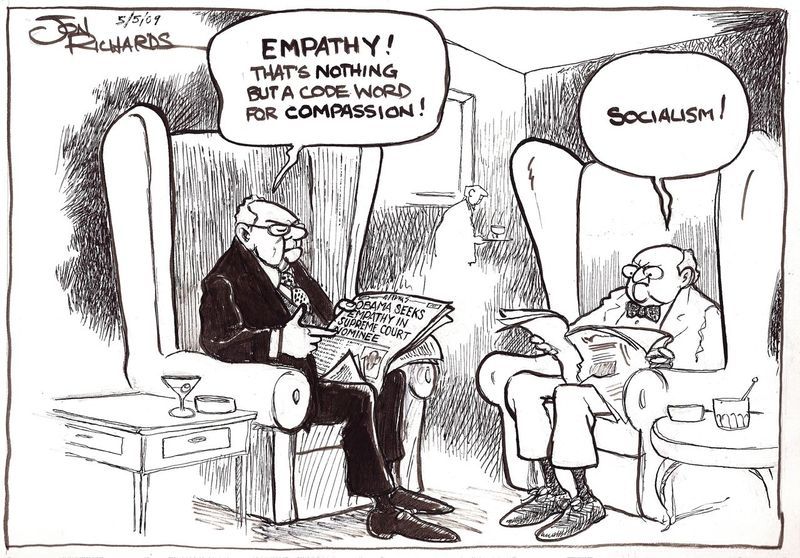
Much as empathy, the ability to see or feel other minds as equivalents of one's own, offers a solution to the problem of solipsism, it also offers a solution to the problem of selfishness in ethics. Being able to approximate the experiences of others in one's mind allows one to appreciate their experiences and thereby establish a kindred connection between Self and Other.

This is a powerful connection that can succeed where reason has failed. While it is certainly possible for one to hold fast to ethical precepts, the abstraction of these precepts cannot match the tangibility of the simulated experiences generated in an emphatic connection.

And the beautiful thing about empathy is this—it allows us to see others in terms of our own selves, thus short-circuiting the solipsistic tendency by transferring our selfness onto others so we could act (or react) as though prompted by our own experience.

This may be a simplistic way of looking at this matter, but it's a start.

Many Singaporeans are accused of being armchair critics who criticise their government and their country without grasping the finer points of governance. That is often true enough, but sometimes the armchair critics are on the other side. One such example is a blog post by a travel writer who lambasts Singaporeans for their "hypercriticality". Below, I have reproduced my reply to the post.

---

Wow... where do I begin? A wealthy tourist likes a place and goes on to proclaim that the people who live there just don't appreciate what they have. Can you see where this is going?

Yes, sometimes one needs to take a step back to get some perspective. But, to put it bluntly, why do you presume to be able to tell those people 'the truth' either? Do you not realise that you too have a particular perspective that is lacking in its own way; i.e. lacking in the everyday experience of living in that place you're talking about.

If couched as a simple reminder to take a step back or a deep breath, then, sure, you may be doing those people a service by writing this. But, as it is, the piece literally compares the people you're discussing to children. If that is not extremely patronising coming from an outsider, then I don't know what is. It's reminiscent of colonial writers from the empire writing about the colonies and their denizens without a serious attempt at understanding the subject matter. It's presumptuous and sickening.

I'm not trying to make this personal. Perhaps I'm being, in a typical way, "hypercritical". But I'm truly astounded by the lack of perspective this piece itself exhibits. And, if it makes sense, that deficiency takes the form of being ostensibly unaware of its own perspective.

Positively poisonous

@ 10:37 , 0 comments


The ineffectual complainer is a hateful figure. But much more insidious is the ever-accepting positive person who is a force of inertia in society.

Chances are you know a few: The people who are always trying to get others to look on the bright side; who cannot accept any negativity; who may regard any criticism as unproductive by definition, professing to prefer 'action' (regardless of whether action by itself would actually change anything).

These types are insidious and even downright dangerous because they are disarmingly benign. They are also eminently lovable—certainly to the recipients of criticism, but also because they engender positive emotions in others who are taken in by their attitudes. They negate critique and actively try to get society to ignore ugly truths.

Suppose a man-made disaster happens in a society. These are the people who would advocate not pointing fingers—as was the case in the aftermath of the 2008 financial crisis. They ignore the fact that not laying any blame would likely result in similar disasters happening again in the future, due to the failure to enforce any form of accountability.

Even if these positive people are simply genuinely positive by nature, they must always be treated with a healthy dose of skepticism. It may be difficult—their positive emotions are infectious. But if they are allowed to be dominant, society's progress towards a more positive future would, ironically, be slowed.


I think I've had just about enough.

Often, people believe lies because they like the sound of them. It has been said that our minds are hardwired to look for patterns, even where there are none. In addition, we lock on to some of these patterns and superimpose them on things that we subsequently see. We let preconceived notions determine how we experience the world.

Certainly, such phenomena are not necessarily bad; to some extent they may even be important in helping us make sense of the world. At the same time, however, they lead us to all kinds of falsehood by making us insensitive to our actual experiences. They impose a mental processing system by which we make sense of and even twist these experiences to suit our preconceived notions.

The genius philosopher Wittgenstein devoted part of his life's work to quashing traditional philosophical thinking that falls into such a pattern. To quote a recent New York Times article on the subject:
..the non-empirical (“armchair”) character of philosophical investigation—its focus on conceptual truth—is in tension with [the goal of discovering actual truth].  That’s because our concepts exhibit a highly theory-resistant complexity and variability. They evolved, not for the sake of science and its objectives, but rather in order to cater to the interacting contingencies of our nature, our culture, our environment, our communicative needs and our other purposes.
Letting premade concepts filter our experience can inure us to authentic experiencing, compelling us into thinking that our experiences conform to those concepts. I believe that this is what makes people automatically assume that there is a god and that certain experiences are divine and must have had certain effects. It's what makes people believe in miracles that can happen any time they want. 


The scientific-minded may just cite the lack of conclusive evidence for the occurrence of miracles, but this objection goes beyond that. It highlights how we, fundamentally, look at the world around us in an inauthentic way and why we are capable of seizing upon lies and integrating them into our reality. It demystifies what is at once an act of cosmic arrogance and wilful ignorance. 

And the most egregious cases of this act are what I just can't stand anymore.

Lies multiply

@ 15:03 , , 0 comments


I was asked to write a piece on a new marketing concept called the 'multiplier' as an assessment for a job. What I wrote was probably not what they were looking for. Nevertheless, my scepticism towards it is the only worthwhile thing I had to add. 

Here, I reproduce the piece in full.

---

As outlined by McCracken in a blog post, ‘multipliers' seem to not simply be a new breed of consumers but a category of people that supplants them. 'Multipliers' are not consumers in the traditional sense of the word. Creating an opposition between the two terms, McCracken contends that unlike with consumers, whose responses to products are "an end state", producers "depend on [‘multipliers’] to complete the work". 

'Multiplier', however, cannot be a good definition for today's consumer as it seems to represent an attempt at looking past something that we as consumers will probably never leave behind—the act of consumption, with all its less-than-noble implications (or, in McCracken’s words, its “mischievous and sometimes malevolent intent”). 

The idea of consumption is closely tied to the consumer-being, the Subject, and therefore also to his physical self. 'Multiplication' is orientated towards the Object, which is either a product or its value. Therefore, there are two inherent dangers in using the latter term: The first is that the term 'multiplier' objectifies the highly anthropocentric act of consumption and takes it entirely into the abstract realm of value, thereby inverting the relationship between Subject and Object; the second is that in abstracting the act of consumption, we would forget the physical and to some extent destructive nature of consumption. These problems are explained in turn below.

The Subject-orientation of consumption means that although consumers may sometimes build on a product they buy, in reality they do not ultimately do so to engage in the act of value creation. Consumers make consumption decisions according to their desires and goals. This means that even where they add value to products, they do so for their own purposes, which may or may not be to the producers’ benefit. For example, player modification of PC games for the benefit of other players is good for producers where it drives sales for the base products. Conversely, fan-made subtitles (fan subs) of Japanese animation often come with the original products for free, and thus many viewers, for whom the subs are a crucial access point to the products, need not pay for the products at all. These details would likely be lost with the term ‘multiplier’ or ‘multiplication’.

The second danger in using the term 'multiplier' is that we would risk forgetting the nature of the beast—of the physical, animalistic and often irrational impulse of consumption. 'Multiplication' makes it sound like a pure act of creation and would therefore belie the endless, insatiable and destructive striving that has come to be implied by the term 'consumption'. And thus we may forget the real costs that consumption imposes, whether or not any value was added in the process. This is not just in the context of finite resources; it is also relevant when the Object does gain mastery over the Subject, such as when the Diderot Effect (another area of McCracken’s work) takes hold and a new possession induces an avalanche of consumption.

All of these are nuances contained within the term ‘consumer’ that I do not see in the term ‘multiplier’. Making the latter the definition of today’s consumer would therefore risk sounding like a cynical marketing exercise that conveniently glosses over them. Caveat emptor.

Child's play

@ 15:54 , , , 0 comments


Luck is superstition—at least when it suggests the existence of a god in the machine, a capricious supernatural force that determines one's fortunes. That said, luck could be a descriptive term, merely used in reference to circumstances that are perceived to be out of one's control. The first kind of luck, a prescriptive understanding of luck, should rationally be relegated to the level of superstition.

But what about the work of providence, or what people often call blessings? How much stock can we really put into that concept in our everyday lives?

It is convenient and perhaps sometimes truly beneficial to claim that, yes, one is specifically blessed in a particular matter. But here too a distinction needs to be made between a descriptive use of the word and a prescriptive one. A descriptive use could, for example, be meant to express gratitude. A prescriptive use of it would, however, go further in implicitly claiming, in a definitive way, that one is indeed personally helped by a higher power in a particular instance.

Such a claim probably stems from a desire to feel that one's every want and need is taken care of by a higher power, or that one has direct access to or a favour-based personal relationship with a deity.  

I find such notions as presumptuous or childish as they sound. Our desires don't simply translate into reality. And if we accept that a higher power exists, and that this power deserves our devotion, the appropriate attitude would be subordinate our needs and wants to its will. Even trying to think up a win-win scenario strikes me as being arrogant and wrong.

However, just as many believe in luck as a metaphysical force, so do many believers subscribe to the idea that God blesses them in every human and banal matter that they are concerned with. I think that is a very simplistic expression of faith, one that resembles young children's belief in Santa Claus or in their parents' unfailing ability to grant their every wish. I think we need to grow up from such notions and learn to find faith that does not need constant reassurance.