Film review: The Dark Knight Rises
@
05:07
•
culture,
democracy,
fascism,
film,
heroes,
ideology,
politics,
society
•
0
comments

I'd finally gotten round to seeing The Dark Knight Rises last month, and, frankly, I enjoyed it. As such, although the film—like Nolan's other works—did not leave me with much of a lasting impression, I will not be too critical of it, acknowledging the film for what it is: An encapsulation of Hollywood at its flashiest.
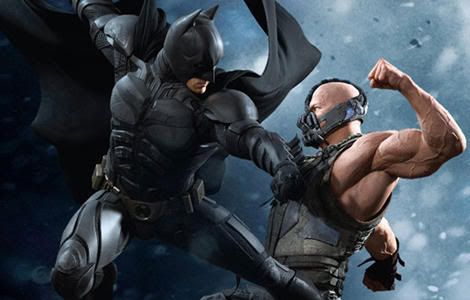
Certainly, one may detect proto-fascist undertones in the film. The Dark Knight Rises tells us, after all, that raw violence and not money or influence is the ultimate source of power—Bruce Wayne's wealth and position may get him all his fancy gadgets, but he could not defeat Bane until he trained himself up physically and prevailed against his adversary in a slugging match.
Nevertheless, I will not go as far as to say that The Dark Knight Rises' politics are regressive or backward. For one, the film strikes me as partly an attempt to articulate a contemporary brand of political consciousness; although it does so in a traditional comic-book-hero fashion, hence the seemingly more backward elements in its symbolisms. The film's favouring of muscle power over sophisticated methods could, for example, simply be explained by the film's comic book roots.
The Batman of the Nolan films is also very much a traditional comic book hero. He is basically benevolent, despite his psychological scars and his initial motivation to seek vengeance. And he fights for a supposedly universal sense of justice while remaining outside of the political and legal systems. The latter is an especially important aspect in The Dark Knight Rises, and it has been given a contemporary twist: The legal and political system of Gotham are structurally unable to solve the city's serious crime problem, and it's thanks to the work of a vigilante hero that the city is saved—a narrative that banks heavily on today's post-crises distrust of traditional institutions.
But Batman isn't just Batman; he is also Bruce Wayne, whose wealth and technological expertise can save the world in their own right. How he uses or does not use them is bound to be interesting. And it turns out that he chooses not to use them except in aid of his role as the vigilante hero—all because of his fear that someone might misuse whatever technological marvel he came up with that could, on the other hand, have untold benefits for humankind.
Not only that, while fighting crime as Batman, the wealthy and powerful Bruce Wayne does little or nothing to transform the legal and political systems that are part of Gotham's problem. As such, Bruce Wayne/Batman stands for the contemporary reluctance to rock the boat too hard, representing our bitterness towards the capitalist/democratic system that is, at the same time, tempered by an unwillingness to cast it aside. Nolan's Batman is thus the hero of today: A benevolent but broadly non-interventionist patriarch, shaking his head at the excesses of late capitalist society but letting it go on nonetheless, only scraping at the mould on the rotting meat. If anything, the world must be "ready" for utopia before it can be given it—or, more correctly, it must ready itself, because he is too cynical to help it along.
Where radical movement and revolution are represented in the film, they are portrayed as simply a big con job perpetrated by the terrorist Bane, who is not actually interested in emancipating the people. Even then, when Bane's motives are finally revealed, the film plainly steers clear of any portrayal of ideological conflict. The origins of the war (on terror) can ultimately be attributed to family drama, a perennial bourgeois favourite of a genre since when novels were the most prevalent form of mass entertainment.
Thus, it's difficult not to see the film as reactionary, a middle class abrogation of things like the Occupy movement, or perhaps even a vision in a Tea Party reverie with Bruce Wayne standing in for the Koch brothers. However, it is probably overstating the case to say, for example, that the film advocates fascist politics or plain old feudalism. After all, I would hesitate to attribute a nefarious genius to a politically-flat director like Nolan. Instead, I would suggest that the film was primarily made to entertain and, like many other films, to make money, and that its haphazard politics are merely an accident, the result of the film being made in contemporary times.
Thinking that way certainly helped me switch off and enjoy the mindless entertainment while it lasted.