Padd Solutions

Converted by Falcon Hive

Showing posts with label freedom. Show all posts

Watching Spielberg's Lincoln feels at first like watching a distant, momentous time–a time from which our banal modern lives with its host of "First World problems" are far removed.

But then I realised that there are still freedoms to fight for today, and in Singapore some of those are gay rights. There is still a law against homosexuality in Singapore which stands for an unwarranted intrusion of the state into people's private lives. And there is still significant support for that law, especially among the religious. To put it simply, these people are wrong; I'll tell you why.

Firstly, those who support the law are unable to give good evidence that the repeal of such a law would negatively affect society in any significant way. Why would it deprive any groups of rights when it actually helps a currently marginalised group? Do people have a right to ban something they don't like? And how would it destroy the family structure? Would birth rates decline significantly if homosexuality is no longer illegal? Or would it simply cause more people to lead immoral lives?

This last question is really the crux of the matter–those people have a moral objection to homosexuality. That's alright, but what makes homosexuality so special that they want to prohibit it by law? Why do they not seek to ban other sins such as gambling, prostitution or binge drinking with the same vigour and vociferousness?

Conservatives tend to put some stock in the ideas of personal responsibility and self-control. And where sins do not cause direct harm to others, they don't like to advocate such sweeping legal interventions as outright bans. However, the same position is not adopted towards homosexuality, and thus their opinion on its legality seems out of character and even irrational.

Moreover, it's foolish to insist on imposing your faith-based moral code on the legal system. Far from being a dirty word, the notion of secularism should, in law and in politics, be upheld by religious groups. Pluralism is bound up with secularism, for without the latter, a dominant religious group could persecute other groups. For example, Islamic countries may try to forbid or restrict Christian worship. A non-secular system would only benefit whichever group happens to be the most powerful. Thus, and thinking about fellow believers who are persecuted in other parts of the world, how could the religious fail to uphold secularism?

The bottom line is religion should not be brought into the debate about the law. At the same time, the non-religious arguments for keeping the ban have so far been unable to go beyond baseless talking points and wild theories about the consequences the law's repeal. Without good arguments backed by solid empirical evidence, there is simply no case for criminalising a whole swath of the population over their private choices.

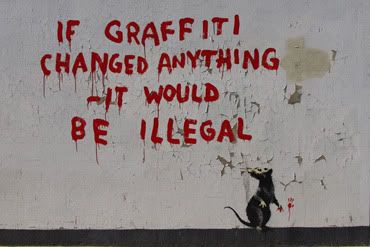
Please subvert

@ 16:08 • , , , , • 0 comments


Art and patronage has a complicated relationship. The reason is simple: Whoever pays for and facilitates the creation of art tends to influence the direction of art.

While this may be an ordinary thing in the art market, where artworks are freely hawked like any other commodity, it presents a problem for political art of the subversive kind. Art that receives state patronage is by definition art that is approved by the state; it therefore has limited subversive potential. Subversive art must hence be art that is not explicitly approved by the state; and an artistic object or act that is extra-legal is thus a good candidate for subversive art.

The arrest of the 'Sticker Lady' in Singapore and the subsequent online furore provides a good entry point for a discussion about the relationship between the state and subversive art.

From the point of view of the state, what she did was an act of vandalism or (if the distinction matters) at least that of the defacing of public property; to many, it was art. These are irreconcilable viewpoints not just because the state is not the best arbiter of what is and what is not art, which is a complex debate not suited to the dry legalist realm of discourse, but also because what she did is so compelling by virtue of the fact that it was an act of defiance of the law—in other words it spoke to its audience because it was subversive.

So, in that sense, demanding that the government recognise what she did as art and not a crime is quite beside the point. And, by extension, turning this into an issue of national policy on art and creativity is the wrong way to go about it; without a consensus that what she did was worthy of official recognition, the conversation would quickly reach a dead end. Instead, what we can do is to question the penalty against such acts and debate the implications of a harsh penalty on freedom of expression. Realistically speaking, what she did would always be legally deemed as a crime, but the enforcement of the relevant laws could certainly be toned down.

Why is a review the legal penalty for vandalism important? Firstly, a harsh penalty for vandalism is indicative of an authoritarian political culture that is not tolerant of dissenting voices, especially when this penalty is disproportionately heavy compared to penalties for other more severe crimes.

Secondly, if we want art of every kind to flourish, including subversive art, then it follows that we should try to reduce the heavy-handed prosecution of some kinds of art. Demanding that the authorities recognise subversive art is contradictory, but asking them to be less stern towards it is not.

Finally, this would also serve as a tangible and actionable goal that extends beyond this incident–a larger goal that could actually be reached without the debate being hopelessly mired in arguments about art and vandalism.


Doing some research on the public discourse surrounding last year's racist tram incident in the UK, I was prompted to ponder the rise of xenophobic sentiments in Singapore. 

As held in diaspora studies, there is no such thing as a mythical, unchanging homeland. A people's conception of their homeland is formed through experience: What you grow up knowing as your home will be the home that you know. That may seem obvious and tautological; yet people persist in perceiving their homeland as a thing unchanging, when, in reality, their conception of the homeland is simply that which they have learned.

As such, if you're used to the idea of a homogeneous or monocultural homeland, that is how you would conceive of your homeland; that is the image in which you might want to remake your country.

At the very least, Singaporeans are accustomed to the idea of multi-racialism. It has been drilled into us since we were young. Those with a libertarian bent may deride such education as plain indoctrination, but, in truth, it is hardly alien to the process of socialisation that every normal member of society goes through as he/she grows up. And it works. Of course, racism still exists, but there is no popular challenge to idea of Singapore as a multi-racial society.

Yet it has not saved Singapore from the tensions and culture shock associated with immigration, as immigrants from 'alien' cultures have become numerous enough to have a perceived impact on the local way of life. 

Further fuelling the tensions is the political situation, the official support for mass immigration, which sets up a bitter conflict between the authorities and citizens who feel that their grievances are being ignored. While I believe that an open immigration policy is, as typically held by liberal political philosophy, morally right, Singapore's immigration policy is firmly rooted in neoliberalism. In line with the country's ideology of 'pragmatism', immigration is to be supported on the basis of its necessity for economic growth. 

This ideology reduces not only immigrants into economic units, it does the same to the locals, who must embrace cutthroat competition. Wages are driven down and the economic worth of immigrants, especially that of the wealthy among them, is emphasised. The latter is clearly demonstrated by the Chinese evening daily's headline on the recent accident involving a reckless Ferrari driver from China. While hardly relevant to the tragic incident, the newspaper opted to announce the wealth and prestige of the driver first, perhaps to pre-empt local anger, ever-simmering as it was, towards Chinese immigrants. 

What the headline ends up doing is intensifying the existing social tensions, as locals once again feel that they are being treated as mere economic units whose worth is incessantly being compared to the immigrants'. And the fact that local media is tightly controlled by the authorities lends whatever the former prints an air of official legitimacy—it certainly means the authorities cannot conveniently push the blame away. 

Thus, the knee-jerk xenophobia among the public, while deplorable, should be understood as a by-product of the neoliberal race to the bottom, which has exacerbated social inequality in the name of economic growth. And as long as growth takes precedence over social justice and a fair distribution of rights and responsibilities, the government will continue to give ammunition to the xenophobes; which is a pity, since an open immigration policy could work without driving down local living standards and causing so much resentment, if only the government would speak the right language of multiculturalism, abandon the neoliberal religion and adopt better labour regulations. 


Singapore is a bit like a child who was bullied and looked down on by its peers—it grew up having something to prove.

The insecurities of Singaporean society are a reflection of the insecurities of its founding fathers. And as all deep psychological traumas go, the result is a pathological pattern of behaviour—in this case, the perpetual post-Separation obsession with proving that it can prosper without natural resources and an initial industrial base.

To this end, Singapore has transformed itself into a rentier state in all but name. And the resource that is rented: Human labour. Factories and offices in Singapore are in principle no different from the sweatshops of the Third World, riding on loose or non-existent labour laws and wage legislation that help make the country competitive as a magnet for foreign investment. Politically, in order to facilitate this path of economic development, security and stability have been prioritised over other goals such as democracy and social justice—again, much in the manner of the archetypal rentier state.

What sets Singapore apart from other rentier states that rely on renting its workforce to foreign investors is the kind of industries it seeks to attract. Thus, a significant part of the workforce has to be trained and educated enough to do the kind of work that those industries require, but not in a manner that is enough to enable them to challenge the country's socio-economic trajectory.

That is the essence of Singapore's famous economic and political pragmatism.

However, popular dissatisfaction with its immigration policy and with falling standards in the provision of public services point to a parallel but related trend in the country's political and economic stance.

Even the most diligent of workers may not be able to stomach the fate of forever being a mere cog in the economic machine. Hence, as a form of compensation for their dedication to the government's vision, citizens were promised comfortable middle class lifestyles that were ensured by the provision of subsidised high-quality public services. This is one of the reasons why the government has invested heavily in the country's healthcare and transportation infrastructures—things that are, incidentally, important in maintaining the productivity of the workforce.

This social compact has held until fairly recently. As Singapore increasingly aligned itself with the neoliberal paradigm, however, the old wisdom of labour market liberalisation—which also happens to be a core tenet of neoliberalism—was eventually joined by the move towards the privatisation of state-owned enterprises.

With this move, naturally, came an increased emphasis on profitability, which has been blamed for the fall in service standards in the country's public transportation system, as demonstrated by the recent and unprecedented major disruptions to urban rail services.  At the same time, fares continue to increase, which only helps to lend credence to the notion that the privatisation of public transport has not been in the public's interest.

In addition, as an extension of its stance towards the labour market, Singapore is importing large numbers of cheap workers in its continuing effort to keep labour costs low, thereby contributing to overcrowding and adding to the stress on the country's infrastructure.

Thus, Singaporeans can no longer expect the nanny state to take care of them. Now, all we get in return for our hard work and dedication are promises that are no longer backed by concrete socio-economic support structures. We may have been a first-class rentier state before, but now, with increasing income inequality and decreasing welfare, there is less and less to separate us from the neighbouring states we so enjoy looking down on.

Can things change? Perhaps with the aid of the vast sums of public money that is currently given to the government's investment bankers with little or no public oversight. Will things change? Probably not if we are counting on the old guard to make it happen.

Unfortunately, at the rate we are going, change probably won't come soon enough. Add in the uncertainty in the global economy and the prospect of slower growth, and you know we're in for a rough ride. 

So, in light of our predicament, let me say this: Welcome to the 21st century, ladies and gentlemen. The worst is yet to be.


If it is true that we are all free, why do we consistently choose what is bad? Why does participation not lead to quality in society?

This is a question that Christianity asks in order to call to our attention true freedom in God, free of enslavement and of human weakness, which causes us to be unable to choose anything but the slavery of sin. Unfortunately, Christianity cannot be divine because it is tainted by human beings. Thus we are left to ask questions on our own, as the Church Fathers did.

Does choosing to be slaves imply freedom? Some might say yes. This absurdity and contradiction comes about through two main threads of human thought: Libertarianism and relativism gone mad. The first posits that human agency is so absolute that human beings can, if they so choose, lose it. The second would have us believe that anything can be good to someone—perhaps some people choose to be slaves because they want to be slaves, perceiving slavery as a good? Or perhaps there is no good at all, only preferences, in which case we might as well be nihilists.

Marxist thought, on the other hand, offers a human solution to this puzzle. In our apparent freedom, we perpetually choose to be unfree because of false consciousness. We are not attuned to our real interests, and therefore we choose what is bad by first allowing our freedom to be subverted in letting powerful groups tell us what we want.

"We are free to choose," they say, as they readily queue up for the next Apple product like the hungry for bread.

It is probably true that to some extent preferences are negotiated. The industries give us what we want while trying to mould our tastes to further their own interests. But, if this picture allows neither side to wield near-absolute power, why does the reality feel so stunted? Why does a relatively free market not produce the promised creativity? Why does the UK publishing industry, for example, only publish what appeals to lowest common denominators, what will attract by virtue of its harlot-like easiness?

Why can we not, for the most part, refuse the bad?

Either we are extremely stupid as free beings, or we are not truly free. I choose to believe the latter.

The fact is we are not free as long as we are enslaved by uncompromisingly non-objective conceptions of the good, or by false notions about freedom. And this is something we as free beings are responsible for—we are guilty of enslaving ourselves through our own ways of thinking.

Some scholars are quite dismissive of the Frankfurt School, thinking it an artefact of a bygone age, while they indulge in blissful proclamations about an age of freedom and choice brought about by technologies they hardly know themselves. They study every petty whim of society and profess to find all that is good with the universe in Coronation Street.

But, far from dissipating, power merely grows ever more subtle in its application. The Frankfurt School is not wrong. It has just become less easy to see what they criticised in their time.

A week or two ago, the blog of someone I know received an unexpected comment. Some unknown dude (I shall presume it's a guy, since he sounds like one) seemed to have found the blog and commented, on the entry that talks about moving away from home for the year, that the author sucks and must be "a closet gay".

Well, I don't see what could justify such a comment to begin with. Is any personal reflection a sign of someone being a closet gay?

Another funny thing is the idiot seemed to have done this at work, without being aware that his IP address could be traced to his office. And apparently he works for Firebrand Interactive Ltd at North Bridge Road. Sounds like a pretty regular office worker.

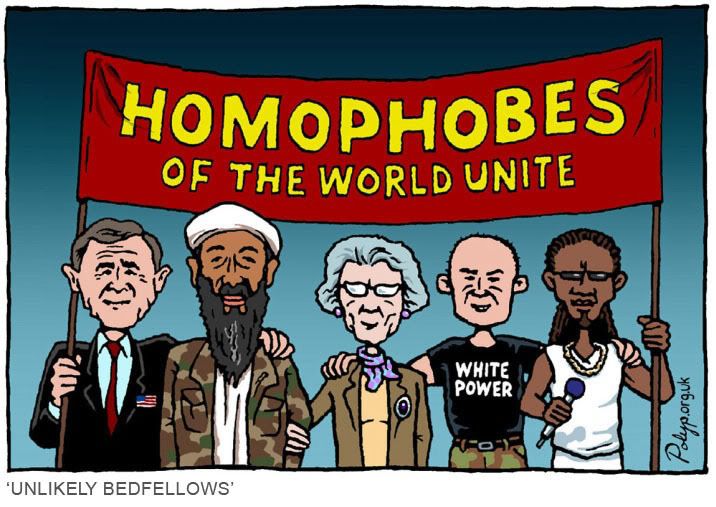
So we can tentatively establish that some Singaporean office workers are juvenile. But the fact that he used the word "gay" in a derogatory manner also indicates that he is intolerant towards a sexuality that is different from his own. And I guess it would not be news to anyone who knows Singapore to say that many Singaporeans are intolerant in the homophobic sense.

Personally, I have little tolerance for the intolerant, but I like how John Rawls puts it: In the absence of a real threat to liberty, we should tolerate the intolerant because we shouldn't act unjustly just because others act unjustly. Moreover, a society that tolerates people who have no title to complain about intolerance towards them (because they preach intolerance themselves) might have a civilising influence on them over time.

In other words, we don't try to outlaw them like they try to outlaw others because we're civilised people, unlike them.

But I'm a Marxist, so I do believe that we should fight back. And we can do so by aggressively questioning the rationale of their political crusade. I'm confident that there is no way institutionalised homophobia is defensible in a modern and secular country. Who said it is immoral and why? Why is it unnatural? The clothes you wear are unnatural – do you propose having them banned for being unnatural? These are just basic questions that I've never heard a homophobe give satisfactory answers to.

And, even under the purview of freedom of speech, there are reasonable limits. Freedom of speech is not an excuse, for one, to have someone in a public position run away with her mouth. Leadership is, after all, supposed to carry responsibility, right? What would happen if public leaders started talking about their reservations regarding certain ethnic groups? What effect would that have on the society?

But I've written on this before, so besides the few points that I've raised here, I would like to leave the intolerant with something they do deserve – ridicule.

I bet they haven't spent much time thinking about what they believe. Maybe only prayed hard about it.


Last week I wrote about what freedom means. But it might raise some questions in some people's minds. What spurs me to confidently state that freedom doesn't really apply to certain opinions? I brought up the fact that freedoms clash, and that some precede others. Thus, the freedom of speech should not be emphasized over (among others) the right to live and to pursue happiness.

Nevertheless, let's dig around a bit more. Or, rather, let's turn our eyes to the elephant in the room: Truth – as opposed to falsity or ignorance.

In all the discourse about the freedom and the relativism of opinion, we might forget that the elephant sits quietly on one side. Others pointedly ignore it. But it's there. Maybe one needs a shock before one remembers its presence. Maybe some news that would set our alarm bells off, for example – like the recent proposals being considered by the Texas Board of Education.

The conservative-dominated Board appointed six reviewers to propose changes to make to the history curriculum. Two of the three reviewers appointed by conservative board members run conservative Christian organisations, while the three appointed by the moderates and liberals are all professors of history or education at Texas universities.

Here are some recommendations that the conservative reviewers made:


Replace Thurgood Marshall with Harriet Tubman or Sam Houston.


In first grade, students are expected to study the contributions of Americans who have influenced the course of history. Rev. Peter Marshall, a reviewer, calls Thurgood Marshall – who as a lawyer argued Brown v. Board of Education and later became the first black justice on the U.S. Supreme Court – a weak example."

Brown v. Board of Education of Topeka was the case where segregated schools were ruled unconstitutional in the United States.


Delete César Chávez from a list of figures who modeled active participation in the democratic process.


Two reviewers objected to citing Mr. Chávez, who led a strike and boycott to improve working conditions for immigrant farmhands, as an example of citizenship for fifth-graders. "He's hardly the kind of role model that ought to be held up to our children as someone worthy of emulation," Rev. Marshall wrote."

César Chávez was a Mexican American labour leader and civil rights activist who made contributions to the recognition of workers' rights in the United States.


Replace references to America's 'democratic' values with 'republican' values


Reviewer David Barton suggests swapping out 'republican' for 'democratic' in teaching materials. As he explains: "We don't pledge allegiance to the flag and the democracy for which it stands."

Can you see where these recommendations are going?

Now, the question that begs asking is what were these religious leaders doing making official recommendations on school curriculum in the first place? Why were actual educators and experts in the field sharing the table with them? We can infer a sad answer from the examples above, especially the third.

And this, by the way, is the Board that has approved the teaching of creationist critiques of evolution in schools.

Thus, the elephant is forgotten amidst all the politicking. And Thio Li Ann's case is another example. Let's pick just one issue amongst the many it has:


Homosexuality is a gender identity disorder; there are numerous examples of former homosexuals successfully dealing with this. Just this year, two high profile US activists left the homosexual lifestyle, the publisher of Venus, a lesbian magazine, and an editor of Young Gay America. Their stories are available on the net. An article by an ex-gay in the New Statesmen this July identified the roots of his emotional hurts, like a distant father, overbearing mother and sexual abuse by a family friend; after working through his pain, his unwanted same-sex attractions left. While difficult, change is possible and a compassionate society would help those wanting to fulfill their heterosexual potential. There is hope.


- Thio Li Ann

Compare that to the American Psychological Association's (among others) findings:


Sexual orientation has proved to be generally impervious to interventions intended to change it... No scientifically adequate research has shown that such interventions are effective or safe. Moreover, because homosexuality is a normal variant of human sexuality, national mental health organizations do not encourage individuals to try to change their sexual orientation from homosexual to heterosexual. Therefore, all major national mental health organizations have adopted policy statements cautioning the profession and the public about treatments that purport to change sexual orientation. The statement of the American Psychiatric Association cautions that “[t]he potential risks of ‘reparative therapy’ are great, including depression, anxiety and self-destructive behavior."

And the American Psychiatric Association's findings:


APA affirms its 1973 position that homosexuality per se is not a diagnosable mental disorder... APA recommends that the APA respond quickly and appropriately as a scientific organization when claims that homosexuality is a curable illness are made by political or religious groups.

Who do you trust, scientists and experts or conservative leaders with religious agendas and maybe some sinners to burn?

And, therefore, this is another compelling reason why freedom of speech is quite beside the point here. We want to argue truth, not falsity. We can talk about the freedom to hold and express an opinion all day, but if the opinion is utterly false, then nothing will be accomplished at all. And there might be a heavy price to pay too.

So, are we going to acknowledge the elephant in the room?

Well, I think I know what the Republicans might have done with theirs.


They don't get freedom, do they?

People are crying foul over a Singaporean academic being denied a teaching place at NYU because of her anti-gay stance, asking "What academic freedom?".

Truth be told, that's almost good question. They don't seem to have a good idea what freedom really means, so they should be asking "What is academic freedom?".

To be fair, a lot of Americans don't get it too. Freedom doesn't mean the freedom to do whatever you want. That has never been the case, since no country on earth has no penal code whatsoever (enforcement is a separate question). Many reasonable people also believe that you don't have the freedom to say anything you want anywhere, freedom of speech or no.

Best of all, one freedom often eats into another. Ireland just passed an anti-blasphemy law in an age where countries are abandoning those. Ostensibly, it's done in the name of freedom of religion. However, it erodes one's freedom to say some things that are relatively harmless.

Which freedom do we uphold?

So let's get straight to the point. There are good principles in this world, and we should follow them. Academic freedom doesn't mean the freedom to be intolerant towards other people at the side
– think about a teacher who secretly favours students of one race over those of another, for example. The much-repeated quote about evil growing where good men and women do nothing about it applies here as well. Intolerance, if left unchecked, breeds intolerance. Many people would be opposed to having a teacher who openly expresses or advocates racism. They know, or at least intuit, that it's not healthy for the society to allow intolerance to fester in an especially sensitive area – where young people are receiving their education. Why should anti-gay people get a pass?

Gay activists and liberals are not quashing academic freedom in being opposed to such a pedagogue (and part-time demagogue?). They are not about to have someone who is lacking in social credentials be placed in a position that carries a clear social responsibility. And, above all, they are for the freedom to coexist.

As for questions of meritocracy, whether academics should get positions based solely on merit in their fields, whoever said that meritocracy is necessarily good anyway? A completely meritocratic society would be exceedingly cruel. The strong would lord it over the weak undisputed
– so much for the development of civilisation (recall Hammurabi's Code, set down thousands of years ago).

I'm sympathetic to the fact that some pedagogues are smart but messed up and we shouldn't waste their talents. If they're that good, give them their positions, but they should not be allowed to publicly express their harmful beliefs during their tenure. Incensed by this recommendation? As it is, you're not allowed to do insider trading so that the financial market can function properly. In a similar vein, you shouldn't be allowed to sabotage the development and maintenance of a tolerant society. And when it comes to being able to make money, people are all for controls like intellectual property rights. I say that there is another kind of 'intellectual property right' in academia: Students have the right not to have their intellect polluted by intolerant views while learning.

And, finally, let me say one more thing. Would you be surprised to find out that some of the same people crying for freedom in this instance would be crying foul if other people took the liberty to do things that they don't like? Why, you needn't look beyond this case to witness that. They want freedom in academia? Why is the law against being a homosexual still there?

Maybe it's freedom unless they disagree with your sexuality...