Padd Solutions

Converted by Falcon Hive

Showing posts with label socialism. Show all posts

Singapore is a bit like a child who was bullied and looked down on by its peers—it grew up having something to prove.

The insecurities of Singaporean society are a reflection of the insecurities of its founding fathers. And as all deep psychological traumas go, the result is a pathological pattern of behaviour—in this case, the perpetual post-Separation obsession with proving that it can prosper without natural resources and an initial industrial base.

To this end, Singapore has transformed itself into a rentier state in all but name. And the resource that is rented: Human labour. Factories and offices in Singapore are in principle no different from the sweatshops of the Third World, riding on loose or non-existent labour laws and wage legislation that help make the country competitive as a magnet for foreign investment. Politically, in order to facilitate this path of economic development, security and stability have been prioritised over other goals such as democracy and social justice—again, much in the manner of the archetypal rentier state.

What sets Singapore apart from other rentier states that rely on renting its workforce to foreign investors is the kind of industries it seeks to attract. Thus, a significant part of the workforce has to be trained and educated enough to do the kind of work that those industries require, but not in a manner that is enough to enable them to challenge the country's socio-economic trajectory.

That is the essence of Singapore's famous economic and political pragmatism.

However, popular dissatisfaction with its immigration policy and with falling standards in the provision of public services point to a parallel but related trend in the country's political and economic stance.

Even the most diligent of workers may not be able to stomach the fate of forever being a mere cog in the economic machine. Hence, as a form of compensation for their dedication to the government's vision, citizens were promised comfortable middle class lifestyles that were ensured by the provision of subsidised high-quality public services. This is one of the reasons why the government has invested heavily in the country's healthcare and transportation infrastructures—things that are, incidentally, important in maintaining the productivity of the workforce.

This social compact has held until fairly recently. As Singapore increasingly aligned itself with the neoliberal paradigm, however, the old wisdom of labour market liberalisation—which also happens to be a core tenet of neoliberalism—was eventually joined by the move towards the privatisation of state-owned enterprises.

With this move, naturally, came an increased emphasis on profitability, which has been blamed for the fall in service standards in the country's public transportation system, as demonstrated by the recent and unprecedented major disruptions to urban rail services.  At the same time, fares continue to increase, which only helps to lend credence to the notion that the privatisation of public transport has not been in the public's interest.

In addition, as an extension of its stance towards the labour market, Singapore is importing large numbers of cheap workers in its continuing effort to keep labour costs low, thereby contributing to overcrowding and adding to the stress on the country's infrastructure.

Thus, Singaporeans can no longer expect the nanny state to take care of them. Now, all we get in return for our hard work and dedication are promises that are no longer backed by concrete socio-economic support structures. We may have been a first-class rentier state before, but now, with increasing income inequality and decreasing welfare, there is less and less to separate us from the neighbouring states we so enjoy looking down on.

Can things change? Perhaps with the aid of the vast sums of public money that is currently given to the government's investment bankers with little or no public oversight. Will things change? Probably not if we are counting on the old guard to make it happen.

Unfortunately, at the rate we are going, change probably won't come soon enough. Add in the uncertainty in the global economy and the prospect of slower growth, and you know we're in for a rough ride. 

So, in light of our predicament, let me say this: Welcome to the 21st century, ladies and gentlemen. The worst is yet to be.





What does it mean to live the good life?


That is Aristotle's question. It's also one that we would do well to think about in this day and age. Does it merely translate to pleasure-seeking, a vulgarised Epicurean way of life, or a crude Utilitarian one based on the consumption of material goods? Looking at how many people view life and its rewards today, those do seem to be very popular views.

Well, I won't be preaching about the good life here. I will merely borrow Aristotle's concept of the eudaimon life—meaning a fulfilling or flourishing life—because I think it's very appealing. Basically, it's a life in which one seeks to realise one's potential as fully as possible.

What I will instead talk about is how the eudaimon life figures in politics. After all, a coherent ethical system has to integrate the private with the public or the individual with the social and political.

I think it's a great weakness of the modern (and here I mean liberal) political system that it doesn't tackle this question. At most, it only goes as far as to praise freedom or autonomy and encourage the means that are necessary to ensure it, such as political participation. Of course, governments often do promote the concepts of a harmonious society, healthy living and etcetera, but these are a matter of policy rather than integral aspects of a coherent philosophy.

The problem comes where, instead of enabling a pluralism of perspectives that the prizing of autonomy warrants, modern political philosophy merely ends up looking away while a dominant ideology monopolises the people's consciousness.

And that ideology can do so because people have material needs, which it has been able to dictate, both through their provision and through the creation of new ones. In other words, with a pervasive market system based on the valuation of most aspects of life through currency, it has been able to dictate people's way of life. It has also been able to create a false consciousness, which I take to mean the creation of endless wants and needs that it and only it can fulfil.

It's no wonder that many view life as a long road of hard (or not so hard) work that promises to reward them with comforts and luxury. And in such a society, money (and I don't mean just hard currency), as the universal medium, becomes paramount. Everyone becomes, often involuntarily, money-minded.

That is quite contrary to the eudaimon life. What the latter seeks is not material wealth, but wealth of character and being. It teaches moderation and encourages the pursuit of excellence. It seeks a balance between the material, social and spiritual.

But only if people are released from the shackles of material domination and false consciousness would they be truly free to pursue such a way of life.

And this is why I think the eudaimon life is related to and forms a moral structure for a socialist society. Far from being an egalitarian hell, socialism seeks to collapse the structures of material domination, to put the fruits of labour in the hands of those who laboured for them so that they may live their lives to the full. It does not stand for authoritarianism and collectivism. It stands for freedom in more aspects life than just the political.

Now, on a final note, does a political philosophy that seeks the fulfilling of one's potential imply support for a meritocratic system? This is something that needs more time to be considered. But if I were to hazard a guess I'd say no, in the sense that if meritocracy gives license for material domination by the meritorious, then it would be contrary to the spirit of a eudaimonic society.

Besides, we need to be careful when we talk about meritocracy. Without a level playing field and true quality of opportunity, true meritocracy is not possible. We need to distinguish between true and idealistic meritocracy and pragmatic meritocracy, the latter which Singapore (for example) subscribes to. Which do we mean?

Pragmatic meritocracy does not make a clear distinction between those who have the odds stacked against them and those who were born lucky. And our sense of fairness, which is apparently corroborated by neuroscientific evidence, should prevent us from buying into it.

People say there is no such thing as a free lunch. Surprisingly, the very same people who might say something like that often seem to expect it.

Let's not talk about corporate bailouts and taxpayer-funded bonuses. That's too much of a fish in a barrel (though it's a large fish that manages to swim away nonetheless). Let's talk about public action, in the sense that the public takes action to negotiate—diplomatically or otherwise—with the authorities.

I've written some time ago that people must organise themselves to fight for their interests, and that legality is not a necessary moral consideration because of the imperfections of the legal system. The angle I'm going to take here is similar but slightly different. It can be encapsulated by a question: What are the ethics of public action?

And, to go straight to the point, I will ask another question: What is the moral worth of representative democracy if the representatives are not willing to, first and foremost, present the interests of the people they represent but are overwhelmingly concerned about being 'constructive'?

Certainly, there are valid considerations that call into question the idea that you must do exactly as the people you represent wish. What if you think that what they want isn't in their interest or is morally wrong? But the issue is not quite so complex here. The issue is whether the desire to be constructive trumps the proper presentation of a legitimate concern of the public.

Well, unlike in what seem to pass for public campaigns these days, the ethics of public action should not be based primarily on etiquette. Whether you are seen as being polite or positive should not be considered ahead of doing what is necessary to push for the interests of the people you are representing. This isn't business, and the fact that business etiquette has bled into politics is quite alarming.


The issue remains when it's the public itself that is overly concerned about the tone of the negotiations. Essentially, the point is you are either prepared to do some tough bargaining if it proves necessary, or you won't change anything. Being positive is not a trump card and asking for charity is seldom going to work. There's no free lunch, remember?

Or is that an excuse for some things only?

But going deeper than that, being constructive means accepting the framework that is imposed by those in positions of power. And by doing so, you are often being put on the defensive when you should be on the offensive.

To take an example from real life, the fact that students pay (sometimes exorbitant) fees for their education is a fact. Hence, that the executives making decisions for the university feel that they are free to increase those fees while cutting services should not, from every reasonable perspective, simply be accepted. It should be resisted as far as possible by the students. However, by choosing to be strictly 'constructive', a student union that is supposed to fight for their interests has already given up half the fight. By doing so, it is assuming a weaker position and is relying on the goodwill of the executives to grant concessions on a matter where there is a conflict of interest between the students and the university. And how such a body can thereafter retain the claim to represent students is beyond me.

On the contrary, the ethics of public action should demand that the necessary actions be taken to fight for the interests of the public. And if that means having to be less constructive and even destructive, so be it.

However, we must note that being destructive does not necessarily mean being physically destructive. In many cases, physical destruction is unwarranted and morally wrong. Rather, being destructive means the opposite of being constructive, and that is not to accept the imposed framework, rejecting it from the democratic perspective of the people's right to decide their affairs. For what is the moral worth of democracy if the people are merely suppliants bound by codes of conduct, amongst other fetters? Similarly, the ethics of public action must be closely tied to the public itself, the subject and the object of public action.

Now, having rejected the imposed framework, negotiations might come to an impasse. And this is where we return to the subject of tough bargaining. Only when you are able to threaten the prevailing order will you have any basis for negotiations. Only when you are willing to commit fully to your own cause will you get anything. To think otherwise is naive and irresponsible.

There are other reasons for declining rates of political participation in some liberal democracies, but the impotence of the public, its inability to effect the desired changes, certainly plays a part.

After all, if we can only go as far as it's polite to do, then we're only going to be politely declined. So what's the point?

A very common accusation made against the left-wing is that it is too idealistic. Communism fails to take into account human nature, they like to say – it's just too impractical.

Those who are fashionably or vacuously apathetic might be especially fond of this criticism. Moreover, according to many of these people, left-wingers and 'liberals' aren't just dreamers, they are also "self-righteous" bores who are always "pontificating".

As a matter of fact, there seems to be an inherent contradiction when one says that Marxism is "idealistic". Marx is said to have turned Hegelian dialectics on its head (or back on its feet) when he transformed it from an idealist to a materialist approach. Marxists generally see matter, not ideas, as the beginning and end of reality.

So why is Marxism labelled as "idealistic"? Well, you might say, that just means that it focuses on an ideal state or has an ideal state of society as its end.

What about democracy, then? Is it not essentially an ideal state of society? A few centuries ago, many would have laughed at those who extolled the virtues of democracy. It's too ideal, they'd say – the people are too unruly to rule themselves. Compare that to the common perception of it today. Many of the same people who would dismiss Marxism as too idealistic are likely to chide authoritarian regimes for being undemocratic. There's at least a tad bit of irony there, don't you think?

But democracy doesn't really have an ideal end, you might now say. It's an achievable state that has been realised and isn't aimed at creating a utopia.

Well, has it been achieved? Is the democratic process not ongoing, repeated regularly in the form of voting exercises? Does it not have to constantly face forces that seek to usurp its procedures, perhaps even powers that want people to choose to be unfree? Is it not always in conflict with the bureaucracy, the state within the state that has its own aims and its own way of doing things?

Democracy, therefore, is an end in itself, and one that will never be 'achieved' in the simple sense of the word. Democracy is a constant struggle.

And so is socialism.

Orthodox deterministic Marxism does lay claim to a scientific view that presages an inevitable Communist society, which is preceded by a period of 'socialism', a dictatorship of the proletariat. And Leninism goes on to say that this period is brought about by a revolutionary party. But these set paths and clear milestones are not necessary elements of Marxism or of its method of historical materialism.

Some Marxists believe in the constant struggle and conflict for a just society – a class struggle, the dialectics of society. Just as the struggle for democracy never really ends, this struggle is perpetual. We make no predictions or promises about a specific kind of utopian society at the end. We know, however, that struggle is the way to progress, that entrenched traditions of injustice have to be gradually worn down. And our end is the human being, who is deserving of equality and dignity.

Gradual progress is not impossible progress. It does not call for world revolution. I believe in working within the constraints of parliamentary government, in working autonomously as individuals in resisting exploitation, as well as in extra-constitutional methods – we can and should use whatever means is necessary and beneficial without contravening the over-riding principle: The equality and dignity of human life. We work towards an end, but we do not specify a particular situation as the outcome, much less do anything and everything to achieve that outcome. Marxism isn't about gulags and purges. Marxism should be humanist and highly realistic.

So, again, what is it about the left that is so idealistic? Choosing the status quo is not being realistic. Left-wingers are the genuine realists because they are attuned to reality and the great suffering that is present, which motivates them to fight for change. They are also realists because they believe that real material life is too important to be dictated by abstract ideas. Reality bears down upon us like an inexorable force. Hunger demands food; tiredness demands rest; discomfort demands alleviation. So when we are told that we have to face poverty and deprivation because of some concept or other, we find it difficult to accept, and we fight. And that is to face reality. That is what it really means to be realistic.

Now to those apathetic types, according to whom we are always "pontificating" and being merely "faux intellectual", there's not very much that needs to be said. Of course, such comments do not constitute criticism, merely some brash lashing out that likely hides an inferiority complex. And if such comments apply to us, they would apply to anyone who has argued for anything, such as in academics. Have such comments enough merit to invalidate whole fields of inquiry, just because these people have no mind for arguments?

But I think we should be quite sympathetic to them. After all, we are opposed to the real faux intellectuals – the 'experts' who treat ideas and unintelligible categories as science. In any case, the left-wing position should not be difficult to grasp. If everything else is ignored, an essential principle can still be easily understood, one that a fireman adheres to everyday: People first, property and wealth later.


To those less enamoured of the economic realities of the world today, things might seem pretty bleak.

We've witnessed the destruction wrought by the big risk-takers and deregulators, those who stand for an unblinking faith in 'experts' and suit-wearing leaders; those who oppose all fetters in the name of freedom, and who think that the consequent risks can be managed.

Yet it's unlikely that these people will go away. There is a renewed consciousness of the need for regulation and moderation, but business culture remains as people continue to buy into it. There's a persistent love for the well-dressed, for achievers, success stories and unlimited accumulation – the Faustian of Spengler actualised; a penchant for concepts and the infinite with little regard for reality.

Who can stand against the colossi who bestride the world, at whose legs we merely peep about to find ourselves dishonourable graves?

From my experience, the average Joe is typically of the opinion that the old Left is a thing of the past. Didn't Communism effectively end with the collapse of the Berlin Wall? And the more astute might observe that developments such as Reaganomics and Thatcherism, as part of a general shift towards the right in the developed world, indicate that capitalism has inexorably triumphed.

History has ended, and it ended at Wall Street.

Now the opposition, it seems, is chiefly between the Right and the New Left. The latter is an umbrella for various causes ranging from women's rights to environmentalism, causes that are frequently allied but do not form a unified front. Most coherently, it is embodied by people with progressive sensibilities who are labelled as 'liberals'. These people are opposed to the markedly right-wing but are often inherently capitalistic. Thus, they are perhaps best described as left-of-centre or even centrist.

Significantly, however, they do not have a strong opposition towards the fundamental characteristics of bourgeois-capitalist thinking. They are also frequently misled by positivism, by a tendency towards abstraction and spiritualism, or by a false sense of independence. Thus, in principle, they represent merely variations of the ideas of the ruling class.

And thus, from the perspective of political ideology, their opposition is not truly dialectical. Consequently, it cannot be truly transformative.

However, I submit that to think in such terms is to deviate from dialectical materialism. As Georg Lukács put it, "It is not men’s consciousness that determines their existence, but on the contrary, their social existence that determines their consciousness." As I interpret it, this implies that the struggle against the social framework of naked capitalism follows from our economic conditions of existence. In effect, we have to look at what is made possible by economic stimuli that push people into action, rather than how ideological currents drive people.

Class struggle embodies the conflict between advancing mode of production and restraining social relations. I think the conflict is intensified when the prevailing social relations actually threaten to undermine the current mode of production. Witnessing the threat posed by modern capitalism to economic stability and survival is a wake up call for many people. Now more aware of dangers inherent in a 'free' market that is dictated by profiteering entrepreneurs, people are calling for greater regulation, smaller corporations, and the abolition of reckless risk-taking.

I think this should be regarded as a movement in the struggle. It has the potential to nudge the focus away from individuals, in the form of industry leaders, and towards the masses, brought about by greater state oversight and the increased strength of workers relative to smaller companies.

As such, I think anyone who is interested in social change should join hands and put their collective weight behind this development. Ideological currents do not often hold people together for long, and there is no use sitting down and waiting for a revolution. Marx himself seems to have disparaged Ultra-Leftists who refused to work with reformists. Left or New Left, we should be interested in improving the economic conditions of the masses, and this can be achieved in some measure by taking power away from the conmen and the charlatans who have controlled the government in past decades.

This could be a chance to undo past reverses and make another step forward.

As for the undying business culture, there is no need to resign ourselves to it. We must cultivate the seeds of resentment that have been sown. This is our side of the culture war. Now that the men in suits are down, albeit only slightly, it's time to press the advantage. We must again join forces with all who are of similar mind to show that the myth of the entrepreneurial Atlas is poison to economic well-being, that the world of business is not the world of the seeing, and that solidarity rather than selfish profit-seeking is the path of stable progress.

Let the precarious economic conditions of the day lead our way. There is hope in solidarity of action. And there is hope for a gradual progress towards a better society.


I might sometimes be guilty of this myself, but I try hard not to be. I have very little respect for people who don't do as they say, people who don't keep their word. But, of course, at the same time, I'm not sure I like Chigurh-style honour either. I guess the choice is often between two evils. As they say, there is no such thing as a free lunch; no such thing, perhaps, as genuine kindness.

Another quip that is often repeated is "Talk is cheap". It sure is. It's much cheaper to talk about integrity than to actually practice it at the cost of giving up the advantages you get by being unprincipled. And, ironically enough, when some people are caught red-handed, they'd be full of it – they'd be full of remorse, warning others not to follow their example, reshaping themselves anew as moral leaders.

But what if they had never been caught?

On a related note, you might expect that I don't believe in things like Corporate Social Responsibility. Well, no surprises here – you'd be right on the money. Corporate Social Responsibility should have a new marketing name: Bull Fucking Shit.

By definition, corporations don't have any sense of social responsibility. Anything they do is for profit or for the bottom line. Why, a company is not an individual with a moral compass. It's a collectively profit-oriented entity composed of business people who employ workers. In fact, Adam Smith, the grandfather of capitalism himself, killed the idea of Corporate Social Responsibility centuries ago by stating that it is self interest that motivates people to work; that good arises out of selfishness by virtue of the invisible hand, which ordains that more social benefit will come out of it than loss.

Of course, today, it's all about dressing it up. The concept of the invisible hand is one of the earliest moral pretences that have been constructed to justify profit-seeking and selfishness in the consciences of people. Another example is the capitalist or conservative ethic: You 'deserve' every penny you earn and don't 'deserve' every penny you don't. In other words, poor people are generally lazy and morally bankrupt people, and that's why they are poor. Evidently, circular logic is sometimes needed to forget the nagging feeling that something isn't right.

And it's actually easy to see what is wrong, if only we'd wrest ourselves from our conditioning. When selling bread, the baker might not be concerned about feeding you, being concerned instead about getting paid. Nonetheless, the baker needs your custom and you need his bread. You exist within a community whose members are interdependent and are thus inevitably working for each other's benefit. Individualism and selfishness are the main reason why there is inequality and poverty. The invisible hand is a myth, and people, by the non-principle of selfishness, go on to create systems that seek to maximise their respective individual benefits even at a terrible price to others. Is the good of a Warren Buffet greater than the good of a hundred people without adequate health care? Is the good of one American or European greater than the good of a hundred Africans?

Therefore, all the moralising hides a serious moral lapse that was born when our imaginations took a leap of faith away from the reality of interdependence.

Speaking of morality, we can probably agree that lying is generally immoral. But is the alternative then to be honest?

Sometimes people have candid moments that betray their true interests, especially when pressed. At a recent conference, a business representative warned that more regulations against corruption would force companies to maintain profits by engaging in more corruption. In a letter to the newspaper, the Singapore National Employers Federation (ST, Sept 30) resisted calls to implement fair employment practices for women, particularly pregnant women, citing the need to maintain profits. These are moments of honesty where we can clearly see that companies are not interested in society insofar as it is not profitable to be.

Does their honesty make it better? The Singapore government argues that it is better than corrupt governments in the region because it is open about paying senior politicians astronomical salaries based on salary estimates of (overvalued) private sector executives, rather than letting them engage in backroom deals. Is it right in saying so?

I contend that being honest about it is no better. Exploitation is exploitation. Injustice is injustice. Dressing them up does not change the fundamental wrongs. The only better way is to say good things and act accordingly.

That said, on a personal level, I do appreciate people who do not mince their words. It is much less tiring to deal with even outright meanness than having to guess what people's true intentions are.

Unfortunately, if we do not engage with hypocrites, some of whom might be living around us, how many people and parties do we have left to deal with? Would we be able to do anything?

Looks like we all have to be willing accomplices in this nauseating game. Personally, I have to reserve my contempt to those who have proven themselves to be completely untrustworthy. Sometimes, or perhaps most of the time, there is no choice but to single out only the worst offenders.

Sometimes, it's hard to be optimistic about this world.


Yesterday, I saw a programme on TV where a woman was crying as she told a group of young people about her plight: She could barely make ends meet and at least one of her kids had to drop out of technical school because she couldn't afford the fees. She couldn't even afford the fares for public transport.

The first question that came to my mind was why is this even on TV? To advertise the fact our society doesn't take care of its less fortunate members very well? Do people watch shows like this to cry a tear and then move on with their lives after a needed catharsis? Is this the reality TV version of Aristotelian tragedy?

Then it occurred to me that, if the programme does show that the system leaves something to be desired when it comes to ensuring the welfare of low-income groups, maybe the point is to encourage the public to help by giving to charity. Yes, our system has left these people behind, so please help them.

And that is more evidence that, in some ways, we might well have failed to evolve much from our Crown Colony days.

Recently, I believe, someone famous wrote in the newspaper extolling the virtues of hard work and practically asserting that poor people have the responsibility to pull themselves up by the bootstraps. That could've come straight out of Nashville Times in all its redneck glory.

We've come so far only to think that laughable stuff like that passes for clever social commentary? But perhaps we've come to where we are precisely because we think so, driven by the need to prove something – to prove that we're better than others.

We're so motivated by the need to win, or to not lose, that such a mindset is a distinctive characteristic of us as a people. It may seem funny, but it has a sinister side – we don't care enough about those who lost.

But I think life isn't all about winners and losers. Even businesses nowadays are focusing less on competition in the workplace and more on moving together as a team. Why should a republic not have that approach? Is our idea of moving together hand-in-hand to wave flags and sing patriotic songs together? Screw that. Where's the real solidarity?

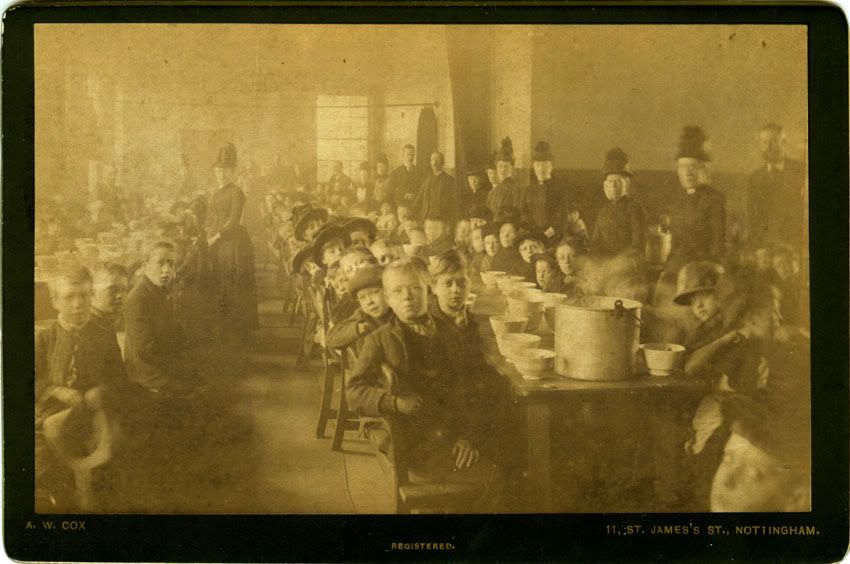
And solidarity with people on the lower rungs is shown first and foremost through social policy, not through charity. Charities did not lift poor workhouse children out of their miserable poverty. Legislation and social programs did. If there's any real determination to pull people up, it would be done on a public capacity, where it is most effective.

But, wait, doesn't the government have policies to help poor people? Heck, it makes sure we hear about those all the time.

Without having to get into a detailed discussion on policy, we can ask a very simple question: Why could that woman not afford to send her child to school?

Isn't it well known, even here, that education is a key factor in social mobility? Why are there cases where people cannot afford it? Especially when it's technical school, not university. Technical school is where people are trained specifically to work for a living. Surely there's no excuse? We can afford to lose $40 billion on stupidly managed investments, we can afford to provide free education to people who would otherwise not have it.

And simply giving handouts, as the government sometimes does (especially if elections are looming), doesn't do much. This is where people who are supposedly for a more equal society often damage their own cause. In fact, here, that could be a symptom of our terrible mindset – people who ask for handouts might often be more interested in tangible short-term gains. They want to get something, but they want it immediately in cold hard cash. That's not how the bigger problems are solved. 

We can hear it from Prof. Eugene Tan of SMU again:

All too often, the larger and more important messages intended by the various budgetary measures are drowned out by the noise of Singaporeans calculating and comparing their budgetary "gains" or "losses".

This "what's-in-it-for-me" mindset may unwittingly lull Singaporeans into sacrificing long-term benefits for short-term gains. 
Instead, a stronger social safety net may encourage Singaporeans to be less risk-adverse and to manage the pluses and minuses of globalisation. More may be willing to take entrepreneurial risks if they can count on a social safety net. The Budget must be seen as more than just a spreadsheet of the state's revenue and expenditures in the new financial year, with goodies thrown in for good measure.

It plays a critical role in keeping our social compact resilient and preparing society not just for tomorrow, but for many tomorrows.
Word.

And, after all, do we really want to live in a country resembling England during the Industrial Revolution, where a class of winners leaves the losers in the dust, only throwing the occasional coin to the latter 'out of the goodness of their hearts'?

Sadly, we might not even realise how close we might be to such a picture. It all looks very nice on the outside. We've also turned image-consciousness into a skill and covered the mirror with a painting.


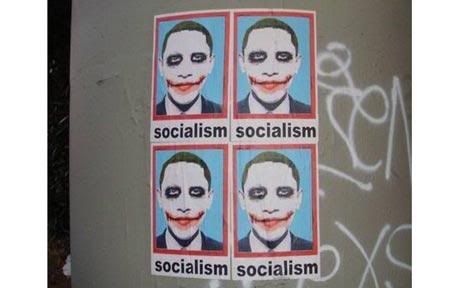
The mania about socialism has gripped America as the Obama administration reveals its true colours – mostly red, of course. A witty poster that has surfaced lately made a brilliant connection:


The Joker and socialism. Who would've thought of that? And Batman is Republican, of course. Heck, he used some crazy tracking device that looked it like it came straight out of the Department of Homeland Security. Commie Joker and holy Repub Batman!

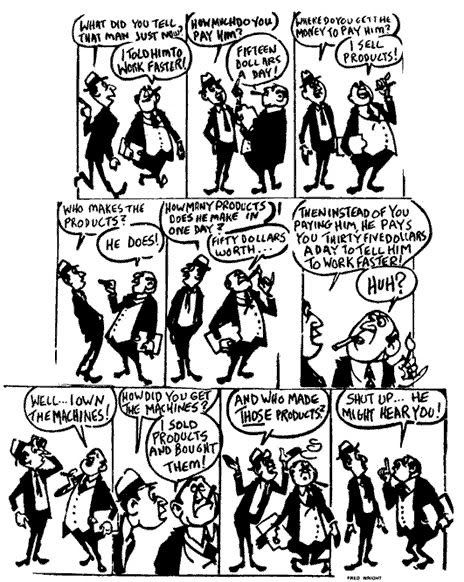
With every Joe Plumber screaming socialism whenever the Obama administration tries to expand federal regulatory powers, I decided to write a piece about socialism and what I think are socialist and what I think are not. Let me begin with an interesting cartoon:

That cartoon is very good because it encapsulates some of the fundamentals of Marxist ideas, which no doubt serve as the spring board for, if not the foundation of, socialism. So keeping it in mind, I shall offer my take on what socialism is about. It is broadly based on my own study of Marx's Capital, which is a key text in Marxist thought.


Marxism is a critique of political economy, and it is a radical one because it demonstrates ad hominem, or the characteristic of being directed towards the human subject. In Marx's words:

Theory is capable of gripping the masses as soon as it demonstrates ad hominem, and it demonstrates ad hominem as soon as it becomes radical. To be radical is to grasp the root of the matter. But, for man, the root is man himself.

Marx argued that the world of political economy is a topsy-turvy world, where economic categories and laws, which are created by man, have enslaved man and replaced him as the foci of socio-economic activity. And instead of the actual use that we have for the things we produce (i.e. focusing on our needs), we are much more concerned by how much they are valued relative to other things (i.e. focusing on the market and its operations).

This is commodification of things. Next comes the commodification of labour. Labour has a use – to produce commodities. It is bought and sold in the labour market. The value by which it goes (the wage) is not the same as the use value that the capitalist who buys it gets. The commodities that a worker produces are usually worth more in the market than the wage that the worker earns for his efforts. This creates surplus value or profit, which the capitalist enjoys.

Now, there are many reasons why this happens, and they are well covered by economics. But I contend that the Marxist critique still holds great truth. We are very focused on the intricate workings of the market, on the value of things when we exchange them, and we often lose sight of the thing behind it all – the man, who has needs, whose labour creates the commodities that are sold on the market. The subject without who nothing at all would matter because we cease to exist, since we are the subject ourselves or, failing that, because without them all economic activity would never have begun.

As I see it, a major contention is then on whether the capitalist plays a necessary role in economic activity. But even if we disagree on that issue, I think there is enough reason to pay attention to the rights of the average worker. What is the human world about but human beings? And the vast majority of human beings are not really capitalists – they still have to sell their labour to earn their wages for a living. And in this huge group of people we must include those who do not even earn wages but who, nevertheless, play important roles in human society: mothers/fathers, stay-home wives/husbands, unpaid social workers, students and children not yet in the workforce, etc.

Another big question is whether capitalism gives more than it takes. No doubt the world has gotten wealthier because of capitalism, despite the economic storms. But that is only to speak of the aggregate amount of wealth. Many people pay a heavy price each time the economy takes a hit due to man-made risks that they didn't personally take or have any control over. I think one of the things capitalism is about is rewarding risk-taking in the name of growth and development. But that should be balanced by the price that common people pay when things go awry. If risks must be taken, there must be something adequate for people to fall back on. Don't forget the common man.

I think that is the fundamental principle of socialism – the return to man. And this is why things such as universal healthcare, free or affordable education and minimum wage laws are pretty solidly socialist. Anything that violates or ignores this principle can hardly be called socialist, and things that are not necessarily based on this principle are not necessarily socialist. As such,
  • Regulation is not necessarily socialist
And, by extension, neither is big government. Plenty of Marxists are libertarian in that they see government and bureaucracy as instruments for the entrenchment of the wealthy minority. They believe in the socialist principle like their statist cousins, but they are very wary of vast and powerful governing apparatuses that can be appropriated by certain interests, and which present a strong resistance to social change from the ground up.

Besides, regulation is also significantly present in regular capitalism, and especially in non-socialist systems that emphasize control, such as Fascism.
  • Taxes are not necessarily socialist.
People all over the world pay taxes no matter what sort of system they live under, provided there is a functioning state and government.
  • High tax rates are not necessarily socialist.
Any system of social organisation can introduce high tax rates or many forms of taxes. For example, popular discontent over excessive taxation was one of the problems feudalistic monarchies had.
  • Labour unions are not necessarily socialist.
This might be more controversial. Labour unions are a very socialist idea, yes, but they can and have been hijacked by vested interests. The funniest ones are those whose leaders are appointed by the businesses whose interests they are supposed to keep in check for the benefit of the workers.
  • Obama is not socialist.
His focus is on Hope and Change, but, from the point of view of socialism, it's not very clear who has the hope or what change is in order. Most socialists would probably not count him as one of them.

I'm sure there are many more things that can be added, but this short list will have to do for this short write up. I hope, however, that I have provided a tool with which one can assess whether a policy could be regarded as socialist.