Padd Solutions

Converted by Falcon Hive

Showing posts with label economics. Show all posts

Many things are more deterministic than we think. We are not so different from who we used to be. Even societies may persist with their old ways, unbeknownst to its members, long after the reins have changed hands.

Simply put, we are constrained by our past choices and directions—a phenomenon known as path dependency. We cannot simply change the direction in which we are moving at any time of our choosing because we cannot will away the present consequences and implications of the past.

Hence, while we often wonder why a problem cannot be fixed, the answer can be found in history.

Why is creativity and entrepreneurship so underdeveloped in this society, for example? That is to a large extent a colonial legacy. Colonial governments were focused on the extraction of resources and the development of trade in the colonies for the benefit of the empire. These required the establishment of strong bureaucracies and civil services to administrate the territories in a stable and efficient way. Hence, education in a colony was geared towards training local elites to be obedient but skilled administrators, not towards developing critical thinkers, leaders and entrepreneurs. This system was then found to be convenient by the new government of the independent colony, who continued to have need of able administrators and to desire stability and quick prosperity. The system, therefore, remains entrenched.

So there's the answer. We cannot so easily abandon what we were—the past casts long shadows on any probable future.


Doing some research on the public discourse surrounding last year's racist tram incident in the UK, I was prompted to ponder the rise of xenophobic sentiments in Singapore. 

As held in diaspora studies, there is no such thing as a mythical, unchanging homeland. A people's conception of their homeland is formed through experience: What you grow up knowing as your home will be the home that you know. That may seem obvious and tautological; yet people persist in perceiving their homeland as a thing unchanging, when, in reality, their conception of the homeland is simply that which they have learned.

As such, if you're used to the idea of a homogeneous or monocultural homeland, that is how you would conceive of your homeland; that is the image in which you might want to remake your country.

At the very least, Singaporeans are accustomed to the idea of multi-racialism. It has been drilled into us since we were young. Those with a libertarian bent may deride such education as plain indoctrination, but, in truth, it is hardly alien to the process of socialisation that every normal member of society goes through as he/she grows up. And it works. Of course, racism still exists, but there is no popular challenge to idea of Singapore as a multi-racial society.

Yet it has not saved Singapore from the tensions and culture shock associated with immigration, as immigrants from 'alien' cultures have become numerous enough to have a perceived impact on the local way of life. 

Further fuelling the tensions is the political situation, the official support for mass immigration, which sets up a bitter conflict between the authorities and citizens who feel that their grievances are being ignored. While I believe that an open immigration policy is, as typically held by liberal political philosophy, morally right, Singapore's immigration policy is firmly rooted in neoliberalism. In line with the country's ideology of 'pragmatism', immigration is to be supported on the basis of its necessity for economic growth. 

This ideology reduces not only immigrants into economic units, it does the same to the locals, who must embrace cutthroat competition. Wages are driven down and the economic worth of immigrants, especially that of the wealthy among them, is emphasised. The latter is clearly demonstrated by the Chinese evening daily's headline on the recent accident involving a reckless Ferrari driver from China. While hardly relevant to the tragic incident, the newspaper opted to announce the wealth and prestige of the driver first, perhaps to pre-empt local anger, ever-simmering as it was, towards Chinese immigrants. 

What the headline ends up doing is intensifying the existing social tensions, as locals once again feel that they are being treated as mere economic units whose worth is incessantly being compared to the immigrants'. And the fact that local media is tightly controlled by the authorities lends whatever the former prints an air of official legitimacy—it certainly means the authorities cannot conveniently push the blame away. 

Thus, the knee-jerk xenophobia among the public, while deplorable, should be understood as a by-product of the neoliberal race to the bottom, which has exacerbated social inequality in the name of economic growth. And as long as growth takes precedence over social justice and a fair distribution of rights and responsibilities, the government will continue to give ammunition to the xenophobes; which is a pity, since an open immigration policy could work without driving down local living standards and causing so much resentment, if only the government would speak the right language of multiculturalism, abandon the neoliberal religion and adopt better labour regulations. 


Singapore is a bit like a child who was bullied and looked down on by its peers—it grew up having something to prove.

The insecurities of Singaporean society are a reflection of the insecurities of its founding fathers. And as all deep psychological traumas go, the result is a pathological pattern of behaviour—in this case, the perpetual post-Separation obsession with proving that it can prosper without natural resources and an initial industrial base.

To this end, Singapore has transformed itself into a rentier state in all but name. And the resource that is rented: Human labour. Factories and offices in Singapore are in principle no different from the sweatshops of the Third World, riding on loose or non-existent labour laws and wage legislation that help make the country competitive as a magnet for foreign investment. Politically, in order to facilitate this path of economic development, security and stability have been prioritised over other goals such as democracy and social justice—again, much in the manner of the archetypal rentier state.

What sets Singapore apart from other rentier states that rely on renting its workforce to foreign investors is the kind of industries it seeks to attract. Thus, a significant part of the workforce has to be trained and educated enough to do the kind of work that those industries require, but not in a manner that is enough to enable them to challenge the country's socio-economic trajectory.

That is the essence of Singapore's famous economic and political pragmatism.

However, popular dissatisfaction with its immigration policy and with falling standards in the provision of public services point to a parallel but related trend in the country's political and economic stance.

Even the most diligent of workers may not be able to stomach the fate of forever being a mere cog in the economic machine. Hence, as a form of compensation for their dedication to the government's vision, citizens were promised comfortable middle class lifestyles that were ensured by the provision of subsidised high-quality public services. This is one of the reasons why the government has invested heavily in the country's healthcare and transportation infrastructuresthings that are, incidentally, important in maintaining the productivity of the workforce.

This social compact has held until fairly recently. As Singapore increasingly aligned itself with the neoliberal paradigm, however, the old wisdom of labour market liberalisation—which also happens to be a core tenet of neoliberalism—was eventually joined by the move towards the privatisation of state-owned enterprises.

With this move, naturally, came an increased emphasis on profitability, which has been blamed for the fall in service standards in the country's public transportation system, as demonstrated by the recent and unprecedented major disruptions to urban rail services.  At the same time, fares continue to increase, which only helps to lend credence to the notion that the privatisation of public transport has not been in the public's interest.

In addition, as an extension of its stance towards the labour market, Singapore is importing large numbers of cheap workers in its continuing effort to keep labour costs low, thereby contributing to overcrowding and adding to the stress on the country's infrastructure.

Thus, Singaporeans can no longer expect the nanny state to take care of them. Now, all we get in return for our hard work and dedication are promises that are no longer backed by concrete socio-economic support structures. We may have been a first-class rentier state before, but now, with increasing income inequality and decreasing welfare, there is less and less to separate us from the neighbouring states we so enjoy looking down on.

Can things change? Perhaps with the aid of the vast sums of public money that is currently given to the government's investment bankers with little or no public oversight. Will things change? Probably not if we are counting on the old guard to make it happen.

Unfortunately, at the rate we are going, change probably won't come soon enough. Add in the uncertainty in the global economy and the prospect of slower growth, and you know we're in for a rough ride. 

So, in light of our predicament, let me say this: Welcome to the 21st century, ladies and gentlemen. The worst is yet to be.


Let's face it, adults as a group are pretty bad at giving advice to young people. For example, if young people aim low, adults tell them to aim higher and have more ambition; on the other hand, if young people aim high, adults tell them to be realistic and to pay their dues first. Basically, a lot of advice actually boils down to "do/don't do what I did" or "be/don't be like me".

Then there are those who assume that people think or should think they way they do, and this group certainly includes young people as well.

In times of great uncertainty, the advice and words of wisdom become especially loud and numerous, as everyone chimes in on what they think people should or will do. And I dare say that most of them haven't got a clue.

Now, on the Guardian's question of whether the tripling of tuition fees to £9,000 will inevitably turn students into consumers –this is a silly question and those who are happy with it are quite inevitably going to come up with silly answers. I mean, it implies that students haven't always been consumers. Does the price of a good determine whether you are a consumer? Or is there some kind of a consumer continuum? Shoppers at cheap Tesco are not as much consumers as shoppers at Waitrose?

Of course, this doesn't matter to those who wish to use the question as an excuse to air their self-righteous opinions and advice. In particular, I'm thinking of those who would take this opportunity to remind young people of the value of education, of which they are themselves naturally and keenly aware.

But instead of rushing to tell people what they should or will do, let's address the question carefully. Aside from the fact that it seems to be predicated on the strange idea that students aren't already consumers of education, there is a related question that we must first ask: What qualities can we objectively attach to consumers as a group? Certainly, there are examples of consumers behaving both rationally and irrationally. At times, they are able to make pretty good cost/benefit calculations and drive the market in a way that benefits them; at other times, they consume almost mindlessly. The diversity of consumer behaviour means we cannot assign any particular quality to consumers in their capacity as consumers and argue whether students will be more or less like them.

It also suggests that it is difficult, if not impossible, to predict how students will generally behave due to the fee increase, beyond invoking a basic economic maxim and saying that demand for higher education will almost certainly go down to some extent.

So there really isn't a good answer to the question of whether university students will become consumers, not even if we interpret it as one that is concerned with the value that future students will place on university education.

Is that a boring answer? Well, I think it certainly beats the millionth musing on how students don't value the education they are receiving enough.


While cultural studies has today succeeded in appearing to undermine the Frankfurt School critique of the Culture Industry, the machinery of commodification steams ahead, more productive than ever. The intellectual world is powerless before this trend and continues to concede its influence. Numerous scholars of culture are striving to make their field at once more obscure and more accessible. They toil to create a happy vision of a world that is poised to reap the benefits of new communications technology, promising a cosmopolitan future of choice and enlightened consumption.

This vision is constructed through discourse that is sprinkled with an ever-growing list of newly-coined terms. Yet it is, at the same time, one that people can readily identify with—for who isn't ready to believe in the prospect of a brave new world, especially when the media has just informed them of the exciting new products available in the market?

Admittedly, Critical Theory does not often fare well in today's intellectual climate, a circumstance that I feel is attributable to its underpinnings in the labour theory of value, or at least in varying degrees of economic determinism. Popular conceptions of value no longer hold it as something objective or cardinal. Value is something that is purely relational and manifested in actual preferences. In other words, that people value something more than another cannot often be explained in terms of natural and tangible causes. Valuation is often a subjective affair.

In a powerful way, this undermines the Marxist critique of exchange value, not only by dispelling the labour theory of value on which the critique is based, but also by replacing the concept of use value with ordinal utility. Now we have another conception of value that is also Subject-determined and correlated with exchange value but is not equivalent to the latter. And the concept of use value seems cumbersome and obsolete beside one that is able to account for all Subject perceptions of value, including the intangible, instead of being mired in the materialist paradigm. Moreover, this conception of value is seductively democratic. After all, what can appear more empowering than a view of value that privileges people's preferences and decisions?

What this means for the Frankfurt School critique is its effective isolation as an elitist view of culture that presumes to tell people what they ought to value. If preferences are subjective, what right does anyone have to proscribe any as long as no actual harm can reasonably be alleged to result?

It is difficult to defend the Frankfurt School from such a charge. Yet I maintain that its critique of the Culture Industry still rings true, albeit in a way that may necessitate some distancing from Marxist discourse. My proposition is to look at the critique from a particularly modern perspective that revolves around expectations and hype.

If there is anything that we have learned from the last global financial crisis, it is that expectations may diverge from a more tangible reality of a situation, whatever the latter may be. Perhaps this can be seen in terms of the divergence between short-term and long-term confidence, the latter which is dependent on a stricter or more complete procedure of reasoning. But regardless of what exactly we should compare expectations to, the evidence seems to point to the existence of hype.

Hype can be understood, in that sense, as the inflating of expectations of returns relative to a more tangible measure of actual returns. Even under conventional ways of looking at the market, hype is rarely a good thing—it implies that buyers are ultimately losing out in terms of expected versus real returns to their spending. And since hype is paid for by marketing costs that are likely to figure in pricing decisions, hype also represents a potential deadweight loss.

What does this have to do with the Culture Industry? It is my contention that the Culture Industry is a major source of hype. It deals in feelings, manufacturing them in order to generate interest in things—a process that is typically subsumed under the goal of making profit. It thus becomes the primary source of trends that influence people's preferences in goods. To grasp the commercial importance of the Culture Industry under late capitalism, simply witness how advertising thrives on the products of the Culture Industry.

Moreover, this principle does not apply merely to the products of various industries, but also to more general things such as lifestyles and even happiness—the message is that spending our money on something or adopting a certain attitude or lifestyle can bring us happiness or a sense of fulfillment.

But can hype not become real if it proves to be permanent? After all, there are still many people who would be very happy to buy, for example, the latest Apple products simply on the basis of the expectations that have been generated through marketing. Thus, it would seem to be the case that these people continue to get what they expect.

Yet it remains true that no one really knows how long the ephemeral expectations that are associated with hype can last, especially on the level of the individual. All it takes is for the realisation to come, in one fine moment, that there is no basis for believing that something is as good as it has been made out to be. Much of the perceived returns would be lost in that moment, just as the perceived values of certain financial instruments evaporated a few years ago.

The lie that Culture Industry sells us does not, therefore, have to depend on a highly contentious philosophical analysis of value. Whatever the exact nature or typology of value may be, hype as the commodification of feelings can be observed in our everyday experience; and it stands clearly a means of extracting profit through the inflating of expectations.

This letter is a synthesis of my arguments in an extended on-line debate with a member of an older generation. The debate pertains to the political situation in Singapore, but I believe my arguments can also be applied to the context of some of today's so-called liberal democracies, particularly the United Kingdom.

---

Dear Sir,

In the past year, I have witnessed growing discontent in the two societies that I am part of. There is increasing resentment against the ruling elite that stems from economic grievances. Yet, as apt as this may seem from a Marxist point of view, I think much of the resentment is not as productive as one might hope.

In saying this, I appear to be critical of criticisms from the ground, but this neither suggests that I am on your side nor that I have an intellectually elitist viewpoint. I just don't think the criticisms are radical enough.

I'm saying that simpler socio-economic complaints belie the real issue of our need to take back our agency. I'm also saying that we shouldn't get sidetracked into pseudo-xenophobic discussions about immigration. Many European countries are getting mired in this situation and it basically only allows the disaffected to expend their energy on something that wouldn't help them in the longer run. They can restrict immigration, but it wouldn't solve the fundamental problems in their society.

Essentially, the root of the problem is the fact that the people have been patronised all along by the government. I believe what many of us also believe—that our democracy is dysfunctional. You know why the government doesn't listen to us? Because it doesn't really have to. How are we even going to debate public policy properly when the government holds all the cards? And our own culture, mentality and method of opposition are contributing to this. We ourselves are guilty for letting this continue.

One reason might be that we are engaging in politics of wish-fulfilment. We look to the government to fulfil our wants and needs, and we give it pretty much a free hand as long as it can do this. That may sound par the course in politics, but that's also why we're so easily duped. In the next election, the ruling elite would come up with some bones to toss our way, and the majority of us would lap it all up and once again perpetuate the system. Who really holds the power—whether it's the bureaucrats, the politicians or the people—never really mattered to us. And no matter what evasive answers one might give about the necessity of a true participatory democracy, nothing changes the fact that it is what enables the people to govern themselves. If we don't want it, then we can't really cry when we are ignored by the ruling power. We have to blame ourselves for that.

To be fair, it's not entirely our fault. Our psychology is the product of the system. But that's all in the past. The government might have justified a top-down system because of the need to develop. However, now that we have developed to a large extent, what is pretty much the same system is still being kept around in the name of continued economic growth. When will this stop? That is the present question, and only we can come up with the answer.

On the economic aspect of social organisation, I agree that material interests are legitimate interests, but not when we run away with them and forget everything else. Now that times are hard, people are unhappy—that's a perfectly valid sentiment. But what about when times were good? Did we care about how things were done?

A true participatory democracy cannot guarantee that we meet our desired material goals, especially when we set the bar higher and higher. However, what it does guarantee is that we have a real say and that we as a people run our country. The overly risk-averse state of mind is what makes us captives of the system—we want rights and we want to be heard, but we won't take the necessary material risks to make our country our own.

The basic reactionary position is to deny that there is a real fundamental problem, or at least to justify the current system by pointing out that other systems have problems too. Yes, there is an empirical basis for making the latter claim. But does that mean that every society is simply stuck with its own set of problems? I'm saying that there is a possible way forward through changing the system. And systemic change is worth looking at because the problem is structural—it has to do with mechanisms of feedback and control.

There is no panacea for all problems, but we can choose to do something about them instead of simply suffering perpetual injury.

I doubt, however, that you will understand this line of reasoning as long as you choose to regard it as yet another normative point of view in a relativist political paradigm. It doesn't simply boil down to a subjective choice of political and moral values. Advocates of participatory democracy have valid and positive points to make about issues of power and participation as long as democracy serves as our political ideal.

On a final note, you might point to an uncertain future as the defining problem, but so does the ruling elite. And their proposed solution is to band together under their banner to work for the common good.

Yet there is an alternative, one that neither you nor they are willing to entertain. But perhaps under a system that clearly favours one particular brand of hegemonic discourse it's not surprising that we are not really being heard. Just like many of those who have simpler grievances.


Since it's National Day, maybe I should do a bit of my patriotic duty by slamming criticism of the government. I'm proud of Singapore, man!

About a week ago, I read a blog entry complaining about the government's approach to solving the problem of insufficient parking spaces in public housing areas. Apparently, the authorities decided to double "the overnight parking fee from $2 to $4".
Cars need to find a place to park at night. You increase the parking fee, they still need to park there if they have to. How is increasing the fee from $2 to $4 going to help?
So says the blogger, who also adds:
Planning guys! Planning. Either you increase the number of parking spaces or you decrease the number of cars on the road. Increasing the parking fee only give you a bigger bonus at the end of the year. It does not help anyone at all. End of the day, those car still need to park somewhere.
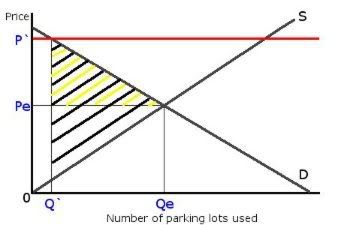
Tsk, tsk. This ignorant bad person obviously needs to get into the shoes of a bureaucrat. Here is a very simple economic model that shows the supply and demand of parking spaces and the effect of price fixing on the market, which I think is sufficient to explain the situation:

*I meant "spaces" not "lots"

The two grey diagonal lines represent the supply (S) and demand (D) 'curves' for parking spaces respectively. The y (vertical) axis of the graph measures the price of each parking lot, while the x (horizontal) axis measures the number of parking spaces used. Clearly, the graph shows the relationship between the price and the number of parking spaces used.

If the market is left to sort itself out, the common assumption is that it would default to a 'natural' sort of equilibrium. The equilibrium (default state of the market at which an equilibrium price is charged and an equilibrium number of parking spaces are used) point would be where the S and D curves intersect. So the equilibrium price would be represented by 'Pe' and the number of parking spaces used would be represented by 'Qe'. That is the point at which supply meets demand, so to speak.

However, let's say that in actual fact there aren't as many parking spaces as 'Qe'. Imagine that the S curve is vertical in the short term, since building of new car parks would take time or there just isn't enough space in the near future. Let's say there really are only 'Q`' number of parking spaces in the short term. So what happens then? The price has to correspondingly go up to 'P`' to reflect the reality of a shortage of supply.

But of course the real world doesn't quite work that way. Parking fees in public housing areas are most likely set by the authorities. That means when the authorities realise that there are too few parking spaces to meet demand, they would fix the price at a higher level in order to curb use and reserve available places for those who need them the most and are therefore willing to pay. 

So what happens in the above model is the authorities would impose the price of 'P`', represented by the red line, in order to meet a target of 'Q`' number of parking spaces used. In other words, this is similar to ERP and such price-based congestion-reducing measures. You increase the price (or impose a 'tax') to decrease the number of people who are ready to use the particular infrastructure.

But why not have the S curve vertical in the model to approximate reality better? First of all, as discussed above, since parking fees are set by the authorities, I want to show the effects of price fixing rather than those of limited and very inelastic supply. Secondly, I'm not sure that 'P`' is the price that corresponds (given demand) to the actual number of parking spaces available, so I can't say that 'Q`' is the number of parking spaces available in reality. Thirdly, this is just an example using very basic economic concepts, so it may not be the best model. Lastly, this can reflect the real situation in the longer term, when there is enough time to increase the supply of parking spaces.

So one of the things worth talking about is not the fact that people still need to park their cars despite the price increase, which is neither here nor there as it skips any attempt at rational analysis, but the fact that there is deadweight loss as represented by the shaded area. However, what is more relevant in this situation is not even that, since we are speaking from the public's point of view, but the loss of consumer surplus, which is represented by the black and yellow shaded area. This area represents the utility loss of those people who don't get to use the parking spaces they otherwise would have used because the fee is now higher than they deem affordable.

Now, it's probably the case that, in the short term, demand for car parks is more inelastic than shown (D curve more vertical) so doubling the price would indeed not result in a significant reduction in the number of parking spaces used. However, this doesn't necessarily mean that people can either have nowhere to park their cars or pay up, as the blogger seems to imply. They may decide to use non-public car parks since those are no longer as expensive relative to public car parks, or they may be more willing to risk parking illegally. More importantly, in the longer run, this may discourage people from using personal vehicles, allowing the supply of car parks to catch up more easily with the demand. 

So although this measure is not exactly good in the short term, it's a reasonable enough solution for the longer run. Besides, in the first place, what else can be done in the short term?

The reality is increasing the supply of parking spaces is not a short term solution, nor is managing the trend of growing use of personal vehicles. In fact, the increase in parking fees, as I've explained, is one way of doing the latter. Furthermore, the officials quoted in the news article this blog entry cites do talk about the need for longer-term solutions, so the entry proves to be very selective in what it mentions. And it certainly ignores the fact that, from an economic point of view, the price increase would better reflect the situation on the ground, giving preference to those with greater need and hence (presumably) greater willingness to pay.

So I've written one of my longest entries ever just to discuss a relatively trivial issue. But the point isn't really to prove that blogger wrong. The point is to illustrate that you don't have to be an expert to criticise something, as many people in Singapore like to imply (when it suits their purposes), but you should at least think through what you're saying. As it is, given such a small pool of dissent in the country, there is too much crap swirling around for it to be taken seriously. Any wonder that the opposition doesn't have much credibility?

Singaporeans like to complain about small things—well, who doesn't? But get it right more often. For a nation of brilliant scorers, we say a lot of stupid things.

Now go watch the parade.


I've been reading an interesting book called The Black Swan. I'm about two-thirds of the way through now and I think I have grasped the central message of the book, which is that our ability to predict the future in social matters is highly limited.

I think this is a very interesting point, and I find myself agreeing with it. I'm not so sure, however, with the seemingly suggested conclusion that a skeptical-empirical approach (which is similar to but more comprehensive than the open-minded attitude I've talked about) is linked to the libertarian position in questions of political economy. Indeed, Hayek and the Austrian school—those proclaimed bastions of libertarian thought—receive not few words of praise in the book and almost no criticism.

The thing is, Hayek might have a good point about economics, but in his political commentary he is guilty of the same thing the book criticises heavily. As I understand it, Hayek alleges that attempts to control economic activity will lead to authoritarianism, hence the 'The Road to Serfdom'. But the evidence speaks for itself. Describing, say, modern-day Britain as authoritarian is a bit of a stretch—what more labelling it as serfdom.

The truth is economic activity in modern society will always be controlled in some (not insignificant) degree, for better or for worse. And this has not and does not seem likely to result in large-scale authoritarianism. Thus, Hayek too fails when he attempts to predict a potential socio-political trend.

But I don't want to focus my criticism on Hayek. Rather, I'd like to talk about why a libertarian position does not necessarily follow from the main point of the book.

The crux of my point is this: As many have pointed out, doing little or nothing also tends to incur costs. There is a price for instituting social programs aimed at helping the impoverished, for example; on the other hand, the alternative of inaction would also have a price.

The book says that not to form quick conclusions is an act as it requires effort. Similarly, not to do something is an act as it tends to have its own cost. Hence, the lack of certainty on the possible consequences cannot justify inaction. As the book also says, having people who take their chances is often necessary for social development.

Therefore, it is rather the case that people are justified in acting on their beliefs as long as they are acting on good faith and are constantly aware of their limitations.

This leads us to another point: It is precisely the lack of absolute certainty in social matters that prevents one from judging a certain school of thought as absolutely wrong, as long as it is not in the business of making predictions or creating concrete historical narratives. So despite, say, the book's criticism of the historicity and scientism of Marxism, a non-scientific/deterministic brand of Marxism is not as vulnerable to the same criticism. Simply put, observations that are not necessarily false cannot be called out for being false.

It turns out, therefore, that under conditions of uncertainty we have to be open-minded about things that have not been proven false. But that's hardly surprising, isn't it? Except perhaps to stubborn libertarians.


I read an amusing blog entry recently that set me thinking about whether the reflection of people's choices is correct simply because it reflects people's choices, as is often implied in economics.

As I've mentioned before, a liberal society is all for autonomy. It is thus, in effect, for individual choice. We've heard the maxims: "To each his own", "Different strokes for different folks"; even J.S. Mill's harm principle can be considered one.

No doubt, choice is great—and everyone knows that these days. Economics is about preferences and choices. Capitalism too promotes individual choice. You can choose what you want to acquire for yourself. Might you be interested in some of these wares? An iPod? An iRiver? Just remember, it's about me. It's about you.

Where do you want to go today?


Yet how do we know that the choices that we make are ours? Is it simply by virtue of the fact that they are the choices we end up making, the fact that they are our revealed preferences? Might there not be something important about their unrevealed aspect, about the psychological processes that take place behind decision making?

I think if we delve into these processes we might find that those are not really our (with emphasis on the sense of ownership) choices. They are not what we really want as individuals abstracted from our surroundings and our social contexts. The fact is we are subject to a lot influences that are external to our wants and needs, at least initially—not least from those who would sell something as your choice.

Indeed, it seems to make little sense to talk about individuals without context. So, in short, life really isn't all about autonomy and choice. It's about existing as an individual, a social creature and a limited physical being at the same time.

Thus, this begs the question: Should we never ask why people make the choices they make?

To some extent our society is conditioned to abhor such questioning. Remember the maxims? If you were to challenge another person's choices, you would often be regarded as a nuisance. It certainly wouldn't help to win you friends.

But you might protest that people do question others' choices, such when they choose to drop out of school at an early age or to acquire bad and destructive habits. However, such questions do not usually arise where decisions are perceived as utility-based. If an individual determines rationally that a choice gives him enough utility as to be worth making, he is justified in making that choice.

And what are the criteria for rational decision making? Typically, it would entail something like weighing decisions in terms of utility gained to the best of one's knowledge. Interestingly, even if it is thus held that people are not always capable of making the best or most accurate choice in terms utility, the above description would seem to leave out instances such as impulse buying. That means many of the decisions made in the marketplace, for a start, might not be considered rational under such a common understanding of rationality.

Yet, ironically, those tend to be regarded as perfectly legitimate economic decisions. The sellers would certainly be quick to assert that they are.

So it turns out that, even assuming that we generally are rational utility-maximising agents, there is still room to question the choices that we make. But how would we go about doing that without attempting to impose arbitrary preferences on each other, as is often presumed to be the case when we dare ask why?

I think this is where the criterion of rationality is worth emphasising. If there are to be questioning and debate, they have to be based on reason. That means we must have good reasons that are backed by good reasoning—and if we do, I see no reason to stop us from asking.

Hence, while questioning and disapproval are not necessarily judgemental in the negative sense that we mean the word, we would come across as judgemental if our positions are not backed up by reason.

Well, that deals nicely with both sanctimonious conservatives and High Street liberals.

An expensive naiveté

@ 18:57 , 0 comments


I read with some amusement a student-written editorial in a campus newspaper. It deals with the issue of cutting bankers' bonuses, and its conclusion is that we shouldn't because we will lose out if we do. It makes me wonder if it's not the case that at least one of the writers is an aspiring banker.

I call into question the article's portrayal of a symbiotic relationship between bankers and society. Yes, they generate income, provide capital that ultimately creates jobs and etc. But this is a bit like saying you need your abusive husband because he earns money. Sometimes, you have to weigh whether the abuse you get is better than being independent, though no doubt the latter will be hard.

I say this because of two fundamental problems with bankers and their performance. First, there is no balance between risk and reward. Everybody wins when the times are good, especially bankers, with their large bonuses. However, when things take a turn for the worse because of the latter's decisions, society is left to foot the bill. Sure, plenty of bankers lost their jobs, but that's after they have profited massively from the bubbles they created. Besides, many others who were not in the driver's seat of crisis creation also lost their jobs. Is it surprising that people are angry, especially when the bankers want to keep their bonuses despite all this?

And aren't the trillions that taxpayers have spent to bailout the banks a good enough demonstration of a lopsided relationship? Privatising the gains and socialising the losses – that's a good description of current practice.

Second, bankers' performance is overrated. The article says that bonuses "should be directly linked to a bankers’ long-term performance and should not reward reckless risk taking". But the point is that's not how they work. Bankers are rewarded for the right results regardless of whether they did it right. They get the money as soon as they show that they are turning a profit. The large bonuses are not given only after they can show many years of consistent results, the ultimate proof of good performance. That wouldn't be something the bankers want either, and hence they would also quit. Thus, the article's call for not cutting bankers’ bonuses can only mean one thing, and that is the continuation of a broken system.

The conclusion that I draw is therefore very different: We should cut their bonuses until the bankers have something to show for them. Otherwise, all we are doing is incentivising bad behaviour. It might be hard to cut a hand off, but we should if it turns out to be gangrenous.

To those less enamoured of the economic realities of the world today, things might seem pretty bleak.

We've witnessed the destruction wrought by the big risk-takers and deregulators, those who stand for an unblinking faith in 'experts' and suit-wearing leaders; those who oppose all fetters in the name of freedom, and who think that the consequent risks can be managed.

Yet it's unlikely that these people will go away. There is a renewed consciousness of the need for regulation and moderation, but business culture remains as people continue to buy into it. There's a persistent love for the well-dressed, for achievers, success stories and unlimited accumulation – the Faustian of Spengler actualised; a penchant for concepts and the infinite with little regard for reality.

Who can stand against the colossi who bestride the world, at whose legs we merely peep about to find ourselves dishonourable graves?

From my experience, the average Joe is typically of the opinion that the old Left is a thing of the past. Didn't Communism effectively end with the collapse of the Berlin Wall? And the more astute might observe that developments such as Reaganomics and Thatcherism, as part of a general shift towards the right in the developed world, indicate that capitalism has inexorably triumphed.

History has ended, and it ended at Wall Street.

Now the opposition, it seems, is chiefly between the Right and the New Left. The latter is an umbrella for various causes ranging from women's rights to environmentalism, causes that are frequently allied but do not form a unified front. Most coherently, it is embodied by people with progressive sensibilities who are labelled as 'liberals'. These people are opposed to the markedly right-wing but are often inherently capitalistic. Thus, they are perhaps best described as left-of-centre or even centrist.

Significantly, however, they do not have a strong opposition towards the fundamental characteristics of bourgeois-capitalist thinking. They are also frequently misled by positivism, by a tendency towards abstraction and spiritualism, or by a false sense of independence. Thus, in principle, they represent merely variations of the ideas of the ruling class.

And thus, from the perspective of political ideology, their opposition is not truly dialectical. Consequently, it cannot be truly transformative.

However, I submit that to think in such terms is to deviate from dialectical materialism. As Georg Lukács put it, "It is not men’s consciousness that determines their existence, but on the contrary, their social existence that determines their consciousness." As I interpret it, this implies that the struggle against the social framework of naked capitalism follows from our economic conditions of existence. In effect, we have to look at what is made possible by economic stimuli that push people into action, rather than how ideological currents drive people.

Class struggle embodies the conflict between advancing mode of production and restraining social relations. I think the conflict is intensified when the prevailing social relations actually threaten to undermine the current mode of production. Witnessing the threat posed by modern capitalism to economic stability and survival is a wake up call for many people. Now more aware of dangers inherent in a 'free' market that is dictated by profiteering entrepreneurs, people are calling for greater regulation, smaller corporations, and the abolition of reckless risk-taking.

I think this should be regarded as a movement in the struggle. It has the potential to nudge the focus away from individuals, in the form of industry leaders, and towards the masses, brought about by greater state oversight and the increased strength of workers relative to smaller companies.

As such, I think anyone who is interested in social change should join hands and put their collective weight behind this development. Ideological currents do not often hold people together for long, and there is no use sitting down and waiting for a revolution. Marx himself seems to have disparaged Ultra-Leftists who refused to work with reformists. Left or New Left, we should be interested in improving the economic conditions of the masses, and this can be achieved in some measure by taking power away from the conmen and the charlatans who have controlled the government in past decades.

This could be a chance to undo past reverses and make another step forward.

As for the undying business culture, there is no need to resign ourselves to it. We must cultivate the seeds of resentment that have been sown. This is our side of the culture war. Now that the men in suits are down, albeit only slightly, it's time to press the advantage. We must again join forces with all who are of similar mind to show that the myth of the entrepreneurial Atlas is poison to economic well-being, that the world of business is not the world of the seeing, and that solidarity rather than selfish profit-seeking is the path of stable progress.

Let the precarious economic conditions of the day lead our way. There is hope in solidarity of action. And there is hope for a gradual progress towards a better society.


I might sometimes be guilty of this myself, but I try hard not to be. I have very little respect for people who don't do as they say, people who don't keep their word. But, of course, at the same time, I'm not sure I like Chigurh-style honour either. I guess the choice is often between two evils. As they say, there is no such thing as a free lunch; no such thing, perhaps, as genuine kindness.

Another quip that is often repeated is "Talk is cheap". It sure is. It's much cheaper to talk about integrity than to actually practice it at the cost of giving up the advantages you get by being unprincipled. And, ironically enough, when some people are caught red-handed, they'd be full of it – they'd be full of remorse, warning others not to follow their example, reshaping themselves anew as moral leaders.

But what if they had never been caught?

On a related note, you might expect that I don't believe in things like Corporate Social Responsibility. Well, no surprises here – you'd be right on the money. Corporate Social Responsibility should have a new marketing name: Bull Fucking Shit.

By definition, corporations don't have any sense of social responsibility. Anything they do is for profit or for the bottom line. Why, a company is not an individual with a moral compass. It's a collectively profit-oriented entity composed of business people who employ workers. In fact, Adam Smith, the grandfather of capitalism himself, killed the idea of Corporate Social Responsibility centuries ago by stating that it is self interest that motivates people to work; that good arises out of selfishness by virtue of the invisible hand, which ordains that more social benefit will come out of it than loss.

Of course, today, it's all about dressing it up. The concept of the invisible hand is one of the earliest moral pretences that have been constructed to justify profit-seeking and selfishness in the consciences of people. Another example is the capitalist or conservative ethic: You 'deserve' every penny you earn and don't 'deserve' every penny you don't. In other words, poor people are generally lazy and morally bankrupt people, and that's why they are poor. Evidently, circular logic is sometimes needed to forget the nagging feeling that something isn't right.

And it's actually easy to see what is wrong, if only we'd wrest ourselves from our conditioning. When selling bread, the baker might not be concerned about feeding you, being concerned instead about getting paid. Nonetheless, the baker needs your custom and you need his bread. You exist within a community whose members are interdependent and are thus inevitably working for each other's benefit. Individualism and selfishness are the main reason why there is inequality and poverty. The invisible hand is a myth, and people, by the non-principle of selfishness, go on to create systems that seek to maximise their respective individual benefits even at a terrible price to others. Is the good of a Warren Buffet greater than the good of a hundred people without adequate health care? Is the good of one American or European greater than the good of a hundred Africans?

Therefore, all the moralising hides a serious moral lapse that was born when our imaginations took a leap of faith away from the reality of interdependence.

Speaking of morality, we can probably agree that lying is generally immoral. But is the alternative then to be honest?

Sometimes people have candid moments that betray their true interests, especially when pressed. At a recent conference, a business representative warned that more regulations against corruption would force companies to maintain profits by engaging in more corruption. In a letter to the newspaper, the Singapore National Employers Federation (ST, Sept 30) resisted calls to implement fair employment practices for women, particularly pregnant women, citing the need to maintain profits. These are moments of honesty where we can clearly see that companies are not interested in society insofar as it is not profitable to be.

Does their honesty make it better? The Singapore government argues that it is better than corrupt governments in the region because it is open about paying senior politicians astronomical salaries based on salary estimates of (overvalued) private sector executives, rather than letting them engage in backroom deals. Is it right in saying so?

I contend that being honest about it is no better. Exploitation is exploitation. Injustice is injustice. Dressing them up does not change the fundamental wrongs. The only better way is to say good things and act accordingly.

That said, on a personal level, I do appreciate people who do not mince their words. It is much less tiring to deal with even outright meanness than having to guess what people's true intentions are.

Unfortunately, if we do not engage with hypocrites, some of whom might be living around us, how many people and parties do we have left to deal with? Would we be able to do anything?

Looks like we all have to be willing accomplices in this nauseating game. Personally, I have to reserve my contempt to those who have proven themselves to be completely untrustworthy. Sometimes, or perhaps most of the time, there is no choice but to single out only the worst offenders.

Sometimes, it's hard to be optimistic about this world.


Wow, I can hardly believe this. Check out what Prime Minister Lee had to say to students:
It is not all about grades, Prime Minister Lee Hsien Loong told undergraduates at the end of a dialogue on Tuesday. They should also be charged up about other issues and causes, like their counterparts in the United States, India or China, he added.

'If you look at the best students in dynamic societies such as the US, India or China, they are not just bright, they are passionate, idealistic, driven, out to change the world for the better and to make a mark for themselves.'
However, what will make the difference is when Singaporeans live overseas and are exposed to a different environment, he said. 'You see how other people live, and you cope with the different circumstances, and from that we hope you get new tools in your toolbox to solve problems.'
So we're supposed to bring the student scene from overseas here?

Somehow I really doubt they'd like protests and rallies much. A half-hearted attempt at change as usual? I guess so.

But, hey, why not try, right? So let's look at the ways through which we can participate, starting from the running of our daily lives.

I'm just going to focus on one aspect (but lessons for some others can be drawn from it), since a related issue has been around for some time: How to exercise some rights in the face of a private company's monopoly on a public service.

Consumers don't like monopolies for obvious reasons. They are price setters and might severely reduce the consumer surplus and create deadweight loss since they are producing at far below the Pareto Optimum in order to maximise profits. Economic jargon aside, I think all of us can at least intuit that monopolies can get away with doing things like setting much higher prices due to the lack of competitors.

So what happens in the case of a natural monopoly, where the set-up costs or any other barrier to entering the market is so high that there can only be one effective provider of a service? The government should then step in by nationalising the company, subsidising it or setting price controls to safeguard the interests of the public. Which measure is taken might depend on how vital the service is.

Unfortunately, the price isn't the only aspect where the public stands to lose when a vital service is run by a monopoly.

The private sector can get away with many things the public sector can't. Racial discrimination, for example, is not nice, but private companies reserve the right to not serve anyone for any reason. Your influence as a consumer in a free country lies in your ability to take your custom somewhere else. If a company is given to bad practices, they lose business. Simple as that.

This understanding is probably as entrenched in Singapore as in the USA. Some countries favour regulations to restrict bad practices, but Singapore has a 'one of the freest places to do business in' reputation to maintain, right?

But what happens when it's a monopoly? You can't take your custom anywhere else. You can simply not buy the service at all, but you don't really have a choice if it's a vital service. And I'm getting to the issue itself public transport is vital service.

SMRT has seen fit to enforce absurd restrictions on the consumption of food and drink within its vehicles and premises. Fair enough, many people might think. But as I've mentioned before, they've gone to such lengths as to fine someone for having a sweet in her mouth.

I've personally been told that even drinking plain water is not allowed. So they're saying that if someone feels dehydrated, she is not allowed to hydrate herself with good ol' H2O on their property? Even if the water spills, how much trouble would it be to clean up a small puddle of water, if needs cleaning up at all? Can you imagine telling your guest that he is not allowed to drink even plain water in your house?

Here's a tip: There are rules, and there is crazy enforcement.

Some things just aren't worth enforcing to such an extent if you don't want to be a major jackass. The government seems to know this sometimes, as shown by its present stance on 377A. SMRT doesn't.

Maybe it's not that big a deal, but its attitude constitutes giving bad service, especially since they can charge you a significant amount of money for a trivial thing. Money-making scheme much?

And despite public criticism, it has persisted with the practice. This is good evidence that it knows it's in a position to not have to back down on things, unless the government intervenes, which it probably won't do because again Singapore needs to promote business freedom.

And SMRT can do this because it's a monopoly facing an inelastic demand curve as a vital service provider. You still have to take its trains even if you don't like its policies.

I really dislike the idea of bending over for such companies. Many people don't either. So this is how you can exercise some rights: Flout the rule.

Oh, no, but that's bad or illegal!

But in what other way can we resist? When Rosa Parks flouted the rules, was she wrong?

This is the concept of civil disobedience when you have no say, you refuse to obey.

However, although civil disobedience is meant to be visible as a political statement, I'm not suggesting we make martyrs of ourselves. It's not worth it to have to pay fines for stupid reasons just to make a statement that might not change anything, given the way things work here. Instead, we disobey quietly. Go on with eating and drinking simple things when the staff isn’t watching. It's not that difficult.

We make our actions visible as anonymous individuals acting in concert. They'd probably know that they can't stop people from doing it when they're not looking. Maybe they will let it go. Maybe they will continue and look like idiots. Maybe they will attempt to stop it with more ridiculous measures that would make the issue more manifestly absurd in the eyes of the public and draw increasing and harsher criticism. It's a lose-lose situation for the company.

But maybe the best thing is for their measures to actually be counter-productive. Instead of helping to maintain cleanliness and reduce costs, their anal-retentive policies should actually make their property dirtier. It would probably make them rethink their position.

To that effect, let's surreptitiously but intentionally spill stuff like soft drinks and create all sorts of mess when we can. It's time to punk a company that thinks it has free rein.

This is how we resist. This is how we learn not to take it up the ass because we have no say.